QUESTION IMAGE
Question
Question was provided via image upload.
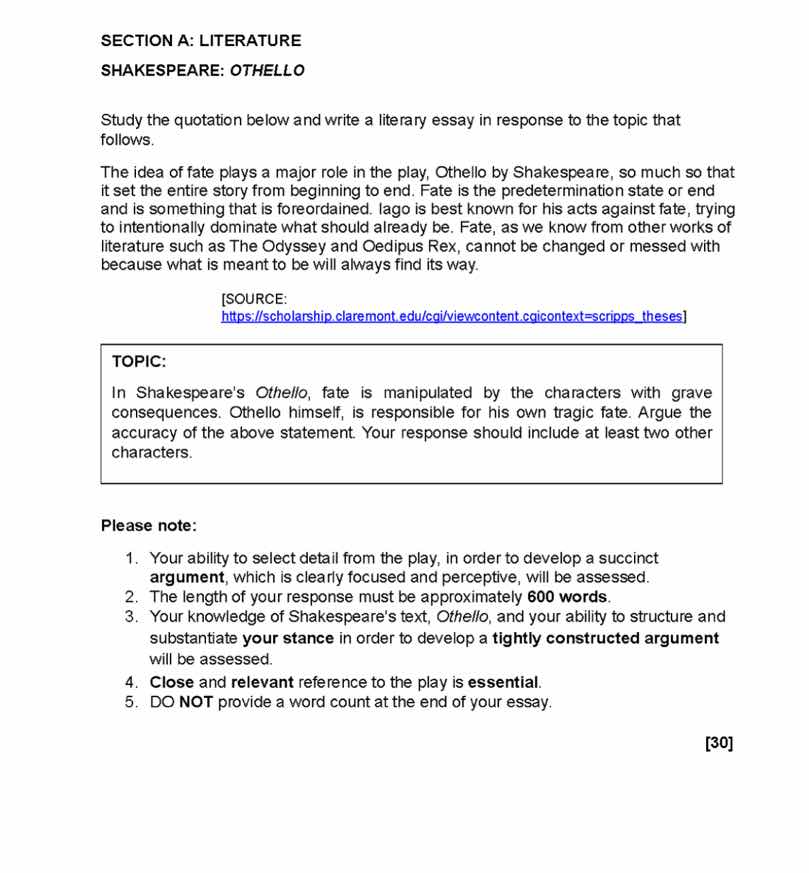
Analyze the essay prompt and establish the thesis
The prompt asks to argue the accuracy of the statement: "In Shakespeare's Othello, fate is manipulated by the characters with grave consequences. Othello himself, is responsible for his own tragic fate." The response must include at least two other characters (e.g., Iago and Desdemona) and be approximately 600 words.
Thesis: While external manipulation by Iago acts as the catalyst, Othello is ultimately responsible for his own tragic downfall due to his internal insecurities, jealousy, and choice to abandon reason, while characters like Desdemona unwittingly contribute to their own fates through their actions.
Outline the arguments and select textual evidence
- Othello's Responsibility: His hubris, deep-seated insecurity as an outsider in Venice, and immediate susceptibility to jealousy make him the primary architect of his ruin. He chooses to believe Iago over his wife without objective proof, sealing his own fate.
- Iago's Manipulation: Iago acts as the master manipulator who exploits the vulnerabilities of others, orchestrating events (like the handkerchief) to construct a false "fate" for Othello and Cassio.
- Desdemona's Role: Desdemona's innocent but naive actions—such as her persistent advocacy for Cassio's reinstatement—inadvertently fuel Othello's jealousy, showing how characters' choices shape their tragic outcomes.
Draft the literary essay
Draft a cohesive, structured essay of approximately 600 words addressing the prompt directly without adding meta-commentary or word counts.

Snap & solve any problem in the app
Get step-by-step solutions on Sovi AI
Photo-based solutions with guided steps
Explore more problems and detailed explanations
In William Shakespeare’s tragedy Othello, the downfall of the protagonist is not the result of cosmic predetermination, but rather the direct consequence of human agency, vulnerability, and manipulation. While the villainous Iago acts as a malicious catalyst, orchestrating circumstances to mimic the hand of "fate," it is ultimately Othello’s own internal flaws—his deep-seated insecurities, jealousy, and ultimate abandonment of reason—that make him responsible for his tragic end. Furthermore, the tragic outcomes of other characters, such as Desdemona and Roderigo, are heavily shaped by their own choices and interactions within this web of manipulation, demonstrating that character action, rather than destiny, governs the play.
Othello’s responsibility for his own demise lies in his rapid surrender to jealousy and his failure to maintain the rational judgment that once characterized him as a noble general. Despite his initial declaration of trust in Desdemona, Othello possesses latent insecurities stemming from his position as an older, foreign Black man in sophisticated Venetian society. Iago exploits these vulnerabilities, but Othello must choose to internalize the poison. Instead of demanding objective, irrefutable proof, Othello allows his imagination to be corrupted, famously demanding "ocular proof" but settling for the flimsy circumstantial evidence of a misplaced handkerchief. His decision to bypass open communication with Desdemona and instead enter into a murderous pact with Iago represents a conscious abdication of his moral agency. By choosing to murder Desdemona, Othello seals his own tragic fate, realizing too late that his own hands destroyed his soul.
While Othello holds primary responsibility, Iago’s deliberate manipulation of "fate" serves as the engine of the tragedy. Iago does not possess supernatural powers; rather, he is a master psychologist who reads the desires and weaknesses of those around him. He manipulates Roderigo’s lust for Desdemona, Cassio’s pride and low tolerance for alcohol, and Othello’s trusting nature. By planting the handkerchief and staging conversations, Iago constructs a false reality that Othello mistakes for inevitable truth. Iago’s actions demonstrate how human malice can masquerade as destiny, guiding vulnerable individuals toward self-destruction while keeping his own hands clean for much of the play.
Desdemona, too, plays an unwitting role in her own tragic end through her virtuous but naive choices. Her persistent, passionate advocacy for Cassio’s reinstatement is driven by genuine friendship and loyalty, yet she fails to perceive Othello’s growing agitation. By repeatedly pressing Othello to forgive Cassio at highly inappropriate moments, she inadvertently provides the "evidence" Iago needs to substantiate his lies. Her innocence blinds her to the danger of Othello’s jealousy, and her submissive defense of her husband, even on her deathbed when she claims she killed herself, highlights how her unwavering devotion ultimately seals her doom.
In conclusion, the tragedy of Othello is a profound exploration of human vulnerability and accountability. Although Iago expertly pulls the strings, creating a simulated trap of fate, the characters are ultimately undone by their own decisions. Othello’s tragic downfall is not written in the stars, but in his own heart; his choice to trust a deceitful subordinate over his loving wife is the true cause of his ruin. Along with Desdemona’s naive persistence and Iago’s calculated malice, the play reveals that characters are the ultimate authors of their own grave consequences.