QUESTION IMAGE
Question
Question was provided via image upload.
Analyze the visible question context
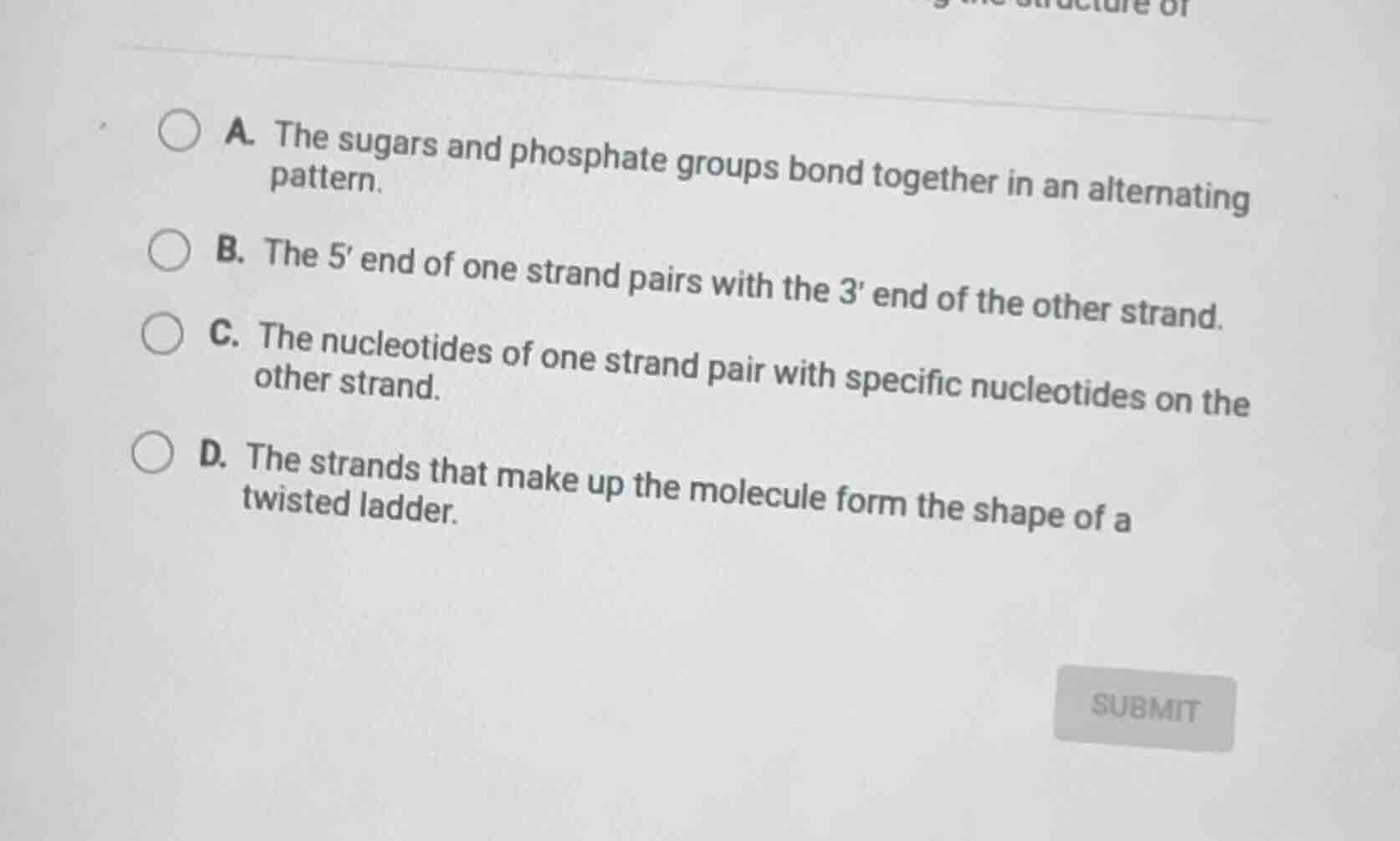
The image shows a multiple-choice question with options describing structural features of DNA. The top of the image is cut off, but we can see the phrase "...ing the structure of". Based on the options, the question asks which statement describes a specific structural feature of DNA, likely related to its antiparallel nature or complementary base pairing. Let's evaluate each option using our understanding of DNA Structure.
Evaluate Option A
Option A states: "The sugars and phosphate groups bond together in an alternating pattern."
This describes the sugar-phosphate backbone of a single DNA strand, which is a fundamental component of DNA Structure.
Evaluate Option B
Option B states: "The 5' end of one strand pairs with the 3' end of the other strand."
This describes the antiparallel orientation of the two strands in a double-stranded DNA molecule. The 5' (five-prime) end of one polynucleotide strand aligns with the 3' (three-prime) end of its complementary strand.
Evaluate Option C
Option C states: "The nucleotides of one strand pair with specific nucleotides on the other strand."
This describes complementary base pairing (adenine with thymine, and cytosine with guanine) across the two strands, which is held together by hydrogen bonds.
Evaluate Option D
Option D states: "The strands that make up the molecule form the shape of a twisted ladder."
This describes the double helix shape of the DNA molecule.
Determine the most specific structural pairing description
Without the full question stem, we look for the option that specifically describes how the two strands align or pair relative to each other's directionality. Option B uniquely and accurately describes the antiparallel pairing mechanism of the double helix: the 5' end of one strand aligns with the 3' end of the opposite strand.

Snap & solve any problem in the app
Get step-by-step solutions on Sovi AI
Photo-based solutions with guided steps
Explore more problems and detailed explanations
- A. The sugars and phosphate groups bond together in an alternating pattern.
- B. The 5' end of one strand pairs with the 3' end of the other strand. (Correct answer)
- C. The nucleotides of one strand pair with specific nucleotides on the other strand.
- D. The strands that make up the molecule form the shape of a twisted ladder.