QUESTION IMAGE
Question
Question was provided via image upload.
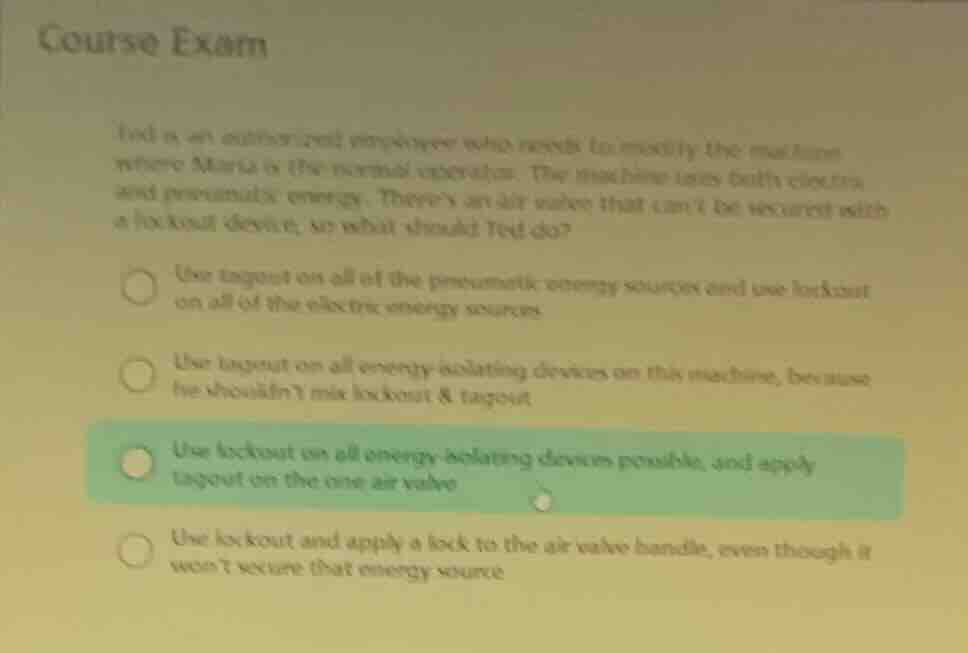
Analyze the scenario and constraints
The scenario describes Ted, an authorized employee, who needs to service a machine that uses both electrical and pneumatic energy. One air valve cannot be secured with a lockout device. Under OSHA standards, lockout must be used whenever an energy isolating device is capable of being locked out. If an energy isolating device is not capable of being locked out, a tagout program must be utilized.
Evaluate the options
- Option 1 suggests using tagout on all pneumatic sources and lockout on all electric sources. This is incorrect because any pneumatic source that can be locked out should be locked out.
- Option 2 suggests using tagout on all devices because mixing is not allowed. This is incorrect; mixing is allowed and required when some devices cannot accept a lock.
- Option 3 suggests using lockout on all possible devices and tagout on the one air valve that cannot be locked. This aligns perfectly with safety standards.
- Option 4 suggests applying a lock to the handle even though it won't secure it, which is unsafe and ineffective.

Snap & solve any problem in the app
Get step-by-step solutions on Sovi AI
Photo-based solutions with guided steps
Explore more problems and detailed explanations
- (A) Use tagout on all of the pneumatic energy sources and use lockout on all of the electric energy sources
- (B) Use tagout on all energy isolating devices on this machine, because he shouldn't mix lockout & tagout
- (C) Use lockout on all energy isolating devices possible, and apply tagout on the one air valve (Correct answer)
- (D) Use lockout and apply a lock to the air valve handle, even though it won't secure that energy source