QUESTION IMAGE
Question
Question was provided via image upload.
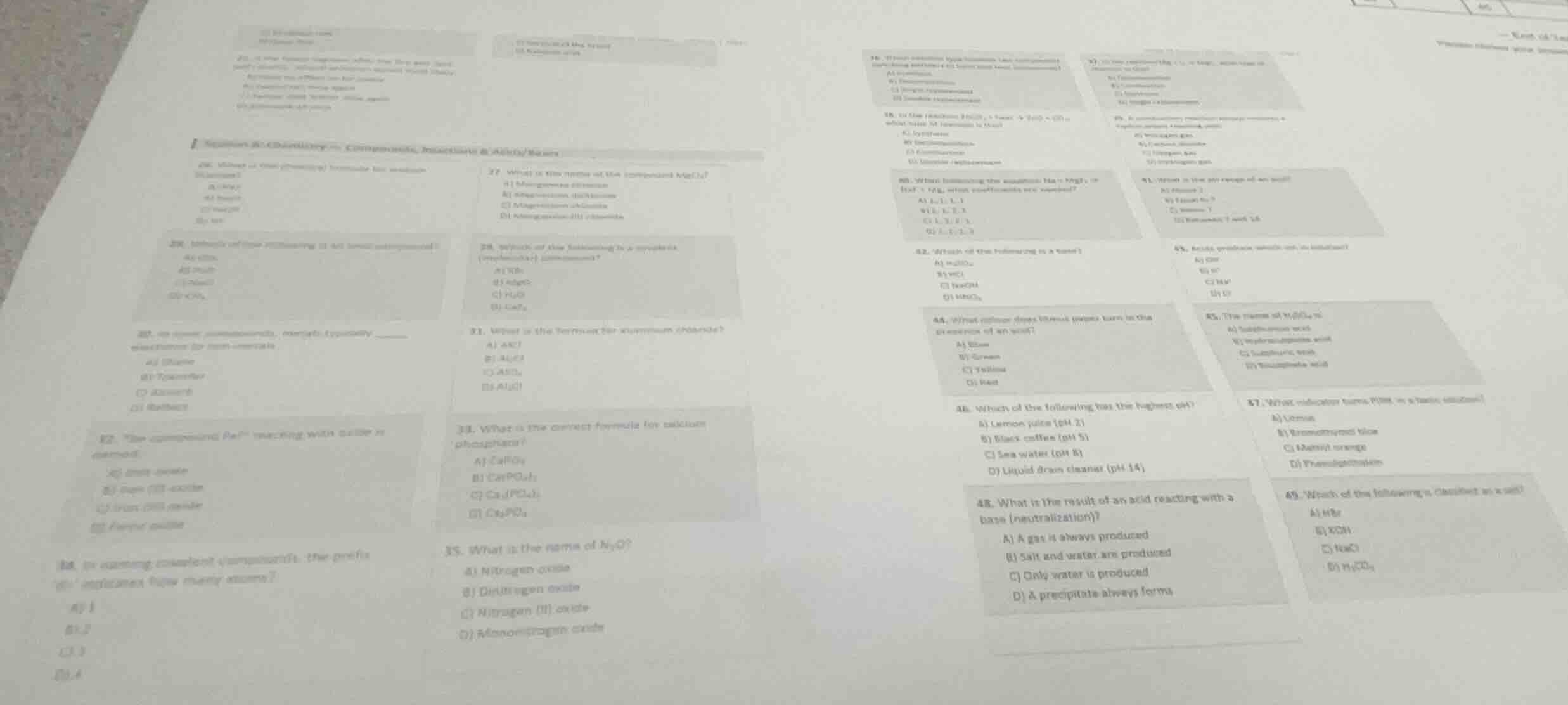
The image contains a chemistry worksheet with multiple-choice questions. Due to the high number of questions (24 visible items) and the blurry quality, we will focus on solving the most legible and central questions clearly. Let's analyze a selection of the clearest questions visible in the center and right columns.
Analyze Question 27
The question asks: "What is the name of the compound \(Mg\text{Cl}_2\)?"
- \(Mg\) is Magnesium, an alkaline earth metal.
- \(\text{Cl}\) is Chlorine, which forms the chloride anion.
- Since magnesium forms only one stable ion (\(Mg^{2+}\)), we do not use Roman numerals.
- The name is Magnesium chloride.
- This corresponds to option C.
Analyze Question 28
The question asks: "Which of the following is a covalent (molecular) compound?"
- Covalent compounds are formed between non-metals sharing electrons.
- Let's look at the options:
- A) \(\text{Al}_2\text{O}_3\) (Ionic)
- B) \(\text{MgO}\) (Ionic)
- C) \(\text{H}_2\text{O}\) (Covalent)
- D) \(\text{CaF}_2\) (Ionic)
- \(\text{H}_2\text{O}\) consists of non-metals hydrogen and oxygen sharing electrons.
- This corresponds to option C.
Analyze Question 31
The question asks: "What is the formula for aluminum chloride?"
- Aluminum forms a \(Al^{3+}\) cation.
- Chlorine forms a \(\text{Cl}^-\) anion.
- To balance the charges, we need three chloride ions for every aluminum ion: \(\text{AlCl}_3\).
- This corresponds to option B.
Analyze Question 33
The question asks: "What is the correct formula for calcium phosphate?"
- Calcium forms a \(\text{Ca}^{2+}\) cation.
- Phosphate is a polyatomic anion with the formula \(\text{PO}_4^{3-}\).
- To balance the charges, we find the least common multiple of 2 and 3, which is 6.
- We need three \(\text{Ca}^{2+}\) ions (\(3 \times +2 = +6\)) and two \(\text{PO}_4^{3-}\) ions (\(2 \times -3 = -6\)).
- The formula is \(\text{Ca}_3(\text{PO}_4)_2\).
- This corresponds to option B.
Analyze Question 35
The question asks: "What is the name of \(\text{N}_2\text{O}\)?"
- This is a covalent compound consisting of nitrogen and oxygen.
- We use prefixes to indicate the number of atoms: "di-" for two nitrogens and "mono-" (often simplified) for one oxygen.
- The systematic name is Dinitrogen monoxide (commonly called dinitrogen oxide).
- This corresponds to option B.
Analyze Question 42
The question asks: "Which of the following is a base?"
- Bases typically produce hydroxide ions (\(\text{OH}^-\)) in aqueous solution.
- Let's look at the options:
- A) \(\text{H}_2\text{SO}_4\) (Acid)
- B) \(\text{HCl}\) (Acid)
- C) \(\text{NaOH}\) (Base)
- D) \(\text{HNO}_3\) (Acid)
- \(\text{NaOH}\) (Sodium hydroxide) is a strong base.
- This corresponds to option C.
Analyze Question 44
The question asks: "What color does litmus paper turn in the presence of an acid?"
- Acids turn blue litmus paper red.
- This corresponds to option D.
Analyze Question 46
The question asks: "Which of the following has the highest pH?"
- pH values range from 0 to 14, where higher values are more basic.
- Let's look at the options:
- A) Lemon juice (pH 2)…

Snap & solve any problem in the app
Get step-by-step solutions on Sovi AI
Photo-based solutions with guided steps
Explore more problems and detailed explanations
Question 27
- (A) Manganese dichloride
- (B) Magnesium dichloride
- (C) Magnesium chloride (Correct answer)
- (D) Manganese(II) chloride
Question 28
- (A) Al2O3
- (B) MgO
- (C) H2O (Correct answer)
- (D) CaF2
Question 31
- (A) AlCl
- (B) AlCl3 (Correct answer)
- (C) Al3Cl
- (D) Al2Cl3
Question 33
- (A) CaPO4
- (B) Ca3(PO4)2 (Correct answer)
- (C) Ca2(PO4)3
- (D) Ca3PO4
Question 35
- (A) Nitrogen oxide
- (B) Dinitrogen oxide (Correct answer)
- (C) Nitrogen (II) oxide
- (D) Mononitrogen oxide
Question 42
- (A) H2SO4
- (B) HCl
- (C) NaOH (Correct answer)
- (D) HNO3
Question 44
- (A) Blue
- (B) Green
- (C) Yellow
- (D) Red (Correct answer)
Question 46
- (A) Lemon juice (pH 2)
- (B) Black coffee (pH 5)
- (C) Sea water (pH 8)
- (D) Liquid drain cleaner (pH 14) (Correct answer)
Question 48
- (A) A gas is always produced
- (B) Salt and water are produced (Correct answer)
- (C) Only water is produced
- (D) A precipitate always forms