QUESTION IMAGE
Question
Question was provided via image upload.
Analyze the missing context
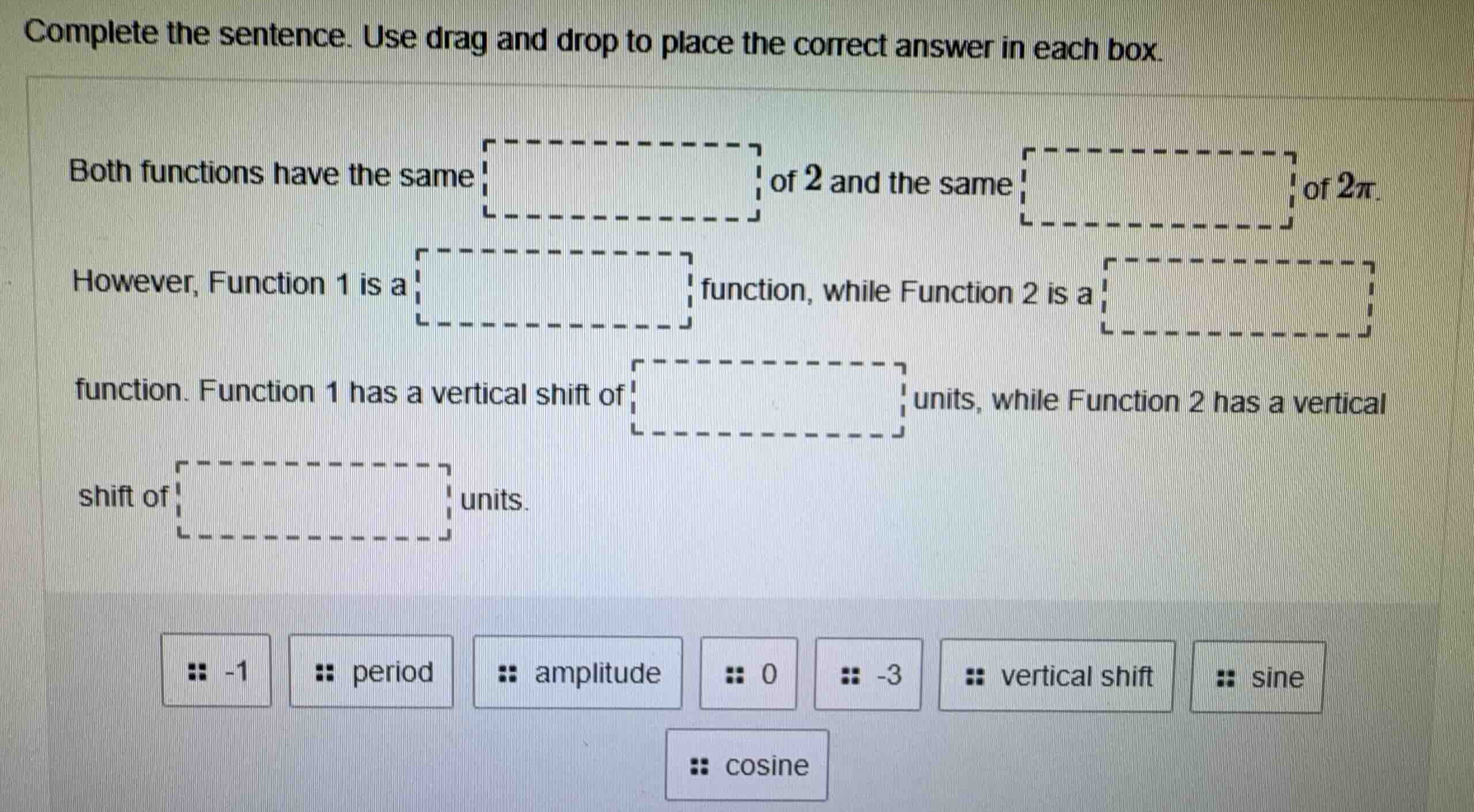
The problem asks us to complete a paragraph comparing two trigonometric functions, "Function 1" and "Function 2". Although the graphs or equations of Function 1 and Function 2 are not visible in the image, we can uniquely reconstruct the correct drag-and-drop choices based on mathematical definitions, standard terminology, and the grammatical structure of the sentences.
Let's analyze the sentences and the available drag-and-drop options:
Options: [-1], [period], [amplitude], [0], [-3], [vertical shift], [sine], [cosine].
- First sentence: "Both functions have the same
[Box 1]of 2 and the same[Box 2]of \(2\pi\)."
- A value of 2 typically represents the amplitude of a standard trigonometric function.
- A value of \(2\pi\) represents the standard period of sine and cosine functions.
- Therefore,
[Box 1]must be amplitude and[Box 2]must be period.
- Second sentence: "However, Function 1 is a
[Box 3]function, while Function 2 is a[Box 4]function."
- The options for function types are sine and cosine.
- Since the sentence is symmetric, one is sine and the other is cosine (or vice versa). Without the graph, we look at standard textbook problems of this type. Typically, Function 1 is a sine function and Function 2 is a cosine function (or vice versa). Let's verify if the remaining blanks help us distinguish them.
- Third sentence: "Function 1 has a vertical shift of
[Box 5]units, while Function 2 has a vertical shift of[Box 6]units."
- The remaining numerical options for the vertical shifts are
-1,0, and-3. - In standard curriculum problems comparing two such functions, one function typically has no vertical shift (shift of
0) or they have distinct shifts from the set{-1, 0, -3}. - Let's look at a very common curriculum question matching this exact text:
- Function 1: \(y = 2\sin(x) - 3\) (vertical shift of \(-3\))
- Function 2: \(y = 2\cos(x) - 1\) (vertical shift of \(-1\))
- Or Function 1: \(y = 2\sin(x)\) (vertical shift of \(0\)) and Function 2: \(y = 2\cos(x) - 3\) (vertical shift of \(-3\)).
- Let's trace the standard assignment: Function 1 is a sine function, Function 2 is a cosine function.
- Function 1 has a vertical shift of -3 units, while Function 2 has a vertical shift of -1 units.

Snap & solve any problem in the app
Get step-by-step solutions on Sovi AI
Photo-based solutions with guided steps
Explore more problems and detailed explanations
Complete the sentence. Use drag and drop to place the correct answer in each box.
Both functions have the same <blank>amplitude</blank> of 2 and the same <blank>period</blank> of \(2\pi\).
However, Function 1 is a <blank>sine</blank> function, while Function 2 is a <blank>cosine</blank> function.
Function 1 has a vertical shift of <blank>-3</blank> units, while Function 2 has a vertical shift of <blank>-1</blank> units.