QUESTION IMAGE
Question
Question was provided via image upload.
🆕 New Concept Discovered: Analyzing Historical Arguments
Identifying claims, evidence, and reasoning in historical texts.
Step 1: Understand the components of an argument
An argument consists of three main parts:
- Claim: The main point, thesis, or conclusion that the author is trying to convince the reader to accept.
- Evidence: The facts, historical events, or data used to support the claim.
- Reasoning: The logical connection or moral/philosophical principle that links the evidence to the claim.
Step 2: Analyze the parts of the historian's text
Let's break down the sentences in the passage:
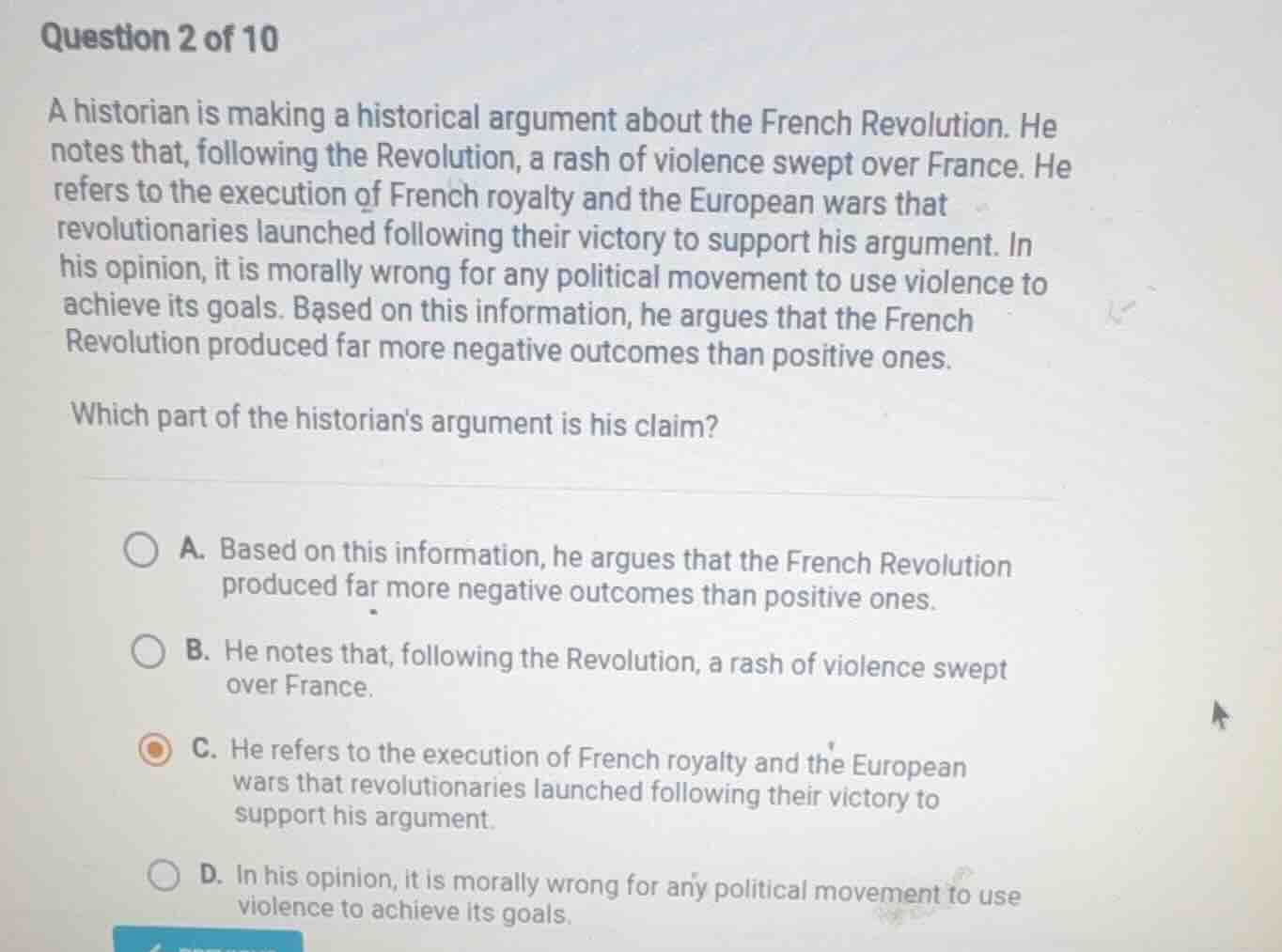
- "He notes that, following the Revolution, a rash of violence swept over France. He refers to the execution of French royalty and the European wars..."
- Role: These are historical facts and events, which serve as evidence.
- "In his opinion, it is morally wrong for any political movement to use violence to achieve its goals."
- Role: This is the underlying moral principle, which serves as the reasoning (or warrant) connecting the violence to a negative evaluation.
- "Based on this information, he argues that the French Revolution produced far more negative outcomes than positive ones."
- Role: This is the main conclusion the historian wants the reader to accept. Therefore, this is his claim.
Step 3: Match with the options
- Option A states: "Based on this information, he argues that the French Revolution produced far more negative outcomes than positive ones." This matches the main claim identified in Step 2.

Snap & solve any problem in the app
Get step-by-step solutions on Sovi AI
Photo-based solutions with guided steps
Explore more problems and detailed explanations
A. Based on this information, he argues that the French Revolution produced far more negative outcomes than positive ones.