QUESTION IMAGE
Question
Question was provided via image upload.
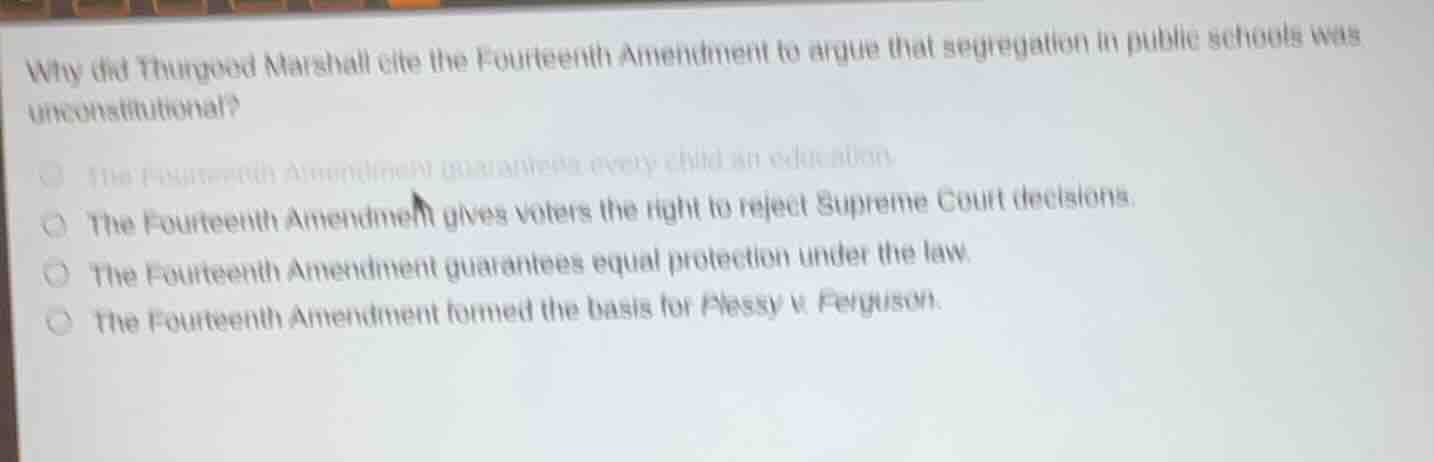
Analyze the constitutional basis of the argument
Using the Brown v. Board of Education and Separate but Equal Doctrine knowledge points, we examine Thurgood Marshall's legal strategy. Marshall, representing the NAACP, argued that state-mandated segregation in public schools violated the Equal Protection Clause of the Fourteenth Amendment, which guarantees all citizens equal protection under the laws.
Evaluate the given options
- Option 1: The Fourteenth Amendment does not explicitly guarantee a right to education.
- Option 2: The amendment does not grant voters the power to reject Supreme Court decisions.
- Option 3: The Equal Protection Clause of the Fourteenth Amendment is the core constitutional guarantee of equal treatment under the law.
- Option 4: While Plessy v. Ferguson interpreted the Fourteenth Amendment to allow "separate but equal," Marshall cited the amendment to overturn that precedent, not to support it.

Snap & solve any problem in the app
Get step-by-step solutions on Sovi AI
Photo-based solutions with guided steps
Explore more problems and detailed explanations
- (A) The Fourteenth Amendment guarantees every child an education.
- (B) The Fourteenth Amendment gives voters the right to reject Supreme Court decisions.
- (C) The Fourteenth Amendment guarantees equal protection under the law. (Correct answer)
- (D) The Fourteenth Amendment formed the basis for Plessy v. Ferguson.