QUESTION IMAGE
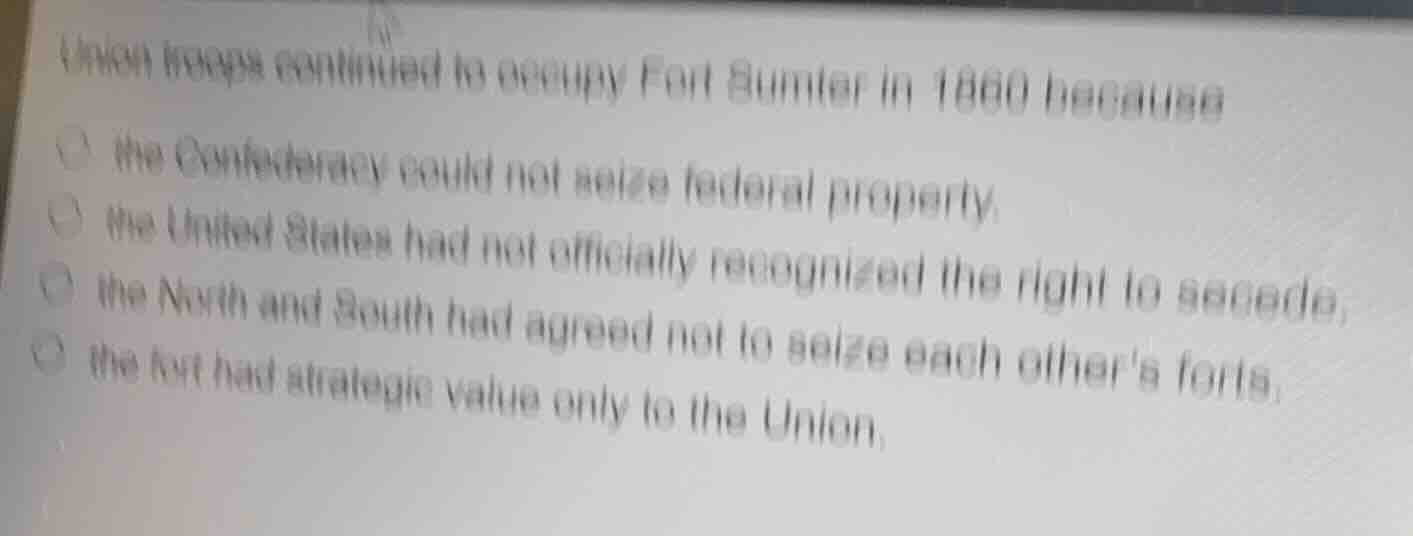
Question
Question was provided via image upload.
Analyze the historical context of Fort Sumter
In late 1860, following the election of Abraham Lincoln, South Carolina became the first state to secede from the Union. The federal government, under outgoing President James Buchanan and incoming President Lincoln, maintained that secession was unconstitutional and legally void. Because the United States did not recognize the legitimacy of secession, it maintained that federal installations, such as Fort Sumter in Charleston Harbor, remained the rightful property of the United States government.
Evaluate the legal status of federal property
Using the Federal Property Disputes and Secession Legality knowledge points, we examine why Union troops remained at the fort. Since the United States government viewed secession as illegal, it did not recognize the Confederate States of America as a sovereign nation. Consequently, the U.S. government refused to surrender federal property to what it considered an unlawful insurrection. This directly aligns with the principle that the United States had not officially recognized the right of Southern states to secede.
Assess the incorrect options
- The Confederacy could not seize federal property: This is historically inaccurate because the Confederacy did seize numerous federal arsenals, post offices, and forts throughout the South.
- The North and South had agreed not to seize each other's forts: No such agreement existed; tensions were extremely high, and Southern forces actively demanded the evacuation of federal installations.
- The fort had strategic value only to the Union: Fort Sumter held immense strategic and symbolic value for both sides, particularly for the Confederacy, as it controlled the entrance to Charleston Harbor, one of the South's most vital ports.

Snap & solve any problem in the app
Get step-by-step solutions on Sovi AI
Photo-based solutions with guided steps
Explore more problems and detailed explanations
- (A) the Confederacy could not seize federal property.
- (B) the United States had not officially recognized the right to secede. (Correct answer)
- (C) the North and South had agreed not to seize each other's forts.
- (D) the fort had strategic value only to the Union.