QUESTION IMAGE
Question
Question was provided via image upload.
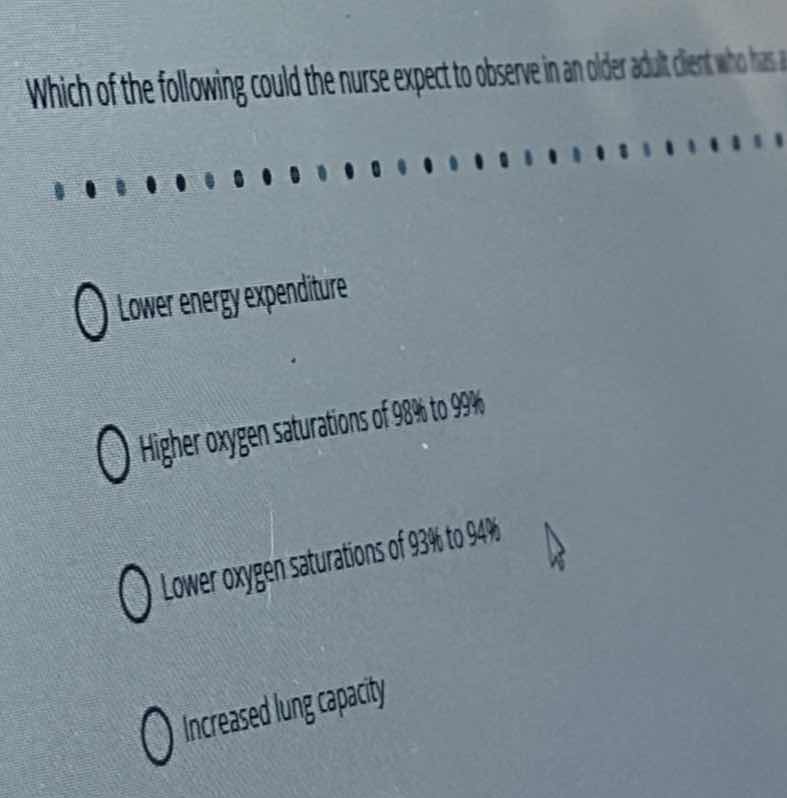
Analyze the visible question stem
The question asks what a nurse would expect to observe in an older adult client. The end of the stem is cut off, but the options focus on respiratory and metabolic parameters: energy expenditure, oxygen saturation levels, and lung capacity.
Evaluate physiological changes in older adults
Aging is associated with structural and functional changes in the respiratory system. These changes include a decrease in chest wall compliance, loss of elastic recoil in the lungs, and a decrease in respiratory muscle strength. Consequently, lung capacity (specifically vital capacity) decreases rather than increases, and residual volume increases.
Evaluate oxygen saturation levels
Healthy older adults typically maintain oxygen saturation (\(\text{SpO}_2\)) levels within a normal range, though it can be slightly lower than in younger adults. However, a baseline oxygen saturation of \(93\%\) to \(94\%\) is considered clinically low (hypoxemia) and is not a normal, expected finding of healthy aging. Normal expected levels remain above \(95\%\).
Evaluate energy expenditure and metabolic rate
Basal metabolic rate and daily energy expenditure naturally decline with age due to a decrease in lean muscle mass (sarcopenia) and changes in metabolic activity. Therefore, a lower energy expenditure is a well-documented, expected physiological observation in older adults.

Snap & solve any problem in the app
Get step-by-step solutions on Sovi AI
Photo-based solutions with guided steps
Explore more problems and detailed explanations
- Lower energy expenditure (Correct answer)
- Higher oxygen saturations of 98% to 99%
- Lower oxygen saturations of 93% to 94%
- Increased lung capacity