QUESTION IMAGE
Question
Question was provided via image upload.
Identify missing visual context
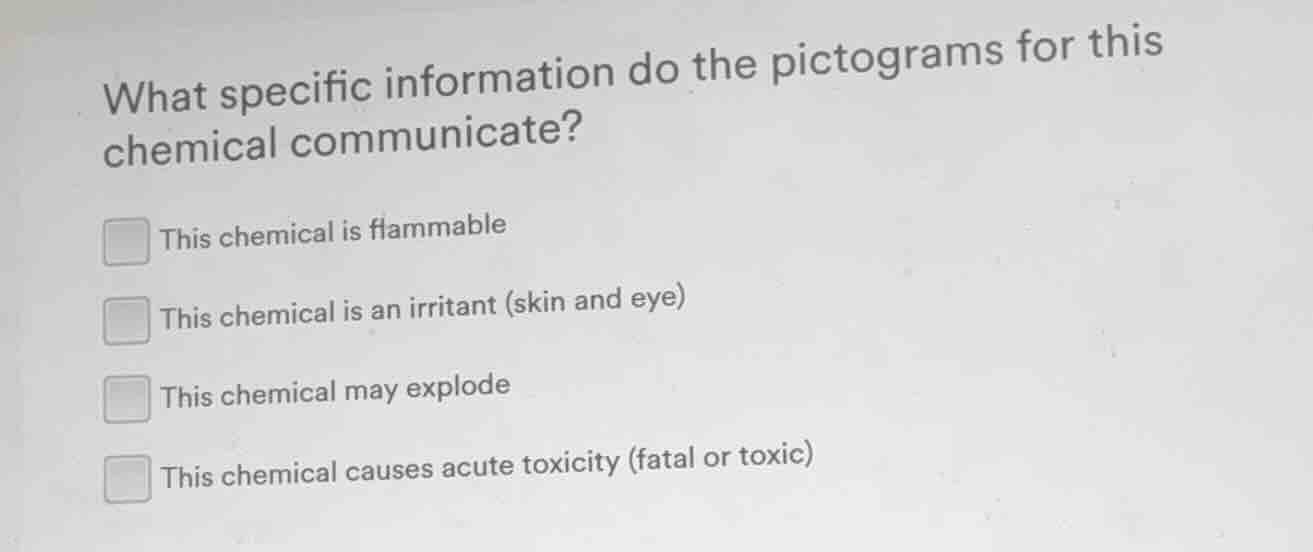
The question asks about specific information communicated by "the pictograms for this chemical," but the actual pictograms are cropped out or missing from the image. We must analyze the options to determine which standard GHS hazards are typically grouped together or identify the limitation.
Analyze standard GHS hazard combinations
In standard laboratory safety, chemicals often carry multiple GHS pictograms. Without seeing the specific pictograms, we cannot definitively select the correct options. However, we can explain what each option represents under Chemical Safety guidelines:
- "This chemical is flammable" corresponds to the Flame pictogram.
- "This chemical is an irritant (skin and eye)" corresponds to the Exclamation Mark pictogram.
- "This chemical may explode" corresponds to the Exploding Bomb pictogram.
- "This chemical causes acute toxicity (fatal or toxic)" corresponds to the Skull and Crossbones pictogram.
Formulate a conditional response
Since the visual pictograms are missing, we will provide the direct mapping of GHS pictograms to each of the choices so that the student can match them to the symbols on their worksheet.

Snap & solve any problem in the app
Get step-by-step solutions on Sovi AI
Photo-based solutions with guided steps
Explore more problems and detailed explanations
Because the pictograms are not visible in the provided image, please match the symbols on your worksheet to the following standard GHS meanings:
- Flame Symbol -> This chemical is flammable
- Exclamation Mark Symbol -> This chemical is an irritant (skin and eye)
- Exploding Bomb Symbol -> This chemical may explode
- Skull and Crossbones Symbol -> This chemical causes acute toxicity (fatal or toxic)