QUESTION IMAGE
Question
Question was provided via image upload.
Identify the question and options
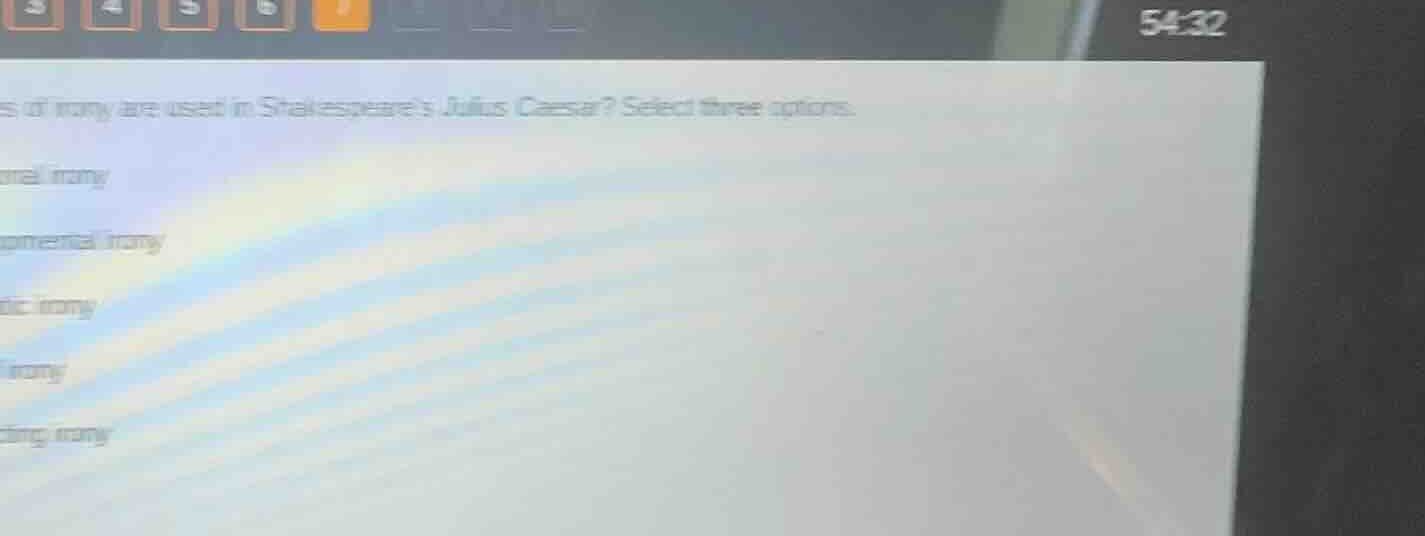
The visible text asks: "Which types of irony are used in Shakespeare's Julius Caesar? Select three options."
The options, though partially cut off on the left, can be reconstructed based on standard literary terms and the visible letters:
- "...ral irony" -> Verbal irony
- "...uational irony" -> Situational irony
- "...tic irony" -> Dramatic irony
- "...l irony" -> Historical irony (or another distractor)
- "...ting irony" -> Acting irony (or another distractor)
Analyze the three main types of irony
The three standard, universally recognized types of irony in literature and drama are:
- Verbal Irony: When a speaker says one thing but means the opposite (e.g., Mark Antony's repeated sarcastic use of "honorable men").
- Situational Irony: When the outcome of a situation is the exact opposite of what was expected (e.g., the conspirators killing Caesar to free Rome, only to cause a civil war and the rise of an empire).
- Dramatic Irony: When the audience knows key information that the characters do not (e.g., the audience knowing about the assassination plot while Caesar remains unaware).
Select the correct options
The three correct options to select are Verbal irony, Situational irony, and Dramatic irony.

Snap & solve any problem in the app
Get step-by-step solutions on Sovi AI
Photo-based solutions with guided steps
Explore more problems and detailed explanations
- verbal irony (Correct answer)
- situational irony (Correct answer)
- dramatic irony (Correct answer)
- historical irony
- acting irony