QUESTION IMAGE
Question
Question was provided via image upload.
Analyze the missing context from part a
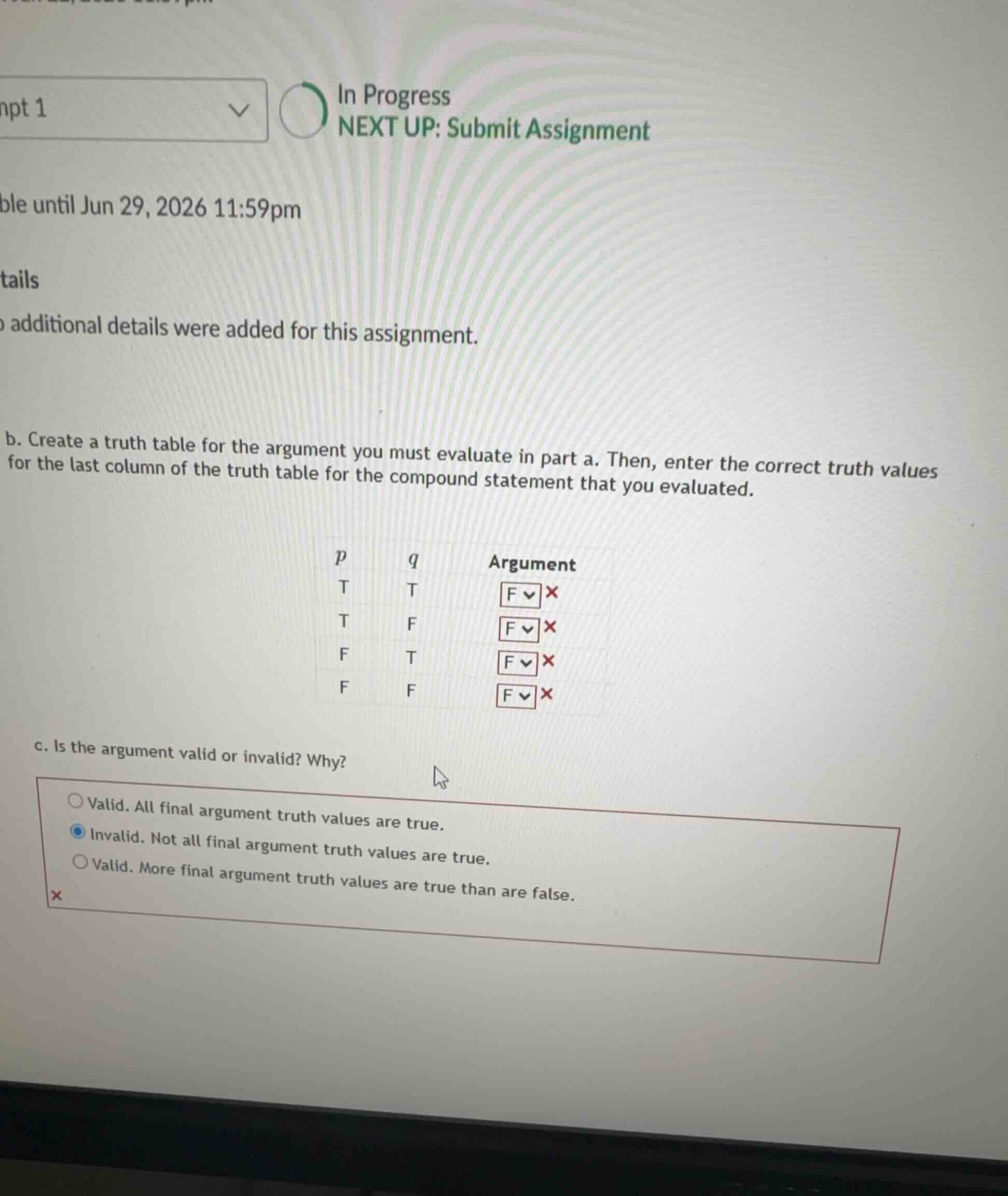
The image shows parts b and c of a logic problem. Part a, which contains the specific symbolic argument to be evaluated, is not visible. However, looking at part c, the student selected "Invalid. Not all final argument truth values are true" and this was marked incorrect (indicated by the red 'x' next to the option box and the red 'x' marks next to the 'F' selections in the truth table).
Since the argument being "Invalid because not all final values are true" is incorrect, the argument must actually be Valid. For an argument to be valid, the conditional statement representing the argument (typically of the form \((P_1 \land P_2 \land \dots \land P_n)
ightarrow C\)) must be a tautology. Therefore, all truth values in the final column of the truth table for the compound statement representing the argument must be True (T).
Determine the truth values for part b
Since the argument is valid, the final column representing the argument must consist entirely of true values:
Determine the correct choice for part c
Since all final truth values in the column are True, the argument is valid. The correct option is:
"Valid. All final argument truth values are true."

Snap & solve any problem in the app
Get step-by-step solutions on Sovi AI
Photo-based solutions with guided steps
Explore more problems and detailed explanations
Question b
The correct truth values for the last column of the truth table are:
- Row 1 (\(p = \text{T}, q = \text{T}\)): T
- Row 2 (\(p = \text{T}, q = \text{F}\)): T
- Row 3 (\(p = \text{F}, q = \text{T}\)): T
- Row 4 (\(p = \text{F}, q = \text{F}\)): T
Question c
- Valid. All final argument truth values are true. (Correct answer)
- Invalid. Not all final argument truth values are true.
- Valid. More final argument truth values are true than are false.