QUESTION IMAGE
Question
Question was provided via image upload.
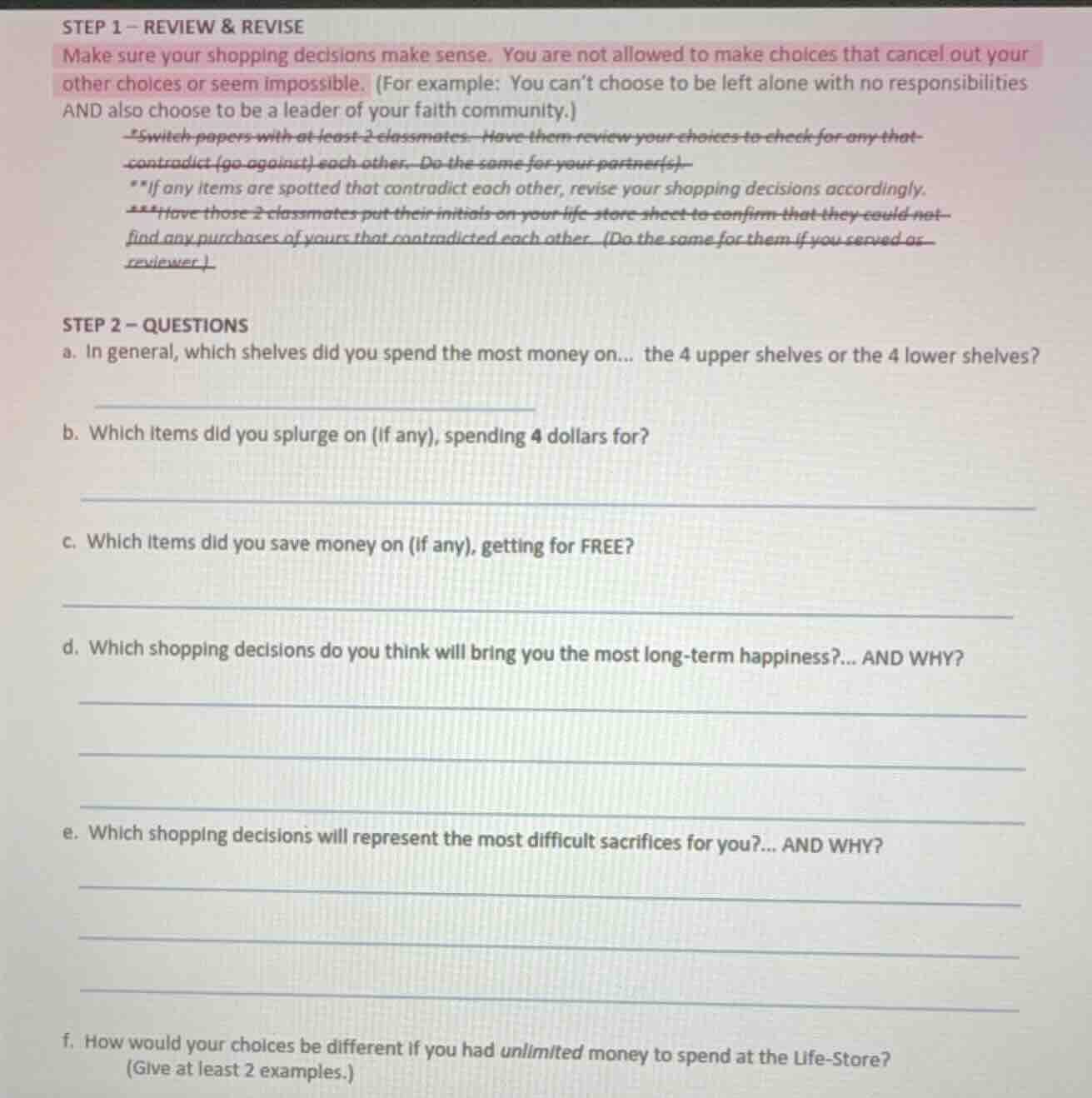
Analyze the activity context
The questions refer to a classroom simulation activity called "Life-Store" where students make hypothetical shopping decisions under a budget constraint. Because this is a personalized reflection worksheet based on individual choices made in a previous step, the answers depend on the specific selections made on the student's "life store sheet."
Address question a
This question asks whether more money was spent on the 4 upper shelves or the 4 lower shelves. Since the actual choices are not visible, we must guide the student on how to answer this by comparing their total spending on the upper shelves versus the lower shelves of their activity sheet.
Address questions b and c
These questions ask to list items that were "splurged" on (costing 4 dollars) and items obtained for "FREE." We will provide a framework explaining how to identify these items from their personal selection sheet.
Address questions d and e
These questions ask for personal reflections on which decisions bring the most long-term happiness and which represent the most difficult sacrifices, along with the reasoning "WHY." We will provide illustrative examples relating to Health and Lifestyle choices (such as investing in sleep, health, or relationships) to help the student formulate their own meaningful answers.
Address question f
This question asks how choices would differ with unlimited money, requiring at least 2 examples. We will explain the concept of scarcity and how removing a budget constraint allows one to avoid trade-offs, providing examples of upgrading free/cheap choices to premium options.

Snap & solve any problem in the app
Get step-by-step solutions on Sovi AI
Photo-based solutions with guided steps
Explore more problems and detailed explanations
Because these questions are based on your personal choices from the "Life-Store" activity sheet, the exact answers depend on what you purchased. Below is a guide and examples to help you fill out each question:
Question a
- How to answer: Look at your completed "life store sheet." Count the total dollars you spent on the items located on the top 4 shelves, and compare that to the total dollars spent on the bottom 4 shelves.
- Fill-in template: "I spent the most money on the [insert 'upper' or 'lower'] shelves."
Question b
- How to answer: Look for any items on your sheet where you wrote down a cost of 4 dollars.
- Fill-in template: "I splurged on [insert the 4-dollar items, or write 'None' if you did not buy any]."
Question c
- How to answer: Look for any items on your sheet that had a cost of 0 dollars (free) that you selected.
- Fill-in template: "I saved money on [insert the free items, or write 'None' if you did not select any]."
Question d
- How to answer: Think about which of your purchases support your long-term well-being, such as health, education, or stable relationships, rather than short-term entertainment.
- Example answer: "I think choosing a healthy lifestyle and good sleep habits will bring me the most long-term happiness because physical and mental well-being prevent stress and give me the energy to pursue my goals."
Question e
- How to answer: Identify the items you really wanted but had to give up or choose a lower-tier option for due to your limited budget.
- Example answer: "Choosing to sacrifice luxury entertainment items was the most difficult because it is hard to give up immediate fun, even though I knew I needed to prioritize my long-term health and responsibilities."
Question f
- How to answer: Think about how your choices would change if budget limits (scarcity) were removed. Provide 2 specific upgrades you would make.
- Example answer: "If I had unlimited money, I would:
- Upgrade my basic housing choice to a highly comfortable living space.
- Choose premium healthcare and wellness options instead of the free or basic tiers."