QUESTION IMAGE
Question
Question was provided via image upload.
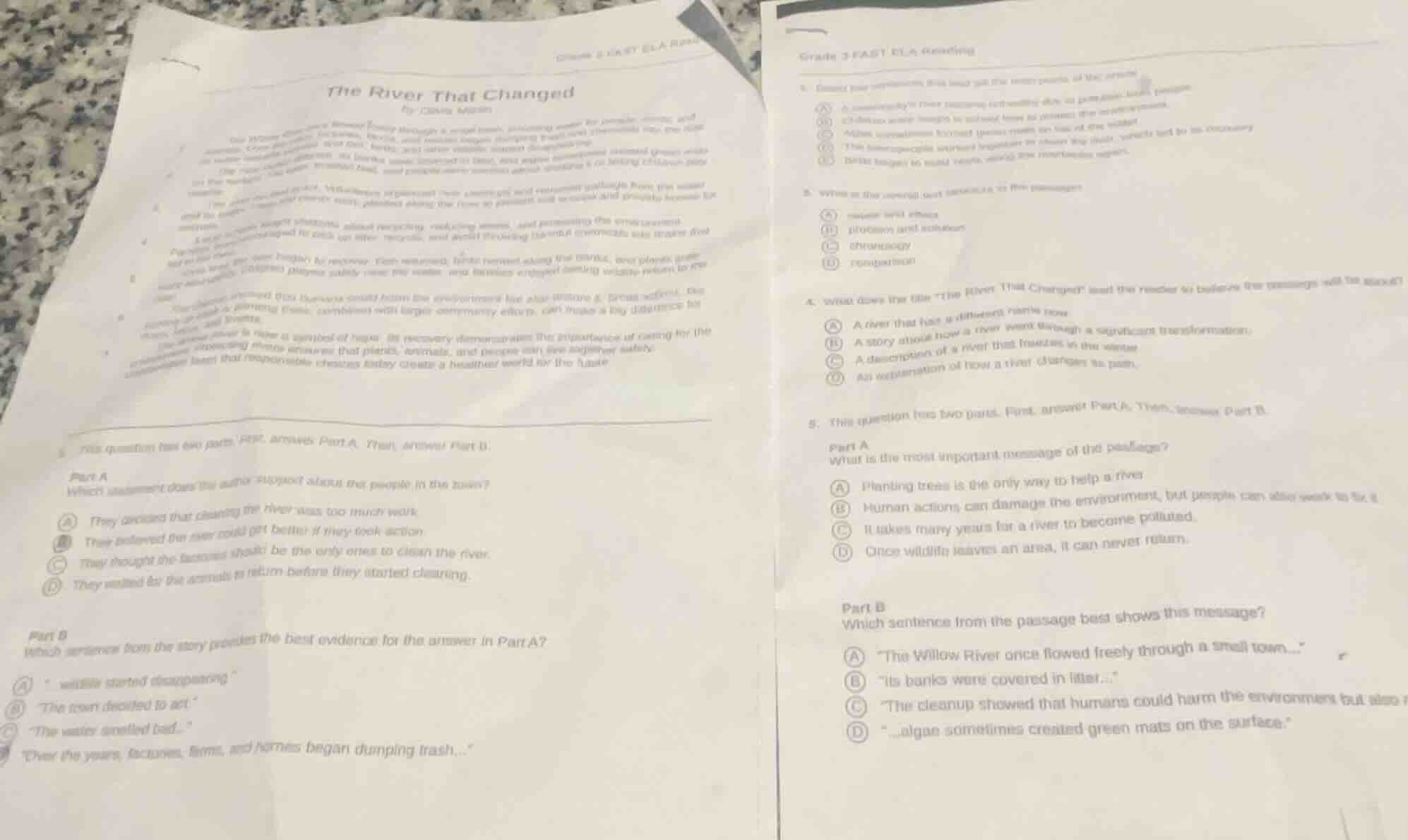
Analyze the central theme and details
Using the Nonfiction Analysis and Central Idea Analysis knowledge points, we examine the text "The River That Changed" by Olivia Martin. The passage describes how the Willow River became polluted due to factories, farms, and homes dumping trash and chemicals, leading to wildlife disappearing. Then, the townspeople decided to act by organizing cleanups, planting trees, and educating others. Consequently, the river recovered, showing that human actions can both harm and restore the environment.
Solve Question 1 (Part A and Part B)
- Part A: The question asks which statement the author supports about the people in the town. Based on the text, the townspeople believed they could improve the river if they took action. Thus, the correct option is (B) "They believed the river could get better if they took action."
- Part B: We need the best evidence for Part A. The sentence "The town decided to act" directly supports their belief and subsequent action. Thus, the correct option is (B) "The town decided to act."
Solve Question 2
The question asks to select two sentences that list the main points of the article.
- The main points of the article focus on:
- The river becoming polluted due to human activities.
- The townspeople working together to clean it up, leading to its recovery.
- Looking at the options:
- (A) "A community's river became polluted due to actions of people." (Main point)
- (C) "The townspeople worked together to clean the river, which led to its recovery." (Main point)
- Therefore, the two correct options are (A) and (C).
Solve Question 3
The question asks for the overall text structure of the passage.
- The passage first describes the problem (the river becoming heavily polluted and wildlife disappearing) and then describes the solution (the townspeople organizing cleanups, planting trees, and restoring the river).
- Therefore, the text structure is problem and solution, which corresponds to option (B).
Solve Question 4
The question asks what the title "The River That Changed" leads the reader to believe the passage will be about.
- "Changed" indicates a transformation over time. The story describes how a clean river became polluted and was then restored to a healthy state.
- Therefore, the title leads the reader to expect "A story about how a river went through a significant transformation," which corresponds to option (B).
Solve Question 5 (Part A and Part B)
- Part A: The question asks for the most important message of the passage. The central message is that while human actions can damage the environment, people also have the power to work together and fix it. This corresponds to option (B) "Human actions can damage the environment, but people can also work to fix it."
- Part B: We need the sentence that best shows this message. The sentence "The cleanup showed that humans could harm the environment but also restore it..." directly states this dual impact of human actions. This corresponds to…

Snap & solve any problem in the app
Get step-by-step solutions on Sovi AI
Photo-based solutions with guided steps
Explore more problems and detailed explanations
Question 1
Part A
- (A) They decided that cleaning the river was too much work.
- (B) They believed the river could get better if they took action. (Correct answer)
- (C) They thought the factories should be the only ones to clean the river.
- (D) They waited for the animals to return before they started clearing.
Part B
- (A) "...wildlife started disappearing."
- (B) "The town decided to act." (Correct answer)
- (C) "The water smelled bad..."
- (D) "Over the years, factories, farms, and homes began dumping trash..."
Question 2
- (A) A community's river became polluted due to actions of people. (Correct answer)
- (B) Children were taught in school how to protect the environment.
- (C) Algae sometimes formed green mats on top of the water.
- (D) The townspeople worked together to clean the river, which led to its recovery. (Correct answer)
- (E) Birds began to build nests along the riverbanks again.
Question 3
- (A) cause and effect
- (B) problem and solution (Correct answer)
- (C) chronology
- (D) comparison
Question 4
- (A) A river that has a different name now.
- (B) A story about how a river went through a significant transformation. (Correct answer)
- (C) A description of a river that freezes in the winter.
- (D) An explanation of how a river changes its path.
Question 5
Part A
- (A) Planting trees is the only way to help a river.
- (B) Human actions can damage the environment, but people can also work to fix it. (Correct answer)
- (C) It takes many years for a river to become polluted.
- (D) Once wildlife leaves an area, it can never return.
Part B
- (A) "The Willow River once flowed freely through a small town..."
- (B) "Its banks were covered in litter..."
- (C) "The cleanup showed that humans could harm the environment but also restore it..." (Correct answer)
- (D) "...algae sometimes created green mats on the surface."