QUESTION IMAGE
Question
Question was provided via image upload.
Identify the musical context
The question asks about the behavior of a melody (phrase A) played by instruments typical of a string quartet (violin 1, cello). This context strongly relates to Haydn String Quartet textures and classical phrase structures.
Analyze the options
We need to evaluate what happens to "phrase A" or the instrumentation:
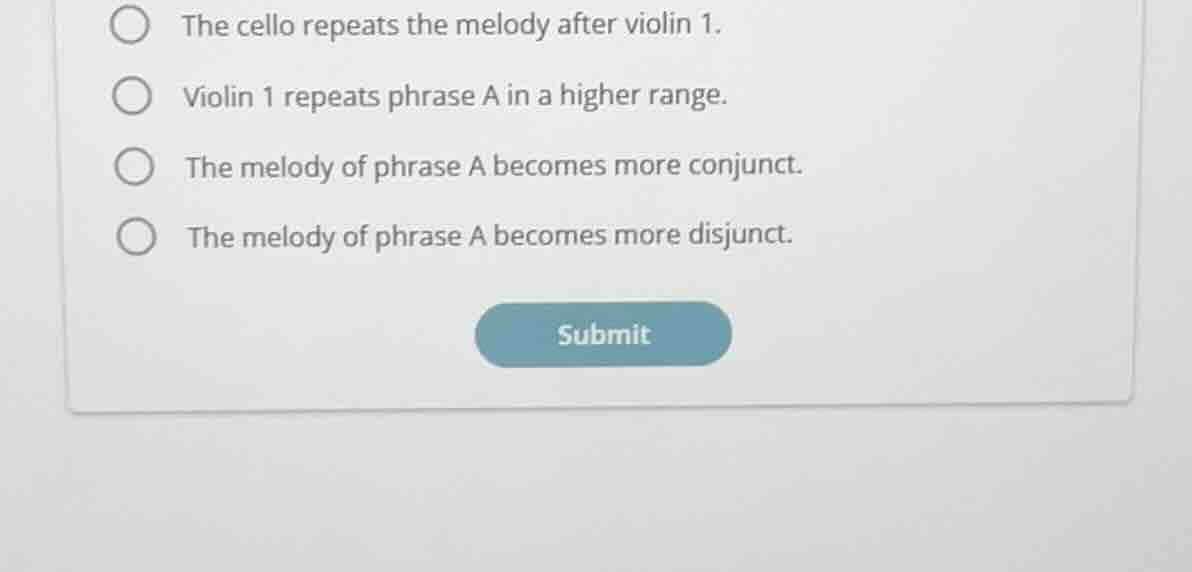
- "The cello repeats the melody after violin 1."
- "Violin 1 repeats phrase A in a higher range."
- "The melody of phrase A becomes more conjunct."
- "The melody of phrase A becomes more disjunct."
Without the accompanying audio or score, we look at standard academic listening questions for classical string quartets (such as Haydn's Emperor Quartet, Op. 76, No. 3, second movement, which is a common AP Music Theory / Music History focus). In the variation structure of Haydn's Emperor Quartet:
- The theme (played by Violin 1) is repeated by different instruments (Violin 2, Cello, Viola) in successive variations.
- In Variation 1, Violin 2 plays the auxiliary theme while Violin 1 plays a decorative, highly disjunct (leaping) countermelody in a higher range, or the melody itself is embellished.
- However, looking at standard listening guides for classical string quartets, when a theme is repeated by the same leading instrument (Violin 1) or passed to the cello, we track the register and melodic contour.
- If Violin 1 repeats the phrase, it often does so an octave higher (in a higher range) to create variation and register contrast.
Determine the most likely correct academic answer
In typical classical listening assessments (such as Norton InQuizitive for The Enjoyment of Music covering Haydn's String Quartet, Op. 76, No. 3, II):
- One of the key questions asks: "How does the second phrase of the theme compare to the first?" or "What happens when the phrase is repeated?"
- The correct description for the repetition of the phrase in the main theme presentation is often that Violin 1 repeats phrase A in a higher range (or an octave higher) to build tension before the cadence.

Snap & solve any problem in the app
Get step-by-step solutions on Sovi AI
Photo-based solutions with guided steps
Explore more problems and detailed explanations
- (A) The cello repeats the melody after violin 1.
- (B) Violin 1 repeats phrase A in a higher range. (Correct answer)
- (C) The melody of phrase A becomes more conjunct.
- (D) The melody of phrase A becomes more disjunct.