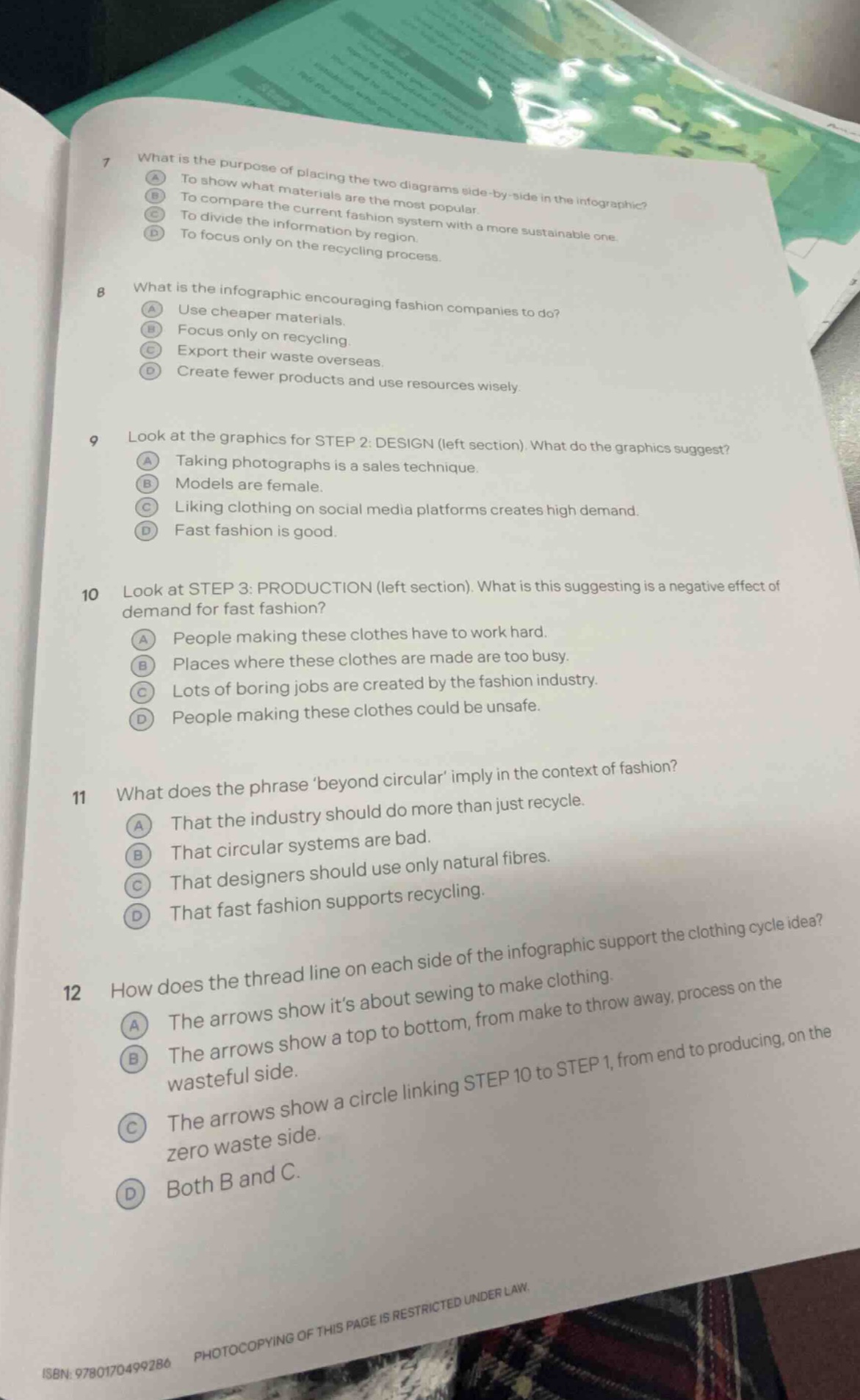
QUESTION IMAGE
Question
Question was provided via image upload.
Analyze questions 7 and 8
The questions refer to an infographic comparing a current fashion system with a more sustainable one.
- Question 7: Placing two diagrams side-by-side typically serves to compare the current system with a more sustainable alternative. This corresponds to option B.
- Question 8: Infographics promoting sustainability encourage fashion companies to create fewer products and use resources wisely. This corresponds to option D.
Analyze questions 9 and 10
- Question 9: In the context of "Step 2: Design" and social media graphics (such as "liking" clothing), the graphics suggest that liking clothing on social media platforms creates high demand. This corresponds to option C.
- Question 10: "Step 3: Production" in fast fashion critiques often highlights labor conditions, suggesting that people making these clothes could be unsafe. This corresponds to option D.
Analyze questions 11 and 12
- Question 11: "Beyond circular" implies going further than standard circular economy practices like recycling, meaning the industry should do more than just recycle. This corresponds to option A.
- Question 12: The thread lines with arrows on each side represent two pathways: a top-to-bottom wasteful process on one side, and a circular loop linking end to beginning on the zero-waste side. Thus, both B and C are correct, corresponding to option D.

Snap & solve any problem in the app
Get step-by-step solutions on Sovi AI
Photo-based solutions with guided steps
Explore more problems and detailed explanations
Question 7
- (A) To show what materials are the most popular.
- (B) To compare the current fashion system with a more sustainable one. (Correct answer)
- (C) To divide the information by region.
- (D) To focus only on the recycling process.
Question 8
- (A) Use cheaper materials.
- (B) Focus only on recycling.
- (C) Export their waste overseas.
- (D) Create fewer products and use resources wisely. (Correct answer)
Question 9
- (A) Taking photographs is a sales technique.
- (B) Models are female.
- (C) Liking clothing on social media platforms creates high demand. (Correct answer)
- (D) Fast fashion is good.
Question 10
- (A) People making these clothes have to work hard.
- (B) Places where these clothes are made are too busy.
- (C) Lots of boring jobs are created by the fashion industry.
- (D) People making these clothes could be unsafe. (Correct answer)
Question 11
- (A) That the industry should do more than just recycle. (Correct answer)
- (B) That circular systems are bad.
- (C) That designers should use only natural fibres.
- (D) That fast fashion supports recycling.
Question 12
- (A) The arrows show it's about sewing to make clothing.
- (B) The arrows show a top to bottom, from make to throw away, process on the wasteful side.
- (C) The arrows show a circle linking STEP 10 to STEP 1, from end to producing, on the zero waste side.
- (D) Both B and C. (Correct answer)