QUESTION IMAGE
Question
Question was provided via image upload.
Analyze the central idea of the article
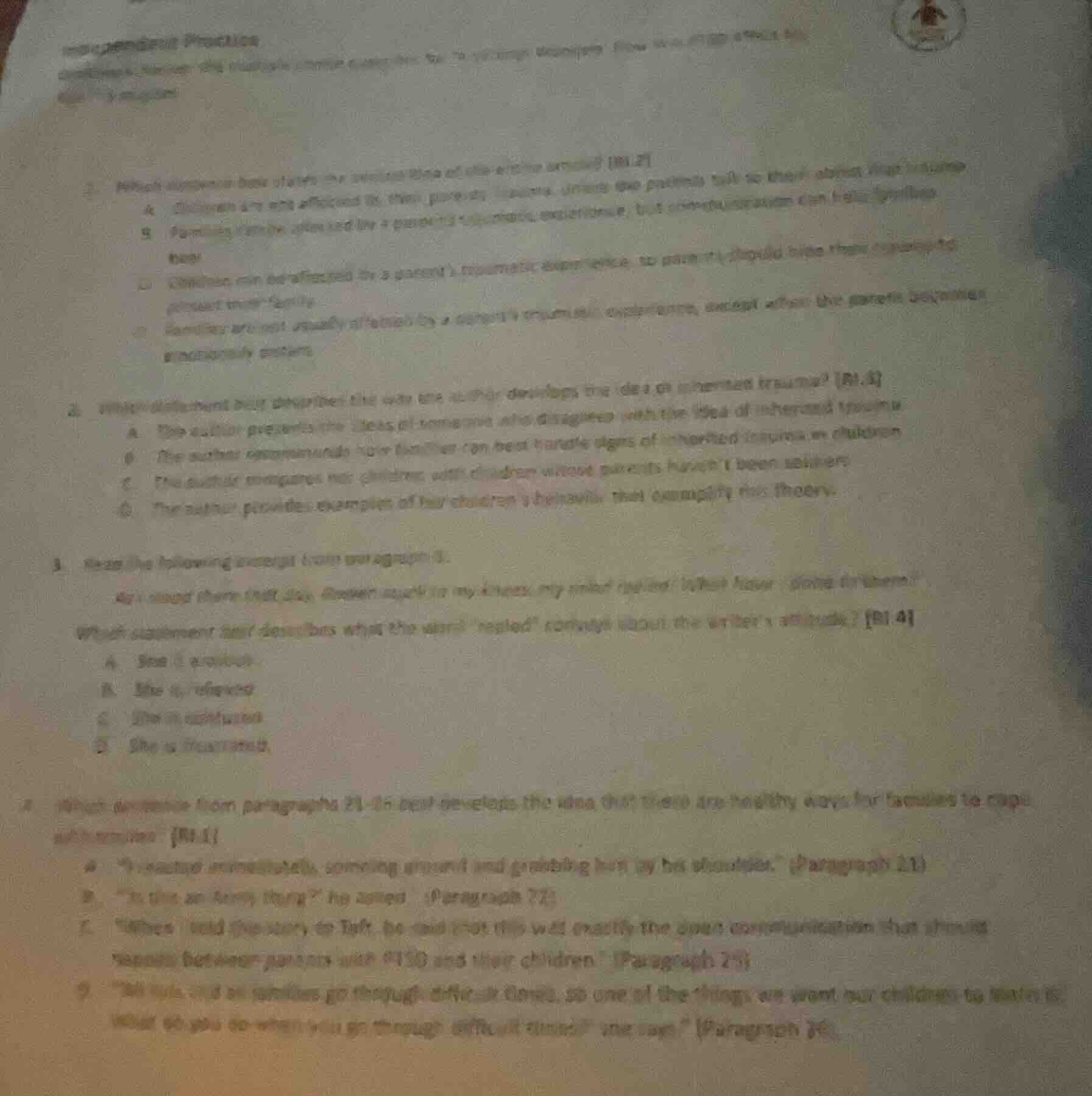
Using the Textual Evidence knowledge point, we evaluate Question 1. The question asks which statement best states the central idea of the entire article. Looking at the options:
- Option A suggests children are not affected unless parents talk about trauma. This is contradicted by the concept of "inherited trauma" where children are affected even without direct discussion.
- Option B states families can be affected by a parent's traumatic experience, but communication can help families heal. This captures both the problem (inherited trauma) and the resolution discussed in the text.
- Option C suggests parents should hide their trauma, which contradicts the text's advocacy for open communication.
- Option D suggests families are not usually affected, which is incorrect.
Therefore, Option B is the most accurate representation of the central idea.
Examine the development of inherited trauma
We analyze Question 2, which asks how the author develops the idea of inherited trauma.
- Option A mentions presenting ideas of someone who disagrees, which is not the primary development method.
- Option B mentions recommending how families can best handle signs, which is a concluding recommendation rather than how the core concept is developed.
- Option C mentions comparing her children with children whose parents haven't been soldiers.
- Option D states the author provides examples of her children's behavior that exemplify this theory. Throughout personal narratives on trauma, authors frequently use their own children's behaviors as primary case studies to illustrate how trauma is inherited. Thus, Option D is the correct choice.
Interpret the author's attitude from diction
We analyze Question 3, which asks what the word "reeled" in paragraph 3 conveys about the writer's attitude. The excerpt reads: "As I stood there that day, frozen myself to my knees, my mind reeled: What have I done to them?"
- "Reeled" indicates a state of shock, confusion, or being overwhelmed by a sudden, distressing realization.
- Among the choices (A. She is anxious, B. She is relieved, C. She is confused, D. She is frustrated), "confused" or overwhelmed (C) best matches the sensation of one's mind spinning ("reeled") in shock and uncertainty.
Identify healthy coping mechanisms in the text
Using the Trauma Coping Mechanisms knowledge point, we evaluate Question 4. The question asks which sentence from paragraphs 21–26 best develops the idea that there are healthy ways for families to cope with trauma.
- Option A describes a physical, reactive response: "I reacted immediately, spinning around and grabbing him..."
- Option B is a simple question: "'Is this an Army thing?' he asked."
- Option C states: "When I told the story to Taft, he said that this was exactly the open communication that should happen between parents with PTSD and their children." This explicitly identifies "open communication" as a healthy, recommended coping mechanism.
- Option D dis…

Snap & solve any problem in the app
Get step-by-step solutions on Sovi AI
Photo-based solutions with guided steps
Explore more problems and detailed explanations
Question 1
- A Children are not affected by their parents' trauma, unless the parents talk to them about that trauma.
- B Families can be affected by a parent's traumatic experience, but communication can help families heal. (Correct answer)
- C Children can be affected by a parent's traumatic experience, so parents should hide their trauma to protect their family.
- D Families are not usually affected by a parent's traumatic experience, except when the parent becomes emotionally distant.
Question 2
- A The author presents the ideas of someone who disagrees with the idea of inherited trauma.
- B The author recommends how families can best handle signs of inherited trauma in children.
- C The author compares her children with children whose parents haven't been soldiers.
- D The author provides examples of her children's behavior that exemplify this theory. (Correct answer)
Question 3
- A She is anxious.
- B She is relieved.</mcq-correct>
- C She is confused. (Correct answer)
<mcq-option>D She is frustrated.
Question 4
- A "I reacted immediately, spinning around and grabbing him by his shoulder." (Paragraph 21)
- B "'Is this an Army thing?' he asked." (Paragraph 22)
- C "When I told the story to Taft, he said that this was exactly the open communication that should happen between parents with PTSD and their children." (Paragraph 25) (Correct answer)
- D "'All kids and all families go through difficult times, so one of the things we want our children to learn is: What do you do when you go through difficult times?' she says." (Paragraph 26)