QUESTION IMAGE
Question
Question was provided via image upload.
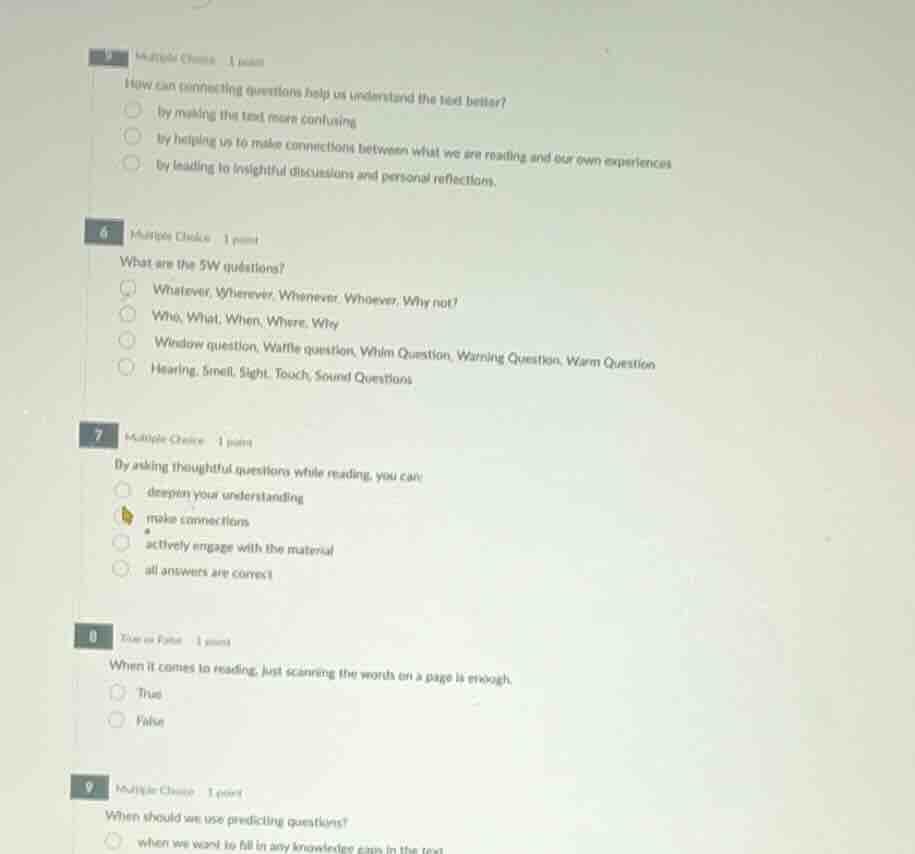
Analyze Question 5
The question asks how connecting questions help us understand a text better. Connecting questions link the text to personal experiences, other texts, or the world, leading to deeper discussions and reflections. Looking at the options:
- Option 1: "by making the text more confusing" (Incorrect)
- Option 2: "by helping us to make connections between what we are reading and our own experiences" (Correct)
- Option 3: "by leading to insightful discussions and personal reflections." (Correct)
Since both Option 2 and Option 3 are valid benefits of connecting questions, and typically these questions are designed to help make personal connections or lead to reflections, we evaluate the best fit. Option 2 directly defines "connecting questions" (making connections).
Analyze Question 6
The question asks "What are the 5W questions?". The standard 5W questions in reading comprehension and journalism are: Who, What, When, Where, Why.
- Option 1: "Whatever, Wherever, Whenever, Whoever, Why not?" (Incorrect)
- Option 2: "Who, What, When, Where, Why" (Correct)
- Option 3: "Window question, Waffle question, Whim Question, Warning Question, Warm Question" (Incorrect)
- Option 4: "Hearing, Smell, Sight, Touch, Sound Questions" (Incorrect)
Analyze Question 7
The question asks "By asking thoughtful questions while reading, you can:".
- Option 1: "deepen your understanding" (True)
- Option 2: "make connections" (True)
- Option 3: "actively engage with the material" (True)
- Option 4: "all answers are correct" (Correct, as all individual options are benefits of active questioning)
Analyze Question 8
The statement is "When it comes to reading, just scanning the words on a page is enough."
- Active reading requires comprehension, engagement, and critical thinking, not just passive scanning.
- Therefore, the statement is False.
Analyze Question 9
The question asks "When should we use predicting questions?".
- Predicting questions are used when we want to guess or anticipate what will happen next in the text based on clues.
- Although the options are partially cut off at the bottom, predicting questions are fundamentally used to anticipate upcoming events or information in a text.

Snap & solve any problem in the app
Get step-by-step solutions on Sovi AI
Photo-based solutions with guided steps
Explore more problems and detailed explanations
Question 5
- (A) by making the text more confusing
- (B) by helping us to make connections between what we are reading and our own experiences (Correct answer)
- (C) by leading to insightful discussions and personal reflections.
Question 6
- (A) Whatever, Wherever, Whenever, Whoever, Why not?
- (B) Who, What, When, Where, Why (Correct answer)
- (C) Window question, Waffle question, Whim Question, Warning Question, Warm Question
- (D) Hearing, Smell, Sight, Touch, Sound Questions
Question 7
- (A) deepen your understanding
- (B) make connections
- (C) actively engage with the material
- (D) all answers are correct (Correct answer)
Question 8
- (A) True
- (B) False (Correct answer)
Question 9
- (A) when we want to predict or anticipate what will happen next in the text (Correct answer)