QUESTION IMAGE
Question
Question was provided via image upload.
Identify the mathematical expressions
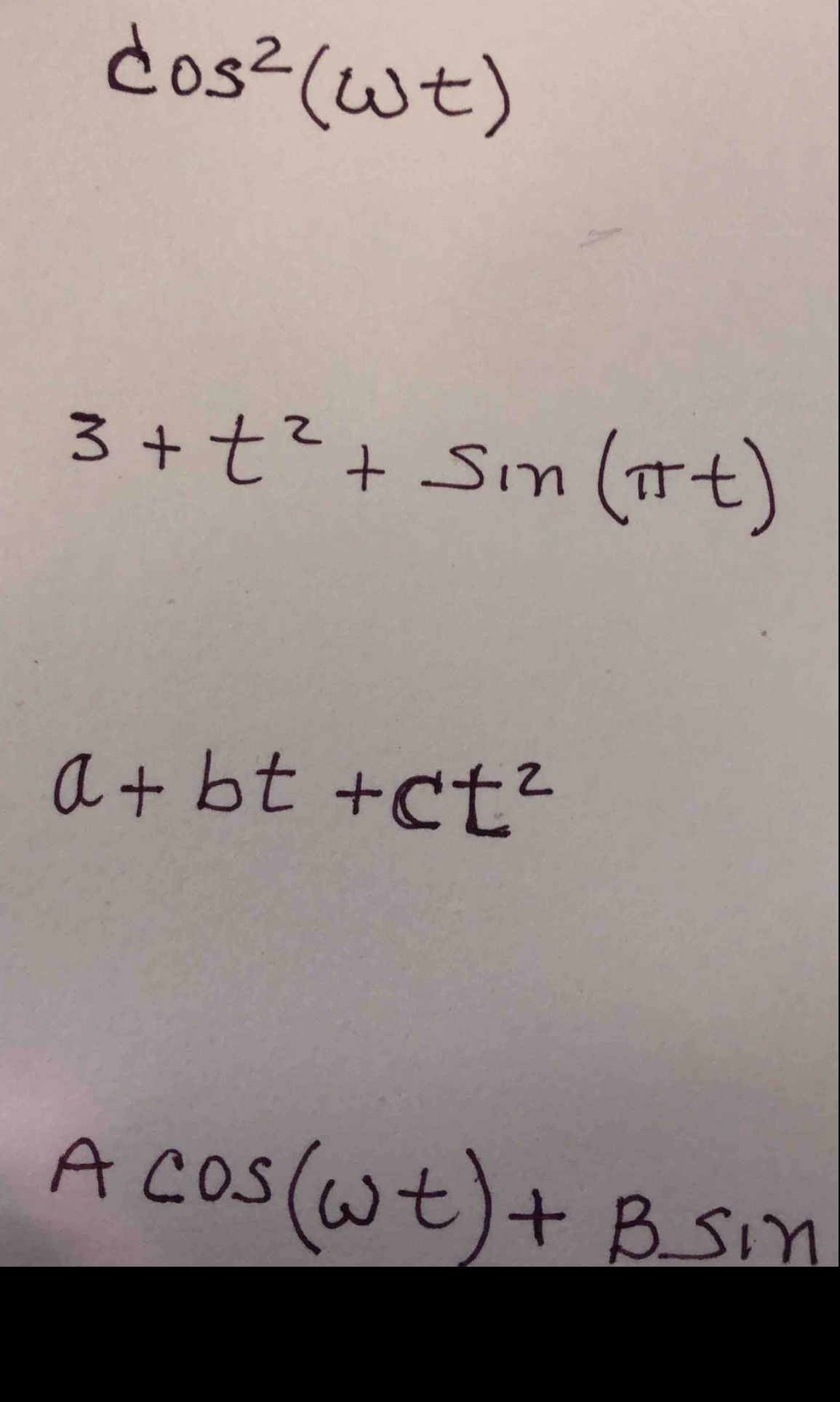
The image lists four mathematical functions of the variable \(t\):
- \(f_1(t) = \cos^2(\omega t)\)
- \(f_2(t) = 3 + t^2 + \sin(\pi t)\)
- \(f_3(t) = a + bt + ct^2\)
- \(f_4(t) = A\cos(\omega t) + B\sin(\omega t)\) (partially cut off as \(B\sin\))
We will analyze the symmetry properties (even, odd, or neither) of each function.
Analyze the first function
For \(f_1(t) = \cos^2(\omega t)\):
Substitute \(-t\) for \(t\):
Since cosine is an even function, \(\cos(-\theta) = \cos(\theta)\):
Thus, \(f_1(t)\) is an even function.
Analyze the second function
For \(f_2(t) = 3 + t^2 + \sin(\pi t)\):
Substitute \(-t\) for \(t\):
Since \(f_2(-t)
eq f_2(t)\) and \(f_2(-t)
eq -f_2(t)\), this function is neither even nor odd.
Analyze the third function
For \(f_3(t) = a + bt + ct^2\):
Substitute \(-t\) for \(t\):
- If \(b = 0\), then \(f_3(-t) = a + ct^2 = f_3(t)\), which is even.
- If \(a = 0\) and \(c = 0\), then \(f_3(-t) = -bt = -f_3(t)\), which is odd.
- In general, if \(b
eq 0\) and at least one of \(a\) or \(c\) is non-zero, the function is neither even nor odd.
Analyze the fourth function
For \(f_4(t) = A\cos(\omega t) + B\sin(\omega t)\):
Substitute \(-t\) for \(t\):
- If \(B = 0\), the function is even.
- If \(A = 0\), the function is odd.
- If both \(A
eq 0\) and \(B
eq 0\), the function is neither even nor odd.

Snap & solve any problem in the app
Get step-by-step solutions on Sovi AI
Photo-based solutions with guided steps
Explore more problems and detailed explanations
The symmetry analysis of the functions shown in the image is as follows:
- \(f_1(t) = \cos^2(\omega t)\)
- Symmetry: Even function, because \(f_1(-t) = f_1(t)\).
- \(f_2(t) = 3 + t^2 + \sin(\pi t)\)
- Symmetry: Neither even nor odd, because \(f_2(-t)
eq f_2(t)\) and \(f_2(-t)
eq -f_2(t)\).
- \(f_3(t) = a + bt + ct^2\)
- Symmetry: Generally neither even nor odd. It is even if \(b = 0\), and odd if \(a = c = 0\).
- \(f_4(t) = A\cos(\omega t) + B\sin(\omega t)\)
- Symmetry: Generally neither even nor odd. It is even if \(B = 0\), and odd if \(A = 0\).