QUESTION IMAGE
Question
Question was provided via image upload.
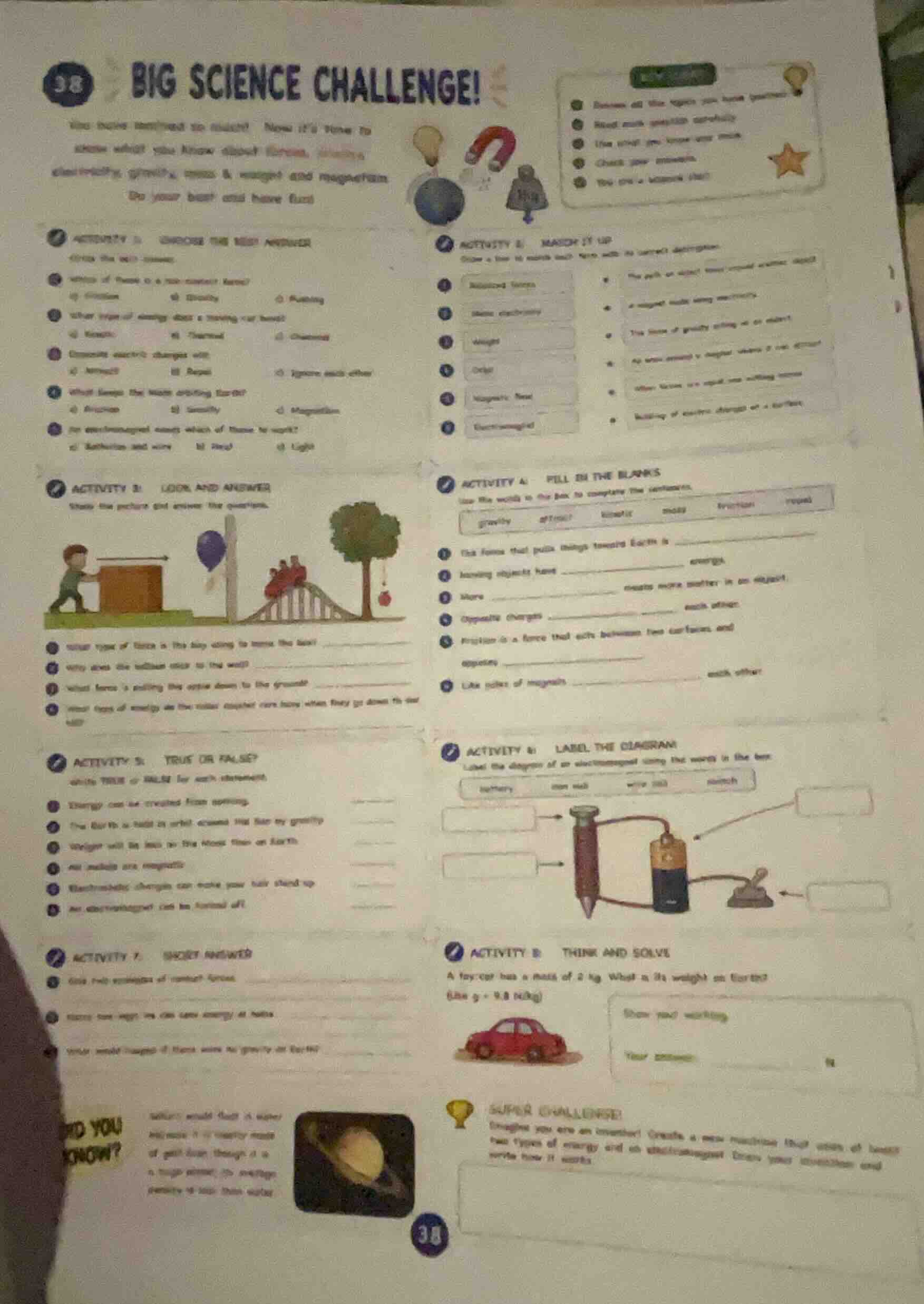
Analyze Activity 1: Choose the Best Answer
We evaluate each multiple-choice question based on basic physics principles:
- Non-contact forces act at a distance. Gravity is non-contact, while pushing and friction require physical contact.
- A moving car possesses kinetic energy due to its motion.
- Opposite electric charges attract each other, whereas like charges repel.
- Gravity is the force that keeps the Moon orbiting the Earth.
- An electromagnet requires electricity (batteries and wire) and a magnetic core (iron nail) to function.
Analyze Activity 2: Match It Up
We match each term on the left with its correct description on the right:
- Balanced forces: When forces are equal and acting in opposite directions (no change in motion).
- Static electricity: A buildup of electric charges on a surface.
- Weight: The force of gravity acting on an object.
- Orbit: The path an object takes around another object.
- Magnetic field: An area around a magnet where it can attract or repel.
- Electromagnet: A magnet made using electricity.
Analyze Activity 3: Look and Answer
We observe the pictures to answer the questions:
- The boy is pushing the box, so the force is a push (or contact force).
- The balloon sticks to the wall due to static electricity (electrostatic force).
- Gravity is pulling the apple down to the ground.
- As the roller coaster cars go down the slope, potential energy is converted into kinetic energy.
Analyze Activity 4: Fill in the Blanks
We select the correct words from the provided box (gravity, attract, kinetic, mass, friction, repel) to complete the sentences:
- The force that pulls things toward Earth is gravity.
- Moving objects have kinetic energy.
- Mass means more matter in an object.
- Opposite charges attract each other.
- Friction is a force that acts between two surfaces and opposes motion.
- Like poles of magnets repel each other.
Analyze Activity 5: True or False
We evaluate each statement:
- Energy cannot be created from nothing (Law of Conservation of Energy) -> FALSE.
- The Earth is held in orbit around the Sun by gravity -> TRUE.
- Weight depends on gravity; since gravity is weaker on the Moon, weight will be less -> TRUE.
- Not all metals are magnetic (e.g., copper, aluminum are not) -> TRUE.
- Electrostatic charges can make your hair stand up -> TRUE.
- An electromagnet can be turned off by cutting the electric current -> TRUE.
Analyze Activity 6: Label the Diagram
We label the components of the electromagnet using the words in the box (battery, iron nail, wire, switch):
- The power source is the battery.
- The metal core is the iron nail.
- The coiled conductor is the wire.
- The mechanism to open/close the circuit is the switch.
Analyze Activity 7: Short Answer
We answer the conceptual questions:
- Two examples of contact forces are friction and applied force (pushing/pulling).
- Roller coaster cars have potential energy at the top of a hill.
- Without gravity, objects would flo…

Snap & solve any problem in the app
Get step-by-step solutions on Sovi AI
Photo-based solutions with guided steps
Explore more problems and detailed explanations
Activity 1: Choose the Best Answer
- b) Gravity
- a) Kinetic
- a) Attract
- b) Gravity
- a) Batteries and wire
Activity 2: Match It Up
- Balanced forces — When forces are equal and acting in opposite directions
- Static electricity — Buildup of electric charges on a surface
- Weight — The force of gravity acting on an object
- Orbit — The path an object takes around another object
- Magnetic field — An area around a magnet where it can attract or repel
- Electromagnet — A magnet made using electricity
Activity 3: Look and Answer
- Pushing (applied force)
- Static electricity (electrostatic force)
- Gravity
- Kinetic energy
Activity 4: Fill in the Blanks
- The force that pulls things toward Earth is gravity.
- Moving objects have kinetic energy.
- Mass means more matter in an object.
- Opposite charges attract each other.
- Friction is a force that acts between two surfaces and opposes motion.
- Like poles of magnets repel each other.
Activity 5: True or False
- FALSE
- TRUE
- TRUE
- TRUE
- TRUE
- TRUE
Activity 6: Label the Diagram
- Left top box: wire
- Left bottom box: iron nail
- Right top box: battery
- Right bottom box: switch
Activity 7: Short Answer
- Friction and tension (or pushing/pulling)
- At the top of the hill
- Everything would float away into space, and Earth would have no atmosphere.
Activity 8: Think and Solve
- Working:
$$
\text{Weight} = \text{mass} \times g = 2\text{ kg} \times 9.8\text{ N/kg} = 19.6\text{ N}
$$
- Your answer: \(19.6\text{ N}\)