QUESTION IMAGE
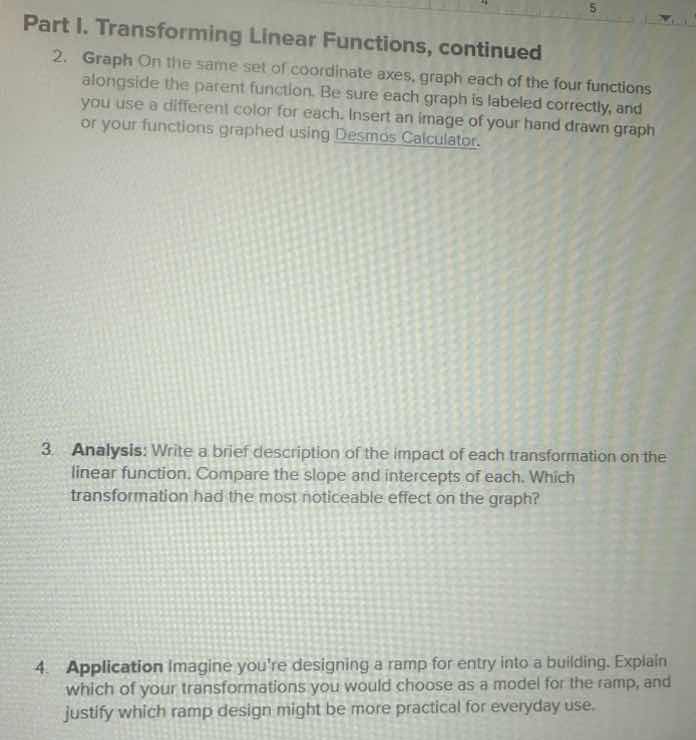
Question
Question was provided via image upload.
Identify the missing context
The image refers to "each of the four functions alongside the parent function" from a previous section (Part I, Question 1) which is not visible. In standard high school algebra curricula covering "Transforming Linear Functions," the parent linear function is:
The four typical transformations explored alongside the parent function usually include:
- A vertical shift: \(g(x) = x + k\) (e.g., \(g(x) = x + 3\))
- A vertical stretch/compression: \(h(x) = ax\) (e.g., \(h(x) = 2x\) or \(h(x) = \frac{1}{2}x\))
- A horizontal shift: \(p(x) = x - h\)
- A reflection: \(r(x) = -x\)
Let us assume a standard set of representative transformations to provide a complete, illustrative solution:
- Parent Function: \(f(x) = x\) (Slope = 1, \(y\)-intercept = 0)
- Transformation 1 (Vertical Shift): \(g(x) = x + 3\) (Slope = 1, \(y\)-intercept = 3)
- Transformation 2 (Vertical Stretch / Steeper Slope): \(h(x) = 2x\) (Slope = 2, \(y\)-intercept = 0)
- Transformation 3 (Vertical Compression / Flatter Slope): \(k(x) = \frac{1}{2}x\) (Slope = 0.5, \(y\)-intercept = 0)
- Transformation 4 (Reflection): \(r(x) = -x\) (Slope = -1, \(y\)-intercept = 0)
Analyze the transformations
Using the Linear Transformations and Parent Functions knowledge points:
- Vertical Shift (\(g(x) = x + 3\)): Shifts the graph up by 3 units. The slope remains 1. The \(y\)-intercept changes from 0 to 3, and the \(x\)-intercept changes from 0 to -3.
- Vertical Stretch (\(h(x) = 2x\)): Makes the line steeper. The slope doubles to 2. Intercepts remain at \((0,0)\).
- Vertical Compression (\(k(x) = \frac{1}{2}x\)): Makes the line flatter. The slope halves to 0.5. Intercepts remain at \((0,0)\).
- Reflection (\(r(x) = -x\)): Flips the line across the \(y\)-axis (or \(x\)-axis). The slope becomes negative (-1). Intercepts remain at \((0,0)\).
The reflection (\(r(x) = -x\)) or the steep stretch (\(h(x) = 2x\)) typically has the most visually noticeable effect because they change the direction or steepness dramatically.
Apply to the ramp design
A ramp requires a safe, gradual incline for accessibility (e.g., ADA guidelines specify a maximum slope of 1:12 or approximately 0.083).
- We compare the slopes of our transformed models.
- The compression model \(k(x) = \frac{1}{2}x\) has the gentlest slope (\(0.5\)) compared to the parent slope (\(1\)) or stretch slope (\(2\)).
- Therefore, a vertical compression (reducing the slope) is the most practical model for a safe, usable ramp.

Snap & solve any problem in the app
Get step-by-step solutions on Sovi AI
Photo-based solutions with guided steps
Explore more problems and detailed explanations
Question 2
The graph below displays the parent linear function along with four representative transformed linear functions:
- Parent Function (Black): \(f(x) = x\)
- Vertical Shift (Purple): \(g(x) = x + 3\)
- Vertical Stretch (Blue): \(h(x) = 2x\)
- Vertical Compression (Cyan): \(k(x) = \frac{1}{2}x\)
- Reflection (Pink): \(r(x) = -x\)
Question 3
- Impact of Transformations:
- \(g(x) = x + 3\) shifts the entire line vertically upward by 3 units.
- \(h(x) = 2x\) increases the steepness of the line.
- \(k(x) = \frac{1}{2}x\) decreases the steepness of the line.
- \(r(x) = -x\) reflects the line across the axes, changing its direction from increasing to decreasing.
- Comparison of Slopes and Intercepts:
- Slopes: \(h(x)\) has the steepest slope (\(m = 2\)), while \(k(x)\) has the flattest positive slope (\(m = 0.5\)). \(r(x)\) has a negative slope (\(m = -1\)).
- Intercepts: Only the vertical shift \(g(x)\) changes the intercepts (to \(y\)-intercept \(3\) and \(x\)-intercept \(-3\)). The others all pass through the origin \((0,0)\).
- Most Noticeable Effect: The reflection \(r(x) = -x\) has the most noticeable effect because it completely reverses the direction of the line.
Question 4
- Model Choice: The vertical compression model, \(k(x) = \frac{1}{2}x\), is the best choice for designing a ramp.
- Justification: A practical ramp must have a gentle, gradual slope to ensure safety and accessibility for everyday use (such as wheelchair access). A steep slope like \(h(x) = 2x\) or even the parent slope \(f(x) = x\) would be too steep and dangerous to climb.