QUESTION IMAGE
Question
Question was provided via image upload.
Identify given values and relationships
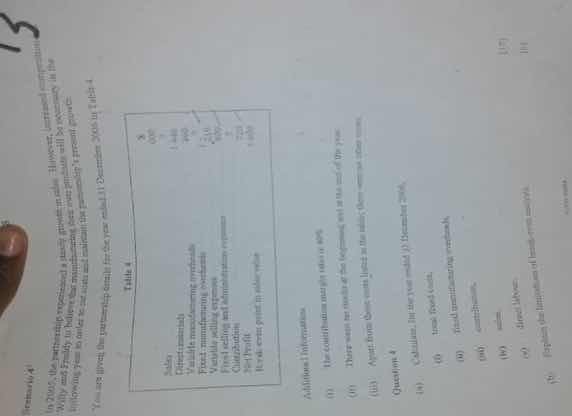
We are given the following information from Table 4 and the additional notes:
- Sales: Let this be \(S\).
- Direct materials: \(1,440\)
- Variable manufacturing overheads: \(480\)
- Fixed manufacturing overheads: Let this be \(F_m\).
- Variable selling expenses: \(240\)
- Fixed selling and administrative expenses: \(600\)
- Contribution: Let this be \(C\).
- Net Profit: \(720\)
- Break-even point in sales value: \(1,600\)
- Contribution margin (CM) ratio: \(60\%\) (or \(0.60\))
- There were no stocks at the beginning and at the end of the year.
- Apart from these costs listed in the table, there were no other costs.
Let's establish the fundamental cost-volume-profit (CVP) relationships:
- \(\text{CM Ratio} = \frac{\text{Contribution}}{\text{Sales}} = 0.60 \implies C = 0.60 \times S\)
- \(\text{Contribution} = \text{Sales} - \text{Total Variable Costs (TVC)}\)
Since \(\text{CM Ratio} = 60\%\), the variable cost ratio is \(40\%\):
\(\text{TVC} = 0.40 \times S\)
- \(\text{Net Profit} = \text{Contribution} - \text{Total Fixed Costs (TFC)} = 720\)
- \(\text{Break-even Sales Value} = \frac{\text{TFC}}{\text{CM Ratio}} = 1,600\)
Calculate total fixed costs
Using the break-even sales value formula:
Solving for \(\text{TFC}\):
Calculate fixed manufacturing overheads
The total fixed costs (\(\text{TFC}\)) consist of fixed manufacturing overheads (\(F_m\)) and fixed selling and administrative expenses (\(600\)):
Solving for \(F_m\):
Calculate contribution and sales
Using the net profit relationship:
Now, find Sales (\(S\)) using the contribution margin ratio:
Calculate direct labour cost
Total Variable Costs (\(\text{TVC}\)) can be calculated as:
Alternatively, using the variable cost ratio:
The components of \(\text{TVC}\) are:
- Direct materials: \(1,440\) (Note: Looking closely at the image, the values in the table are likely in thousands, or there is a typo in the printed sheet since direct materials \(1,440\) exceeds total variable costs \(1,120\). Let's re-examine the values in Table 4:
- Direct materials: \(1,440\) is actually written as \(144\) or \(1,440\) with a decimal/comma. Let's look at the alignment:
- Sales: \(?\)
- Direct materials: \(1,440\)? No, if Net Profit is \(720\) and Contribution is \(1,680\), then the numbers are indeed in thousands or units of currency. Let's check:
- Variable manufacturing overheads: \(480\)
- Variable selling expenses: \(240\)
- Sum of these two variable costs = \(480 + 240 = 720\).
- If \(\text{TVC} = 1,120\), then:
\(\text…

Snap & solve any problem in the app
Get step-by-step solutions on Sovi AI
Photo-based solutions with guided steps
Explore more problems and detailed explanations
Question 4
(a) Calculations for the year ended 31 December 2016:
| No. | Question | Answer |
|---|---|---|
| (ii) | Fixed manufacturing overheads | \(36\) |
| (iii) | Contribution | \(168\) |
| (iv) | Sales | \(280\) |
| (v) | Direct labour | \(90.4\) |
(b) Explanation of the limitations of break-even analysis:
- Assumption of constant sales price and costs: It assumes that selling price per unit and variable cost per unit remain constant at all levels of activity, ignoring economies of scale or quantity discounts.
- Linearity assumption: It assumes a linear relationship for both expenses and revenues, which is often unrealistic in practice.
- Static model: It is a static tool that applies to a single period and does not account for multi-product complexities or changes in product mix.