QUESTION IMAGE
Question
Question was provided via image upload.
Identify the core scientific phenomenon
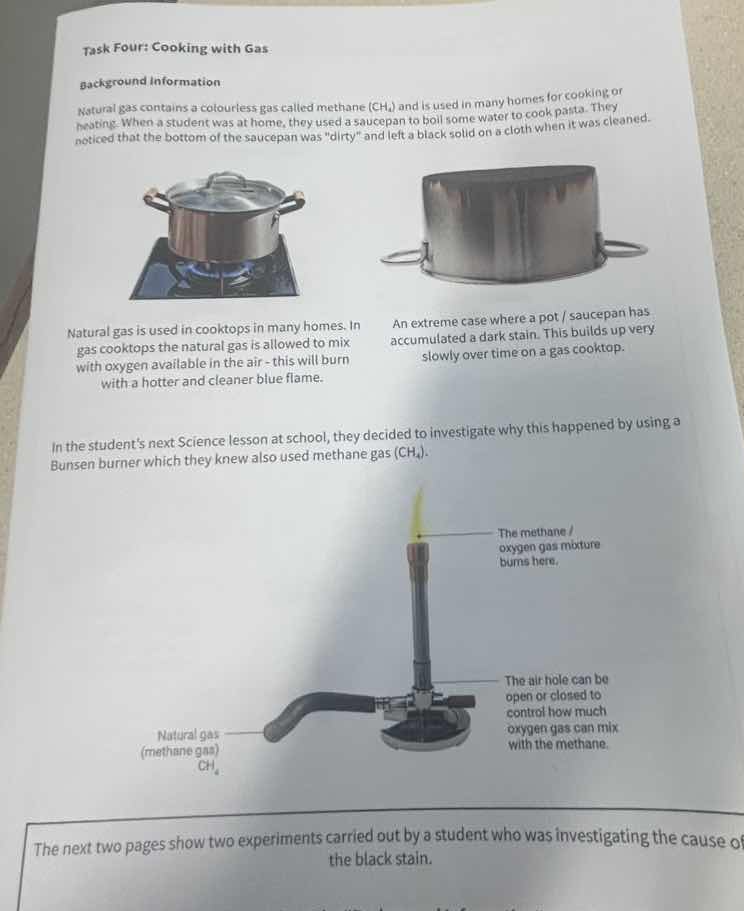
The background information describes a student noticing a "dirty" black solid (soot) forming on the bottom of a saucepan when cooking with natural gas (methane, \(\text{CH}_4\)). It also introduces a Bunsen burner setup where the air hole can be opened or closed to control oxygen mixing. The black solid is carbon powder (soot), which is a product of incomplete combustion.
Explain the chemistry of combustion
When methane burns with plenty of oxygen (air hole open on a Bunsen burner), it undergoes complete combustion, producing carbon dioxide and water vapor:
This reaction produces a hot, clean blue flame.
When oxygen is limited (air hole closed or restricted), incomplete combustion occurs. Instead of forming only carbon dioxide, carbon monoxide (\(\text{CO}\)) and solid carbon (\(\text{C}\), soot) are produced:
The unburnt carbon particles glow yellow in the flame and deposit as a black stain on surfaces.
Connect to the upcoming experiments
The text mentions that the next two pages show experiments investigating the cause of this black stain. Based on the Bunsen burner diagram, these experiments will likely compare the flame and soot production when the air hole is open (complete combustion) versus when it is closed (incomplete combustion).

Snap & solve any problem in the app
Get step-by-step solutions on Sovi AI
Photo-based solutions with guided steps
Explore more problems and detailed explanations
The image introduces a science task about why a black solid (soot) forms on the bottom of a saucepan when cooking with natural gas (methane, \(\text{CH}_4\)).
The black stain is caused by incomplete combustion, which occurs when there is not enough oxygen mixing with the gas:
- With sufficient oxygen (Air hole open): Methane burns completely to produce carbon dioxide and water, creating a clean, hot blue flame.
- With limited oxygen (Air hole closed): Methane burns incompletely, producing solid carbon particles (soot, \(\text{C}\)) and carbon monoxide. The soot deposits on the bottom of the pan as a black residue.
To solve the specific questions or analyze the experiments, please upload the next pages showing the experimental setups and questions!