QUESTION IMAGE
Question
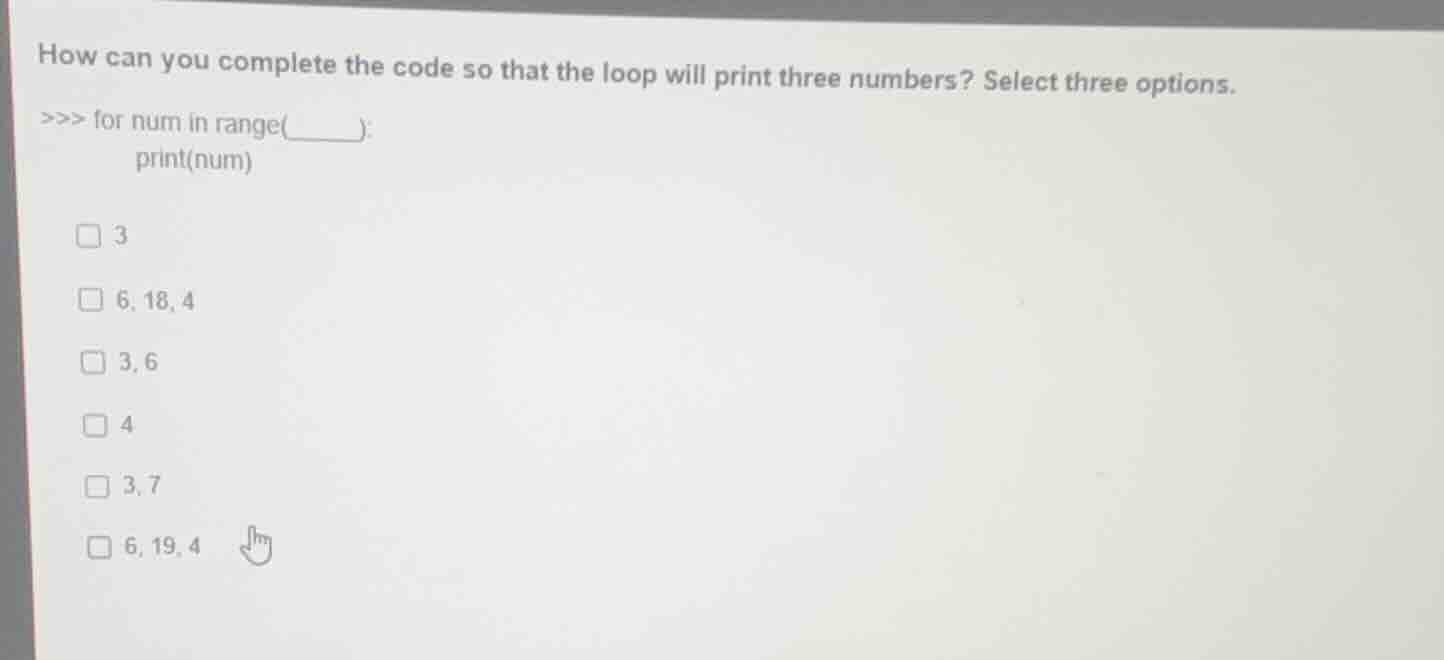
how can you complete the code so that the loop will print three numbers? select three options.
>> for num in range(____):
print(num)
3
6, 18, 4
3, 6
4
3, 7
6, 19, 4
<pre_analysis>
{
"quality": "clear",
"question_count": 1,
"skills_matched": [
"step_cot",
"multiple_choice_formatter",
"explain_then_answer",
"tutor"
],
"needs_drawing": false,
"concepts_used": [],
"new_concepts": [
"Python Range Function",
"For Loops",
"Control Flow"
],
"current_concepts": [
"Python Range Function",
"For Loops",
"Control Flow"
]
}
</pre_analysis>
<reasoning>
Analyze the single-argument range function
The single-argument form \( \text{range}(n) \) generates integers from \( 0 \) up to (but not including) \( n \).
- If \( n = 3 \), it generates \( 0, 1, 2 \) (exactly 3 numbers).
- If \( n = 4 \), it generates \( 0, 1, 2, 3 \) (exactly 4 numbers).
Thus, 3 is a correct option.
Analyze the two-argument range function
The two-argument form \( \text{range}(\text{start}, \text{stop}) \) generates integers from \( \text{start} \) up to (but not including) \( \text{stop} \).
- For
3, 6: it generates \( 3, 4, 5 \) (exactly 3 numbers). - For
3, 7: it generates \( 3, 4, 5, 6 \) (exactly 4 numbers).
Thus, 3, 6 is a correct option.
Analyze the three-argument range function
The three-argument form \( \text{range}(\text{start}, \text{stop}, \text{step}) \) generates integers starting at \( \text{start} \), incrementing by \( \text{step} \), up to (but not including) \( \text{stop} \).
- For
6, 18, 4: - First value: \( 6 \)
- Second value: \( 6 + 4 = 10 \)
- Third value: \( 10 + 4 = 14 \)
- Next value would be \( 14 + 4 = 18 \), which is equal to the stop value, so it is excluded.
- Generated numbers: \( 6, 10, 14 \) (exactly 3 numbers).
- For
6, 19, 4: - First value: \( 6 \)
- Second value: \( 10 \)
- Third value: \( 14 \)
- Fourth value: \( 18 \) (since \( 18 < 19 \), it is included).
- Generated numbers: \( 6, 10, 14, 18 \) (exactly 4 numbers).
Thus, 6, 18, 4 is a correct option.
Select the three correct options
The three options that complete the code to print exactly three numbers are:
36, 18, 43, 6
</reasoning>
<answer>
<mcq-correct>[x] 3</mcq-correct>
<mcq-correct>[x] 6, 18, 4</mcq-correct>
<mcq-correct>[x] 3, 6</mcq-correct>
<mcq-option>[ ] 4</mcq-option>
<mcq-option>[ ] 3, 7</mcq-option>
<mcq-option>[ ] 6, 19, 4</mcq-option>
</answer>
<post_analysis>
{
"subject": "Others",
"question_type": "Multiple Choice",
"knowledge_point": [
"Others",
"Computer Science",
"Python Programming"
]
}
</post_analysis>
Snap & solve any problem in the app
Get step-by-step solutions on Sovi AI
Photo-based solutions with guided steps
Explore more problems and detailed explanations
<pre_analysis>
{
"quality": "clear",
"question_count": 1,
"skills_matched": [
"step_cot",
"multiple_choice_formatter",
"explain_then_answer",
"tutor"
],
"needs_drawing": false,
"concepts_used": [],
"new_concepts": [
"Python Range Function",
"For Loops",
"Control Flow"
],
"current_concepts": [
"Python Range Function",
"For Loops",
"Control Flow"
]
}
</pre_analysis>
<reasoning>
Analyze the single-argument range function
The single-argument form \( \text{range}(n) \) generates integers from \( 0 \) up to (but not including) \( n \).
- If \( n = 3 \), it generates \( 0, 1, 2 \) (exactly 3 numbers).
- If \( n = 4 \), it generates \( 0, 1, 2, 3 \) (exactly 4 numbers).
Thus, 3 is a correct option.
Analyze the two-argument range function
The two-argument form \( \text{range}(\text{start}, \text{stop}) \) generates integers from \( \text{start} \) up to (but not including) \( \text{stop} \).
- For
3, 6: it generates \( 3, 4, 5 \) (exactly 3 numbers). - For
3, 7: it generates \( 3, 4, 5, 6 \) (exactly 4 numbers).
Thus, 3, 6 is a correct option.
Analyze the three-argument range function
The three-argument form \( \text{range}(\text{start}, \text{stop}, \text{step}) \) generates integers starting at \( \text{start} \), incrementing by \( \text{step} \), up to (but not including) \( \text{stop} \).
- For
6, 18, 4: - First value: \( 6 \)
- Second value: \( 6 + 4 = 10 \)
- Third value: \( 10 + 4 = 14 \)
- Next value would be \( 14 + 4 = 18 \), which is equal to the stop value, so it is excluded.
- Generated numbers: \( 6, 10, 14 \) (exactly 3 numbers).
- For
6, 19, 4: - First value: \( 6 \)
- Second value: \( 10 \)
- Third value: \( 14 \)
- Fourth value: \( 18 \) (since \( 18 < 19 \), it is included).
- Generated numbers: \( 6, 10, 14, 18 \) (exactly 4 numbers).
Thus, 6, 18, 4 is a correct option.
Select the three correct options
The three options that complete the code to print exactly three numbers are:
36, 18, 43, 6
</reasoning>
<answer>
<mcq-correct>[x] 3</mcq-correct>
<mcq-correct>[x] 6, 18, 4</mcq-correct>
<mcq-correct>[x] 3, 6</mcq-correct>
<mcq-option>[ ] 4</mcq-option>
<mcq-option>[ ] 3, 7</mcq-option>
<mcq-option>[ ] 6, 19, 4</mcq-option>
</answer>
<post_analysis>
{
"subject": "Others",
"question_type": "Multiple Choice",
"knowledge_point": [
"Others",
"Computer Science",
"Python Programming"
]
}
</post_analysis>