QUESTION IMAGE
Question
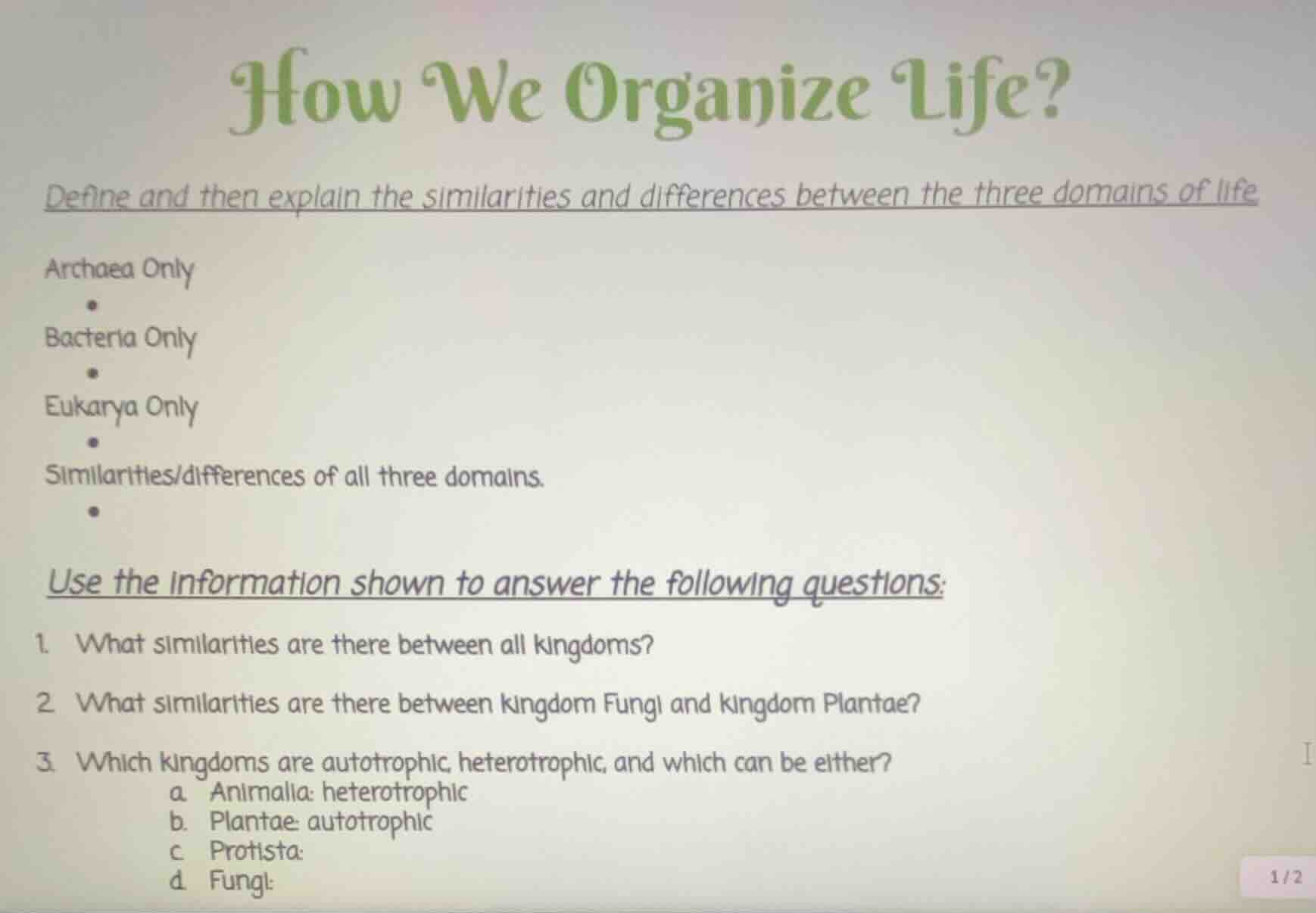
how we organize life?
define and then explain the similarities and differences between the three domains of life.
archaea only
bacteria only
eukarya only
similarities/differences of all three domains.
use the information shown to answer the following questions:
- what similarities are there between all kingdoms?
- what similarities are there between kingdom fungi and kingdom plantae?
- which kingdoms are autotrophic, heterotrophic, and which can be either?
a. animalia: heterotrophic
b. plantae: autotrophic
c. protista:
d. fungi:
Identify similarities among all kingdoms
To find similarities among all taxonomic kingdoms, we look at the fundamental characteristics shared by all living organisms. Using the Taxonomic Kingdoms knowledge point, all kingdoms (Archaebacteria, Eubacteria, Protista, Fungi, Plantae, Animalia) consist of cells, use DNA as genetic material, carry out cellular respiration, and reproduce.
Compare Fungi and Plantae
To compare Fungi and Plantae, we examine their cellular and structural features. Using the Taxonomic Kingdoms knowledge point, both kingdoms consist of eukaryotic organisms, are multicellular (with minor exceptions in fungi like yeast), and possess cell walls surrounding their cell membranes.
Classify nutritional modes of kingdoms
We classify the nutritional modes of the four eukaryotic kingdoms listed in the prompt:
- Animalia: Exclusively heterotrophic (ingest food).
- Plantae: Exclusively autotrophic (photosynthetic).
- Protista: Can be either autotrophic (e.g., algae) or heterotrophic (e.g., amoeba).
- Fungi: Exclusively heterotrophic (absorptive decomposers).

Snap & solve any problem in the app
Get step-by-step solutions on Sovi AI
Photo-based solutions with guided steps
Explore more problems and detailed explanations
Question 1
All taxonomic kingdoms share the following fundamental biological similarities:
- They are composed of one or more cells.
- They contain genetic material (DNA) to direct cellular functions.
- They perform metabolic processes to obtain and use energy.
- They are capable of reproduction and responding to their environment.
Question 2
The primary similarities between kingdom Fungi and kingdom Plantae are:
- Both are composed of eukaryotic cells.
- Both are primarily multicellular organisms.
- Both possess rigid cell walls (composed of chitin in fungi and cellulose in plants).
- Both are generally sessile (stationary) organisms.
Question 3
The nutritional classifications for the kingdoms are:
- Animalia: Heterotrophic
- Plantae: Autotrophic
- Protista: Either (can be autotrophic or heterotrophic)
- Fungi: Heterotrophic