QUESTION IMAGE
Question
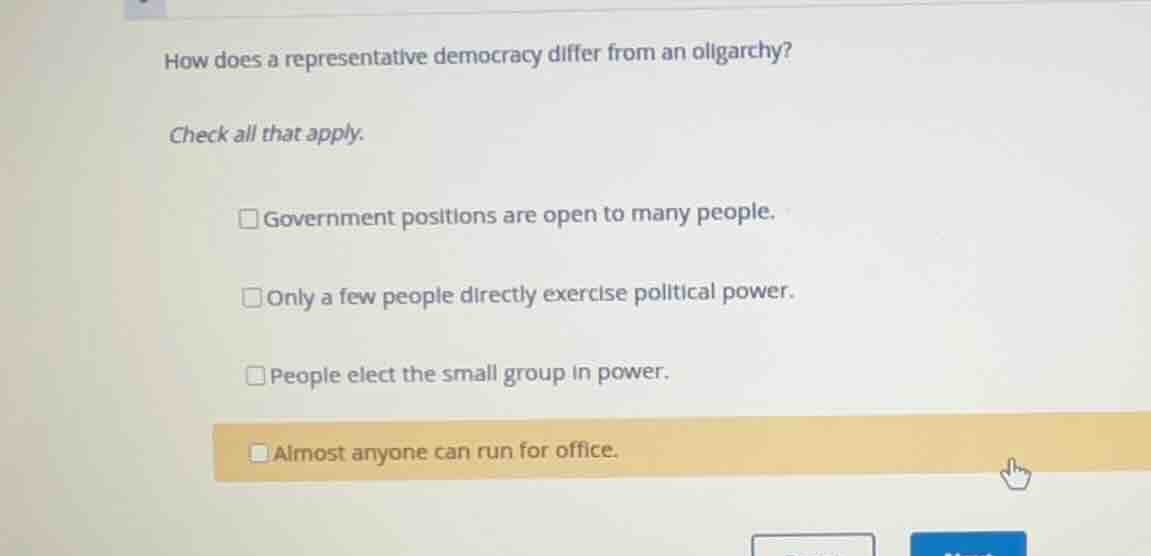
how does a representative democracy differ from an oligarchy?
check all that apply.
government positions are open to many people.
only a few people directly exercise political power.
people elect the small group in power.
almost anyone can run for office.
Define representative democracy and oligarchy
- Representative democracy: A system of government where citizens elect representatives to make laws and govern on their behalf, meaning government positions are open to many people and almost anyone can run for office.
- Oligarchy: A system where power is concentrated in the hands of a small, elite group of people, typically based on wealth, family, or military control, meaning positions are restricted to this small group.
Evaluate the given options
- "Government positions are open to many people": True. In a representative democracy, public offices are accessible to a broad segment of the population, unlike in an oligarchy where power is restricted to a select few.
- "Only a few people directly exercise political power": False. This is a characteristic of both systems (in a representative democracy, only the elected representatives directly exercise power, and in an oligarchy, only the small ruling group does). Thus, it does not distinguish them.
- "People elect the small group in power": True. In a representative democracy, the governing representatives are chosen through popular elections, whereas oligarchs typically inherit power or seize it without democratic elections.
- "Almost anyone can run for office": True. Broad eligibility to run for public office is a defining feature of representative democracy, contrasting sharply with the exclusive nature of an oligarchy.

Snap & solve any problem in the app
Get step-by-step solutions on Sovi AI
Photo-based solutions with guided steps
Explore more problems and detailed explanations
- Government positions are open to many people. (Correct answer)
- Only a few people directly exercise political power.
- People elect the small group in power. (Correct answer)
- Almost anyone can run for office. (Correct answer)