QUESTION IMAGE
Question
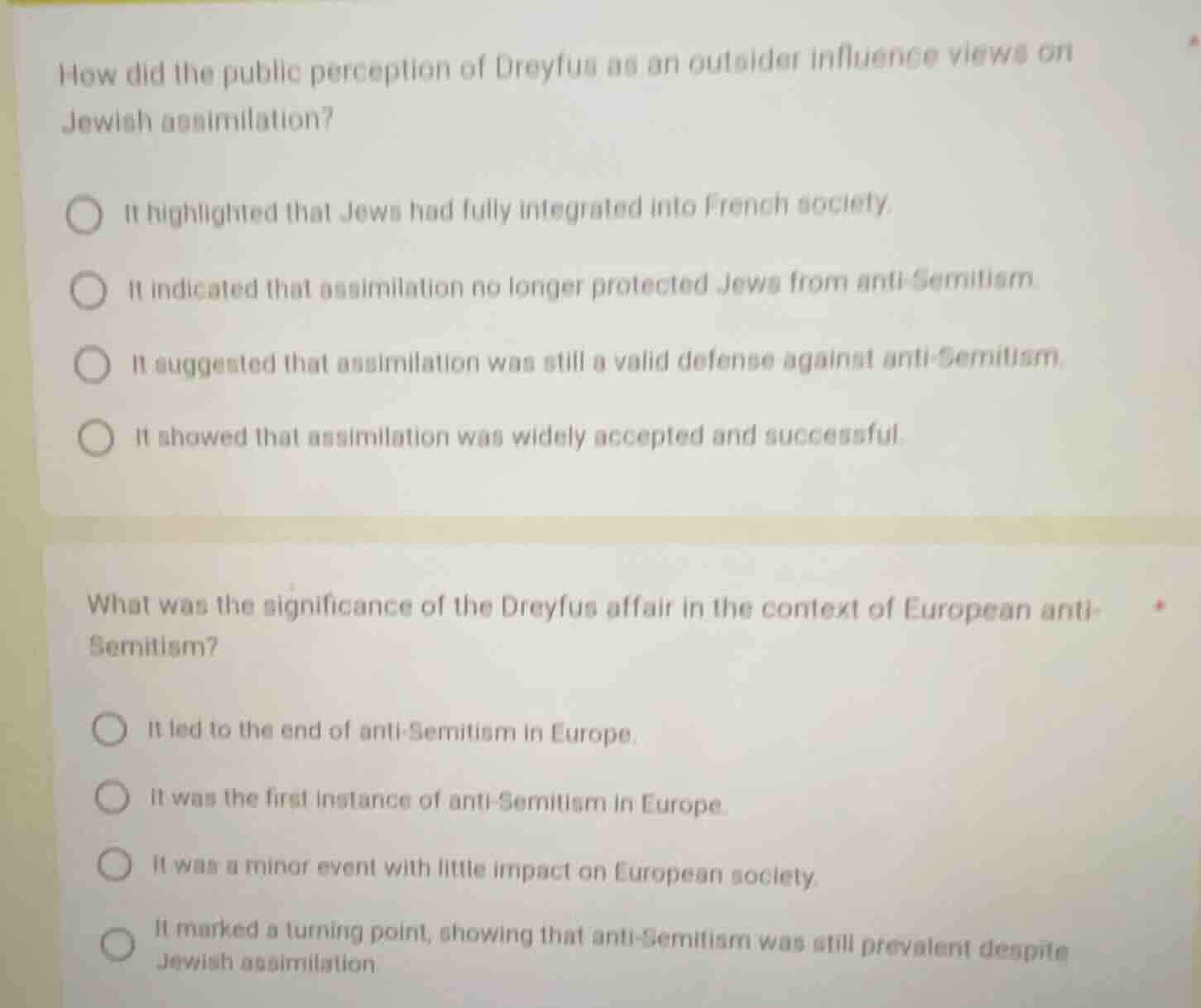
how did the public perception of dreyfus as an outsider influence views on jewish assimilation?
- it highlighted that jews had fully integrated into french society.
- it indicated that assimilation no longer protected jews from anti-semitism.
- it suggested that assimilation was still a valid defense against anti-semitism.
- it showed that assimilation was widely accepted and successful.
what was the significance of the dreyfus affair in the context of european anti-semitism?
- it led to the end of anti-semitism in europe.
- it was the first instance of anti-semitism in europe.
- it was a minor event with little impact on european society.
- it marked a turning point, showing that anti-semitism was still prevalent despite jewish assimilation.
Analyze public perception of Dreyfus
Using the Dreyfus Affair knowledge point, we analyze how Alfred Dreyfus, a highly integrated French Jewish officer, was framed as a traitor. This public perception as an "outsider" demonstrated that despite deep integration, Jewish citizens were still viewed with suspicion, indicating that assimilation no longer protected Jews from hostility.
Evaluate options for Question 1
Using the Historical Analysis knowledge point, we evaluate the choices for the first question:
- Option 1 suggests full integration, which the hostile public reaction contradicted.
- Option 2 correctly identifies that assimilation failed to protect Jews from anti-Semitic scapegoating.
- Option 3 and Option 4 are incorrect because the affair proved assimilation was not a reliable defense or universally accepted.
Analyze significance in European anti-Semitism
Using the Anti-Semitism knowledge point, we examine the broader European context. The Dreyfus Affair shocked observers (including Theodor Herzl) because it occurred in France—the home of liberty and Jewish emancipation—proving that modern anti-Semitism remained highly prevalent despite legal equality and cultural assimilation.
Evaluate options for Question 2
Using the Historical Analysis knowledge point, we evaluate the choices for the second question:
- Option 1 is historically false as anti-Semitism did not end.
- Option 2 is false because anti-Semitism had existed for centuries.
- Option 3 is incorrect because it was a major, highly divisive national and international crisis.
- Option 4 correctly identifies the affair as a turning point showing the persistence of anti-Semitism despite assimilation.

Snap & solve any problem in the app
Get step-by-step solutions on Sovi AI
Photo-based solutions with guided steps
Explore more problems and detailed explanations
Question 1
- (A) It highlighted that Jews had fully integrated into French society.
- (B) It indicated that assimilation no longer protected Jews from anti-Semitism. (Correct answer)
- (C) It suggested that assimilation was still a valid defense against anti-Semitism.
- (D) It showed that assimilation was widely accepted and successful.
Question 2
- (A) It led to the end of anti-Semitism in Europe.
- (B) It was the first instance of anti-Semitism in Europe.
- (C) It was a minor event with little impact on European society.
- (D) It marked a turning point, showing that anti-Semitism was still prevalent despite Jewish assimilation. (Correct answer)