QUESTION IMAGE
Question
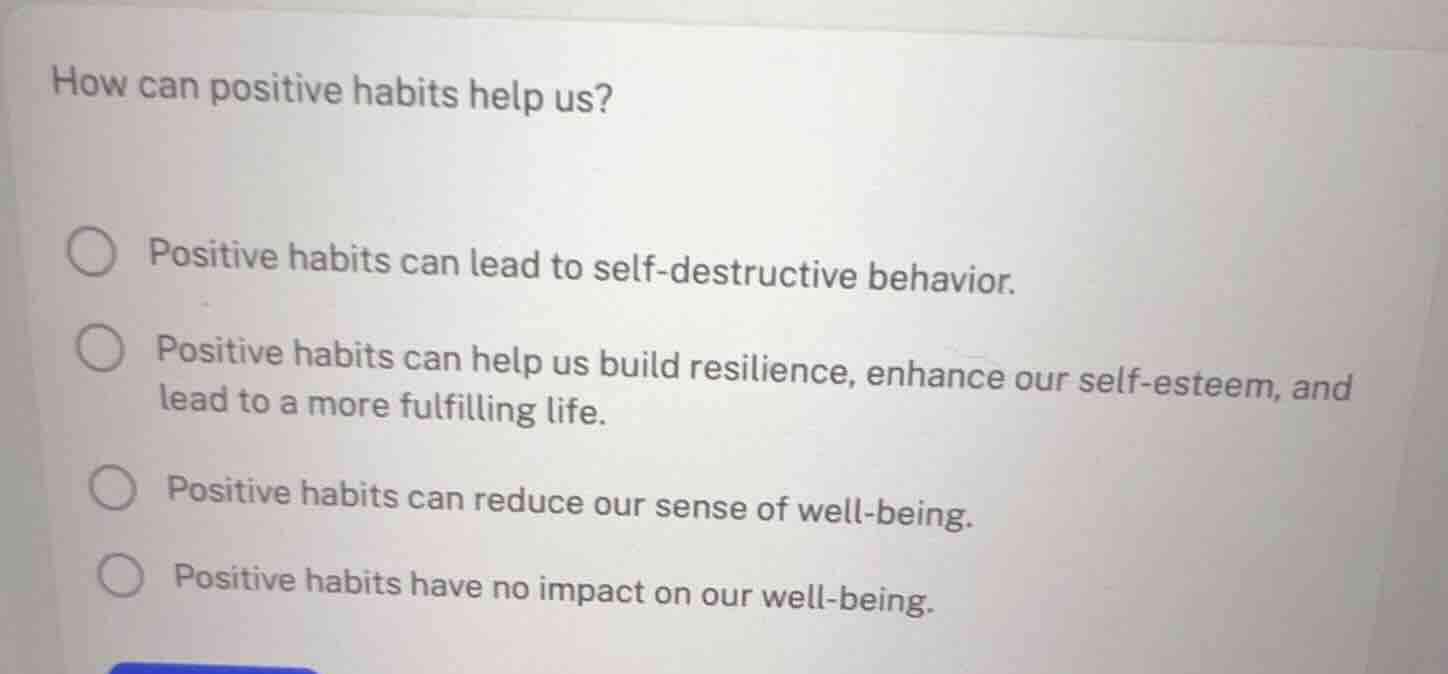
how can positive habits help us?
positive habits can lead to self-destructive behavior.
positive habits can help us build resilience, enhance our self-esteem, and lead to a more fulfilling life.
positive habits can reduce our sense of well-being.
positive habits have no impact on our well-being.
<pre_analysis>
{
"quality": "clear",
"question_count": 1,
"skills_matched": [
"direct_cot",
"multiple_choice_formatter",
"explain_then_answer",
"quick"
],
"needs_drawing": false,
"concepts_used": [],
"new_concepts": [
"Positive Habits",
"Well-Being"
],
"current_concepts": [
"Habit Modification",
"Subjective Well-Being",
"Positive Habits",
"Well-Being"
]
}
</pre_analysis>
<reasoning>
Analyze the question prompt
The question asks: "How can positive habits help us?" This requires identifying the beneficial outcomes of establishing constructive, healthy routines.
Evaluate the options
- Option 1: "Positive habits can lead to self-destructive behavior." This is incorrect because positive habits promote health and growth, whereas self-destructive behaviors are harmful.
- Option 2: "Positive habits can help us build resilience, enhance our self-esteem, and lead to a more fulfilling life." This is correct because positive habits foster mental strength, confidence, and overall life satisfaction.
- Option 3: "Positive habits can reduce our sense of well-being." This is incorrect because positive habits improve, rather than reduce, well-being.
- Option 4: "Positive habits have no impact on our well-being." This is incorrect because habits significantly shape daily life and mental health.
Select the correct option
Option 2 is the only choice that accurately describes the beneficial effects of positive habits.
</reasoning>
<answer>
<mcq-option>(A) Positive habits can lead to self-destructive behavior.</mcq-option>
<mcq-correct>(B) Positive habits can help us build resilience, enhance our self-esteem, and lead to a more fulfilling life.</mcq-correct>
<mcq-option>(C) Positive habits can reduce our sense of well-being.</mcq-option>
<mcq-option>(D) Positive habits have no impact on our well-being.</mcq-option>
</answer>
<post_analysis>
{
"subject": "Social Science",
"question_type": "Multiple Choice",
"knowledge_point": [
"Social Science",
"Psychology",
"Positive Psychology"
]
}
</post_analysis>
Snap & solve any problem in the app
Get step-by-step solutions on Sovi AI
Photo-based solutions with guided steps
Explore more problems and detailed explanations
<pre_analysis>
{
"quality": "clear",
"question_count": 1,
"skills_matched": [
"direct_cot",
"multiple_choice_formatter",
"explain_then_answer",
"quick"
],
"needs_drawing": false,
"concepts_used": [],
"new_concepts": [
"Positive Habits",
"Well-Being"
],
"current_concepts": [
"Habit Modification",
"Subjective Well-Being",
"Positive Habits",
"Well-Being"
]
}
</pre_analysis>
<reasoning>
Analyze the question prompt
The question asks: "How can positive habits help us?" This requires identifying the beneficial outcomes of establishing constructive, healthy routines.
Evaluate the options
- Option 1: "Positive habits can lead to self-destructive behavior." This is incorrect because positive habits promote health and growth, whereas self-destructive behaviors are harmful.
- Option 2: "Positive habits can help us build resilience, enhance our self-esteem, and lead to a more fulfilling life." This is correct because positive habits foster mental strength, confidence, and overall life satisfaction.
- Option 3: "Positive habits can reduce our sense of well-being." This is incorrect because positive habits improve, rather than reduce, well-being.
- Option 4: "Positive habits have no impact on our well-being." This is incorrect because habits significantly shape daily life and mental health.
Select the correct option
Option 2 is the only choice that accurately describes the beneficial effects of positive habits.
</reasoning>
<answer>
<mcq-option>(A) Positive habits can lead to self-destructive behavior.</mcq-option>
<mcq-correct>(B) Positive habits can help us build resilience, enhance our self-esteem, and lead to a more fulfilling life.</mcq-correct>
<mcq-option>(C) Positive habits can reduce our sense of well-being.</mcq-option>
<mcq-option>(D) Positive habits have no impact on our well-being.</mcq-option>
</answer>
<post_analysis>
{
"subject": "Social Science",
"question_type": "Multiple Choice",
"knowledge_point": [
"Social Science",
"Psychology",
"Positive Psychology"
]
}
</post_analysis>