QUESTION IMAGE
Question
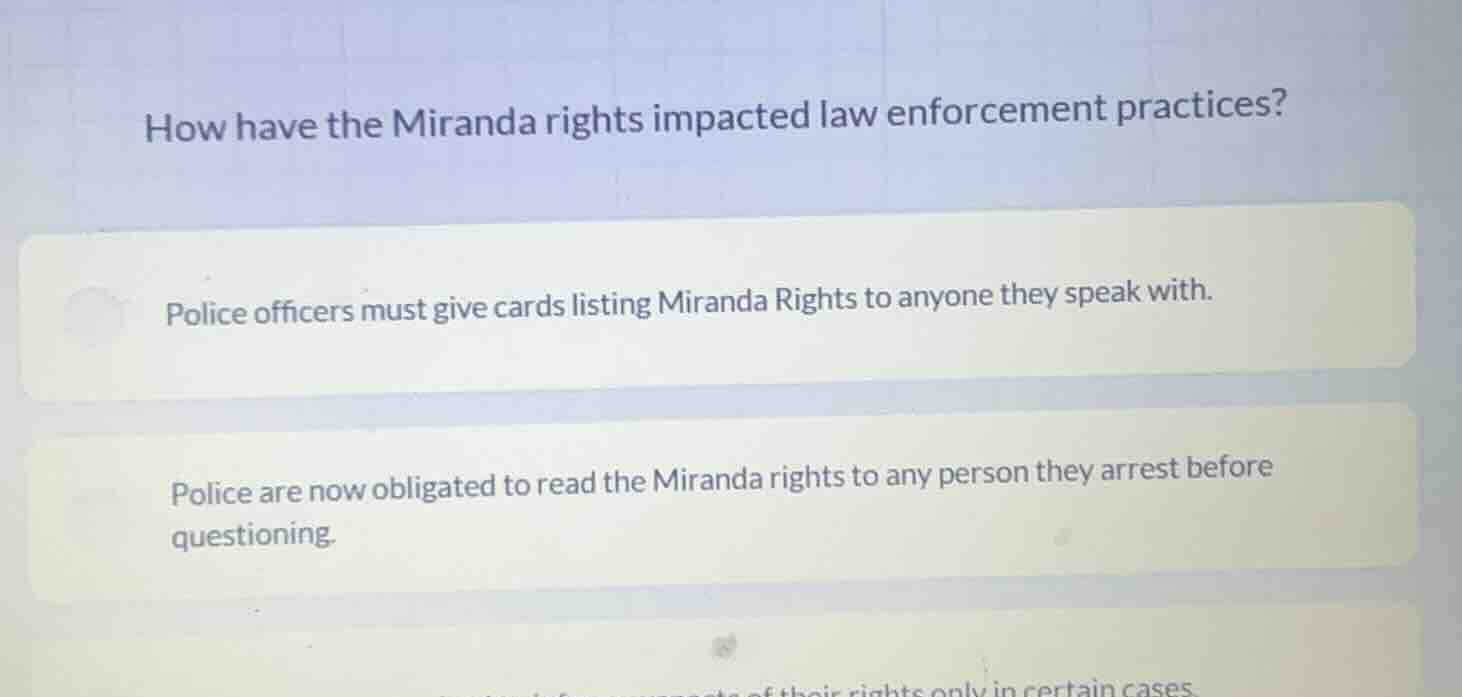
how have the miranda rights impacted law enforcement practices?
police officers must give cards listing miranda rights to anyone they speak with.
police are now obligated to read the miranda rights to any person they arrest before questioning.
Analyze the impact of Miranda v. Arizona
The landmark Supreme Court case Miranda v. Arizona (1966) established that law enforcement must advise suspects of their constitutional rights prior to custodial interrogation. This is a crucial component of Due Process to protect individuals from self-incrimination.
Evaluate the first option
The first option states that police must give cards listing Miranda rights to anyone they speak with. This is incorrect because officers are not required to read or hand out rights during casual, non-custodial conversations.
Evaluate the second option
The second option states that police are now obligated to read the Miranda rights to any person they arrest before questioning. This is correct because the legal requirement for a Miranda warning is triggered by "custodial interrogation"—when a suspect is under arrest (in custody) and subject to questioning.
Evaluate the third option
The third option (partially visible) suggests police inform suspects of their rights only in certain cases. While custody and interrogation must both be present, the second option provides the most accurate and standard description of how Miranda rights have systematically changed law enforcement arrest and interrogation procedures.

Snap & solve any problem in the app
Get step-by-step solutions on Sovi AI
Photo-based solutions with guided steps
Explore more problems and detailed explanations
- Police officers must give cards listing Miranda Rights to anyone they speak with.
- Police are now obligated to read the Miranda rights to any person they arrest before questioning. (Correct answer)
- Police are required to inform suspects of their rights only in certain cases.