QUESTION IMAGE
Question
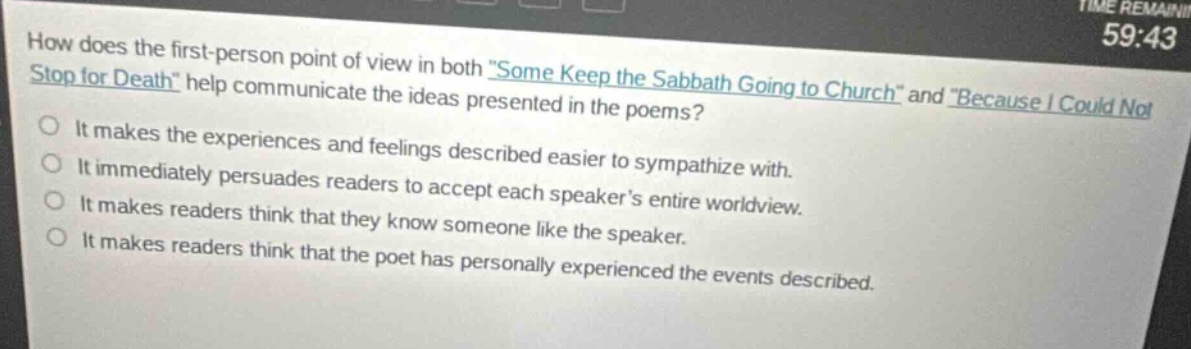
how does the first-person point of view in both \some keep the sabbath going to church\ and \because i could not stop for death\ help communicate the ideas presented in the poems?
- it makes the experiences and feelings described easier to sympathize with.
- it immediately persuades readers to accept each speakers entire worldview.
- it makes readers think that they know someone like the speaker.
- it makes readers think that the poet has personally experienced the events described.
⚡ Using what you learned: point of view: first, second, and third person
Step 1: Analyze the role of first-person point of view
First-person point of view uses pronouns like "I" and "we" to share a speaker's direct, personal thoughts, feelings, and observations. By presenting the narrative through a personal lens, it creates an intimate connection between the speaker and the reader.
Step 2: Evaluate the options
- Option 1: "It makes the experiences and feelings described easier to sympathize with."
By sharing personal reflections directly ("I keep the Sabbath...", "Because I could not stop for Death..."), the reader is invited directly into the speaker's inner world, making their unique perspectives on faith and mortality highly relatable and empathetic. This is the primary literary function of first-person narration in these poems.
- Option 2: "It immediately persuades readers to accept each speaker's entire worldview."
First-person perspective offers a subjective view, but it does not automatically force or guarantee that a reader will adopt or agree with that entire worldview.
- Option 3: "It makes readers think that they know someone like the speaker."
While it makes the speaker feel real, the primary goal of the poetic perspective is emotional resonance and understanding of the themes, not familiarity with a similar person in real life.
- Option 4: "It makes readers think that the poet has personally experienced the events described."
In literature, the speaker of a poem is distinct from the biographical poet. For example, in "Because I Could Not Stop for Death," the speaker is a spirit reflecting on their own death and carriage ride with Immortality—an event the living poet Emily Dickinson could not have literally experienced and reported on.

Snap & solve any problem in the app
Get step-by-step solutions on Sovi AI
Photo-based solutions with guided steps
Explore more problems and detailed explanations
It makes the experiences and feelings described easier to sympathize with.