Sovi.AI - AI Math Tutor

Scan to solve math questions

QUESTION IMAGE

how does diction affect setting? by revealing the authors purpose in wr…

Question

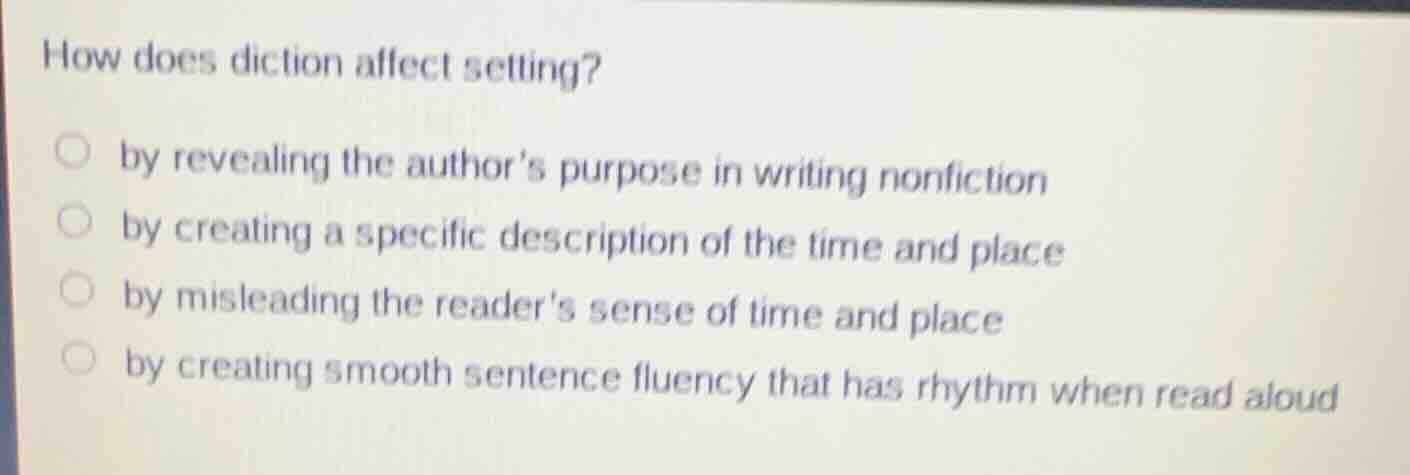
how does diction affect setting?

by revealing the authors purpose in writing nonfiction
by creating a specific description of the time and place
by misleading the readers sense of time and place
by creating smooth sentence fluency that has rhythm when read aloud

Explanation:

Response

<pre_analysis>
{
"quality": "clear",
"question_count": 1,
"skills_matched": [
"direct_cot",
"multiple_choice_formatter",
"explain_then_answer",
"tutor",
"mastery_adaptive_brevity"
],
"needs_drawing": false,
"concepts_used": [
"Diction",
"Setting Analysis"
],
"new_concepts": [],
"current_concepts": [
"Diction",
"Setting Analysis"
]
}
</pre_analysis>

<reasoning>

Define the relationship between diction and setting

Using the Diction and Setting Analysis knowledge points

  • Diction refers to the author's specific choice and use of words and phrases in writing.
  • Setting encompasses the physical location, historical period, and social environment in which a story takes place.
  • By choosing specific, evocative words (diction), an author paints a vivid picture that establishes and describes the precise time and place (setting) of the narrative.

Evaluate the given options

  • Option 1: "by revealing the author's purpose in writing nonfiction" — Incorrect. Diction can help reveal purpose, but this does not describe how it specifically affects the setting.
  • Option 2: "by creating a specific description of the time and place" — Correct. Precise word choices directly construct the sensory details and atmosphere of the setting.
  • Option 3: "by misleading the reader's sense of time and place" — Incorrect. While possible in unreliable narration, this is not the primary or standard function of diction in establishing setting.
  • Option 4: "by creating smooth sentence fluency that has rhythm when read aloud" — Incorrect. This describes syntax and prose rhythm rather than how word choice builds a setting.

</reasoning>

<answer>
<mcq-option>by revealing the author's purpose in writing nonfiction</mcq-option>
<mcq-correct>by creating a specific description of the time and place</mcq-correct>
<mcq-option>by misleading the reader's sense of time and place</mcq-option>
<mcq-option>by creating smooth sentence fluency that has rhythm when read aloud</mcq-option>
</answer>

<post_analysis>
{
"subject": "Arts",
"question_type": "Multiple Choice",
"knowledge_point": [
"Arts",
"Literary Analysis",
"Setting Analysis"
]
}
</post_analysis>

Answer:

<pre_analysis>
{
"quality": "clear",
"question_count": 1,
"skills_matched": [
"direct_cot",
"multiple_choice_formatter",
"explain_then_answer",
"tutor",
"mastery_adaptive_brevity"
],
"needs_drawing": false,
"concepts_used": [
"Diction",
"Setting Analysis"
],
"new_concepts": [],
"current_concepts": [
"Diction",
"Setting Analysis"
]
}
</pre_analysis>

<reasoning>

Define the relationship between diction and setting

Using the Diction and Setting Analysis knowledge points

  • Diction refers to the author's specific choice and use of words and phrases in writing.
  • Setting encompasses the physical location, historical period, and social environment in which a story takes place.
  • By choosing specific, evocative words (diction), an author paints a vivid picture that establishes and describes the precise time and place (setting) of the narrative.

Evaluate the given options

  • Option 1: "by revealing the author's purpose in writing nonfiction" — Incorrect. Diction can help reveal purpose, but this does not describe how it specifically affects the setting.
  • Option 2: "by creating a specific description of the time and place" — Correct. Precise word choices directly construct the sensory details and atmosphere of the setting.
  • Option 3: "by misleading the reader's sense of time and place" — Incorrect. While possible in unreliable narration, this is not the primary or standard function of diction in establishing setting.
  • Option 4: "by creating smooth sentence fluency that has rhythm when read aloud" — Incorrect. This describes syntax and prose rhythm rather than how word choice builds a setting.

</reasoning>

<answer>
<mcq-option>by revealing the author's purpose in writing nonfiction</mcq-option>
<mcq-correct>by creating a specific description of the time and place</mcq-correct>
<mcq-option>by misleading the reader's sense of time and place</mcq-option>
<mcq-option>by creating smooth sentence fluency that has rhythm when read aloud</mcq-option>
</answer>

<post_analysis>
{
"subject": "Arts",
"question_type": "Multiple Choice",
"knowledge_point": [
"Arts",
"Literary Analysis",
"Setting Analysis"
]
}
</post_analysis>