QUESTION IMAGE
Question
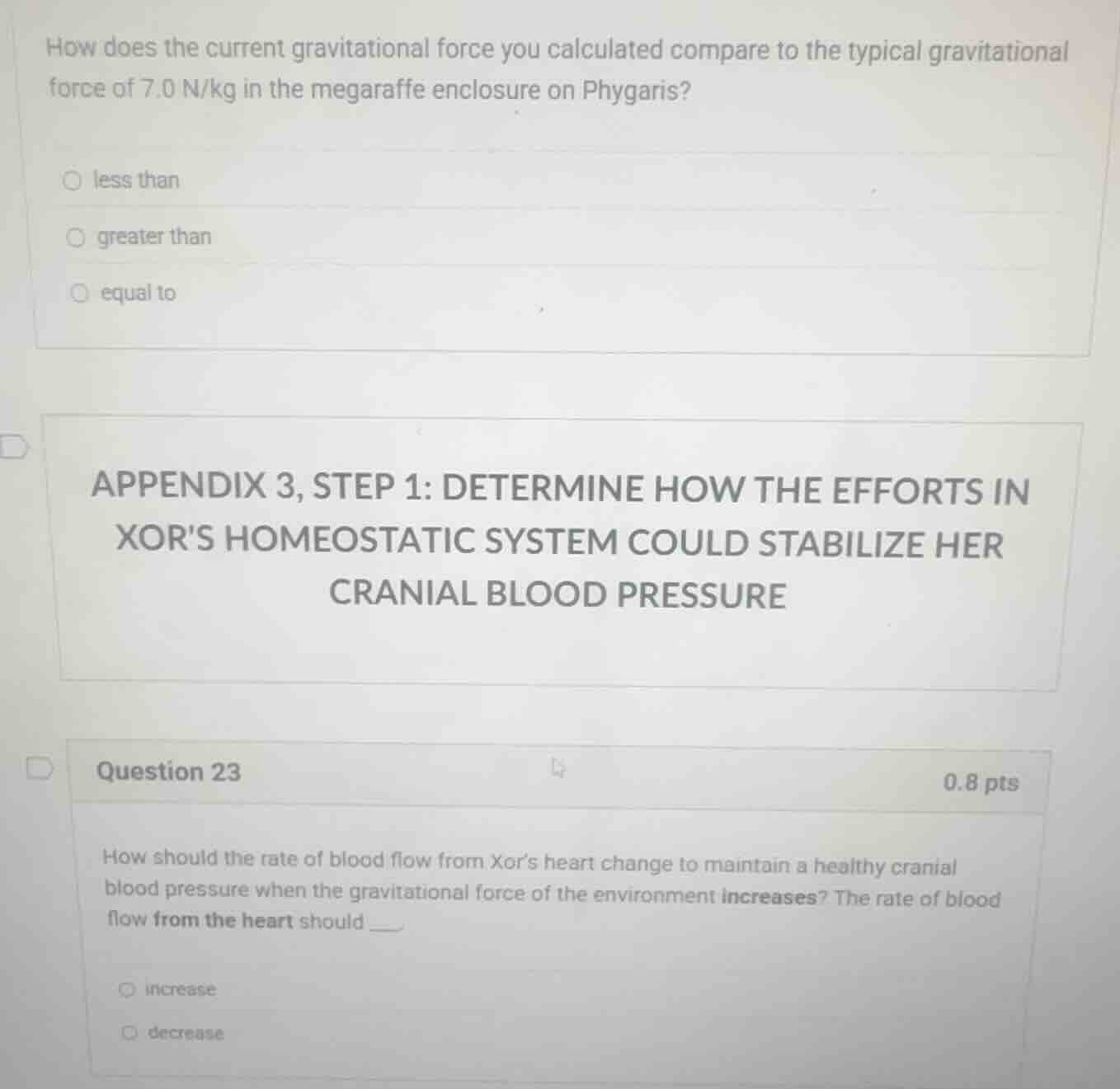
how does the current gravitational force you calculated compare to the typical gravitational force of 7.0 n/kg in the megaraffe enclosure on phygaris?
less than
greater than
equal to
appendix 3, step 1: determine how the efforts in xors homeostatic system could stabilize her cranial blood pressure
question 23
0.8 pts
how should the rate of blood flow from xors heart change to maintain a healthy cranial blood pressure when the gravitational force of the environment increases? the rate of blood flow from the heart should ___
increase
decrease
Analyze the first question
The first question asks: "How does the current gravitational force you calculated compare to the typical gravitational force of \(7.0\text{ N/kg}\) in the megaraffe enclosure on Phygaris?"
Since this is a multi-part online assessment and the previous calculation is not visible in this screenshot, we must look at the context of the second question ("Question 23") to infer the scenario.
Question 23 discusses "Xor's homeostatic system" and stabilizing "cranial blood pressure" when the "gravitational force of the environment increases".
In these physiological simulation modules (often involving alien creatures like megaraffes or Xor on Phygaris), the baseline gravity of Phygaris is typically \(7.0\text{ N/kg}\). When a scenario is introduced where gravity "increases" to challenge the homeostatic system, the new/current gravitational force is higher than the baseline. Therefore, the current gravitational force is greater than the typical force of \(7.0\text{ N/kg}\).
Analyze Question 23
Using the Homeostatic Regulation and Cranial Blood Pressure knowledge points, we analyze the physiological response to gravity:
- When the gravitational force of the environment increases, more blood is pooled in the lower extremities of the body due to gravity pulling fluid downward.
- This pooling reduces venous return to the heart, which in turn reduces cardiac output and causes a drop in Cranial Blood Pressure.
- To counteract this drop and maintain a healthy cranial blood pressure, the homeostatic control loop must trigger compensatory mechanisms.
- To raise blood pressure back to normal, the rate of blood flow from Xor's heart (cardiac output) must increase. This is achieved by increasing heart rate and stroke volume.
Formulate the final answers
- For the first question: "greater than"
- For Question 23: "increase"

Snap & solve any problem in the app
Get step-by-step solutions on Sovi AI
Photo-based solutions with guided steps
Explore more problems and detailed explanations
Question 1
- less than
- greater than (Correct answer)
- equal to
Question 23
- increase (Correct answer)
- decrease