QUESTION IMAGE
Question
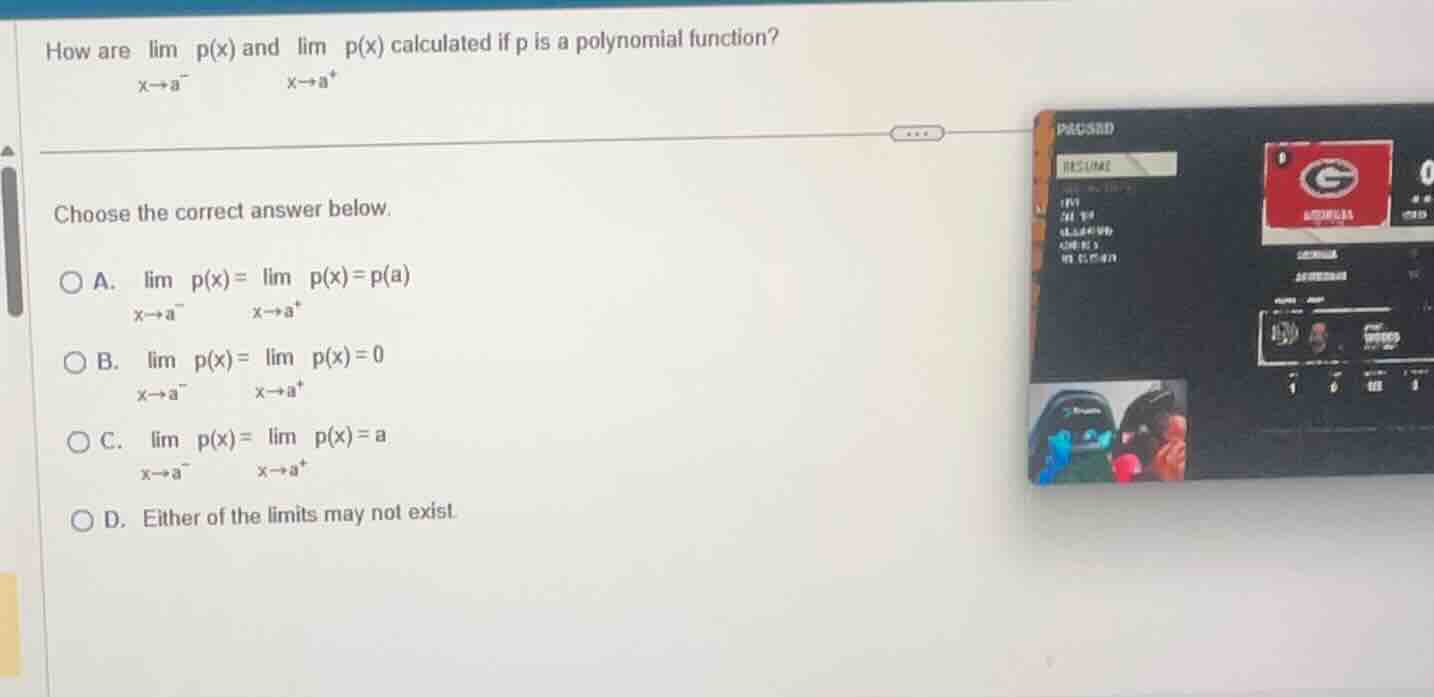
how are \\(\lim_{x \to a^-} p(x)\\) and \\(\lim_{x \to a^+} p(x)\\) calculated if \\(p\\) is a polynomial function?
choose the correct answer below.
a. \\(\lim_{x \to a^-} p(x) = \lim_{x \to a^+} p(x) = p(a)\\)
b. \\(\lim_{x \to a^-} p(x) = \lim_{x \to a^+} p(x) = 0\\)
c. \\(\lim_{x \to a^-} p(x) = \lim_{x \to a^+} p(x) = a\\)
d. either of the limits may not exist.
Identify the properties of polynomial functions
Polynomial functions are continuous everywhere on the real line \(\mathbb{R}\).
Apply the definition of continuity
For any polynomial function \(p(x)\) and any real number \(a\):
Relate to one-sided limits
Since the two-sided limit exists and equals \(p(a)\), both the left-hand and right-hand limits must exist and equal this same value:

Snap & solve any problem in the app
Get step-by-step solutions on Sovi AI
Photo-based solutions with guided steps
Explore more problems and detailed explanations
- (A) \(\lim_{x \to a^-} p(x) = \lim_{x \to a^+} p(x) = p(a)\) (Correct answer)
- (B) \(\lim_{x \to a^-} p(x) = \lim_{x \to a^+} p(x) = 0\)
- (C) \(\lim_{x \to a^-} p(x) = \lim_{x \to a^+} p(x) = a\)
- (D) Either of the limits may not exist.