QUESTION IMAGE
Question
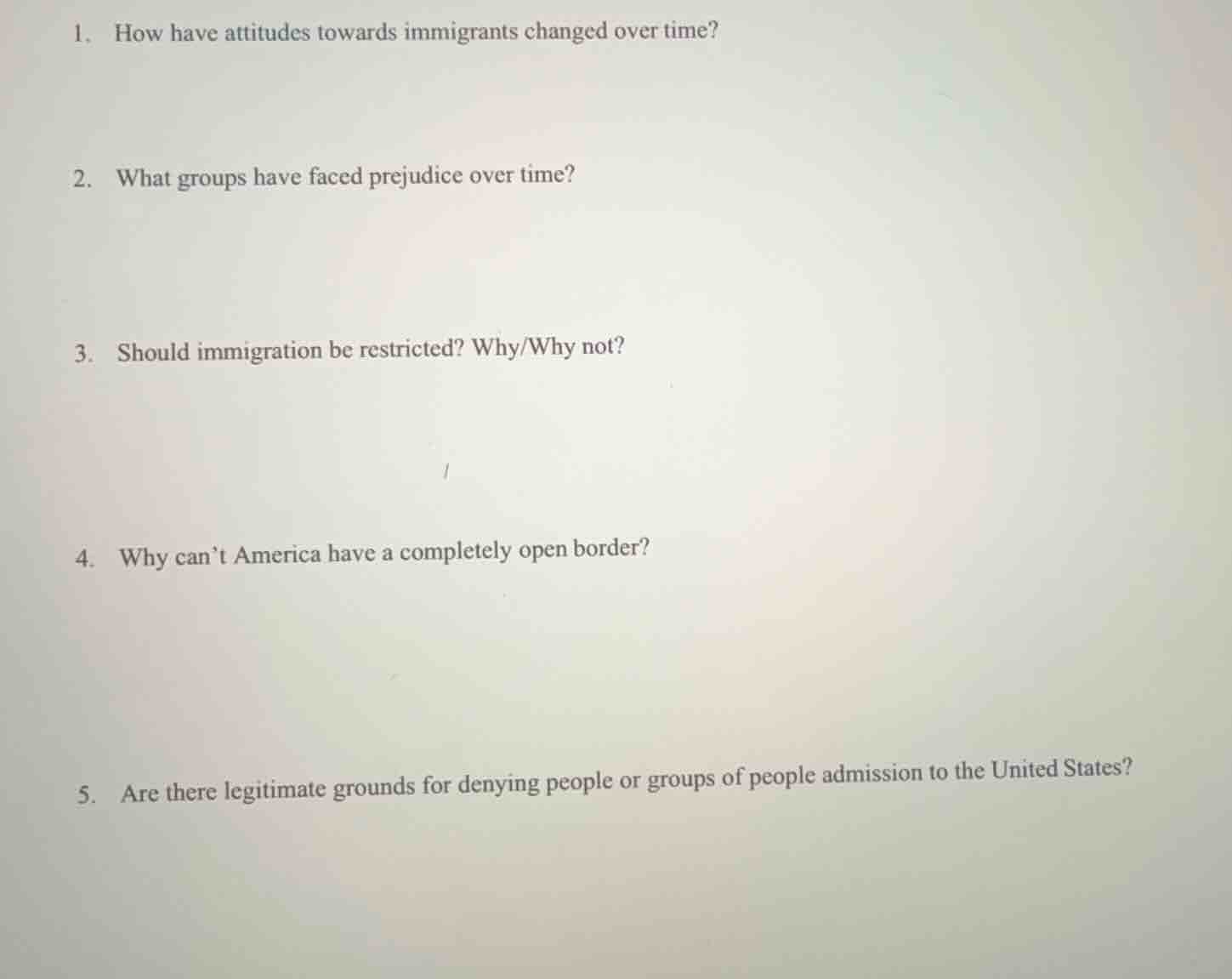
- how have attitudes towards immigrants changed over time?
- what groups have faced prejudice over time?
- should immigration be restricted? why/why not?
- why cant america have a completely open border?
- are there legitimate grounds for denying people or groups of people admission to the united states?
Question 1
Attitudes toward immigrants have evolved. Initially, some welcomed for labor, then nativist sentiments (e.g., against Irish, Chinese) rose. Later, with civil rights, more acceptance, but post - 9/11, security concerns led to stricter views, and recently, debates on diversity vs. economic impact.
Over time, many groups faced prejudice: racial (African Americans, Asian Americans), ethnic (Irish, Italian immigrants), religious (Jews, Muslims), LGBTQ+ community, and disabled people. Each faced discrimination in employment, housing, and social rights.
This is debated. For restriction: to control population, protect jobs, national security, and cultural identity. Against: immigrants contribute to economy (taxes, labor), enrich culture, and the US is a nation of immigrants. Morally, restricting can be seen as unjust, but practical concerns exist.

Snap & solve any problem in the app
Get step-by-step solutions on Sovi AI
Photo-based solutions with guided steps
Explore more problems and detailed explanations
Attitudes evolved: from labor - driven acceptance, to nativist prejudice (e.g., against Irish, Chinese), to more acceptance with civil rights, then post - 9/11 security - based strictness, and recent diversity - economic debates.