QUESTION IMAGE
Question
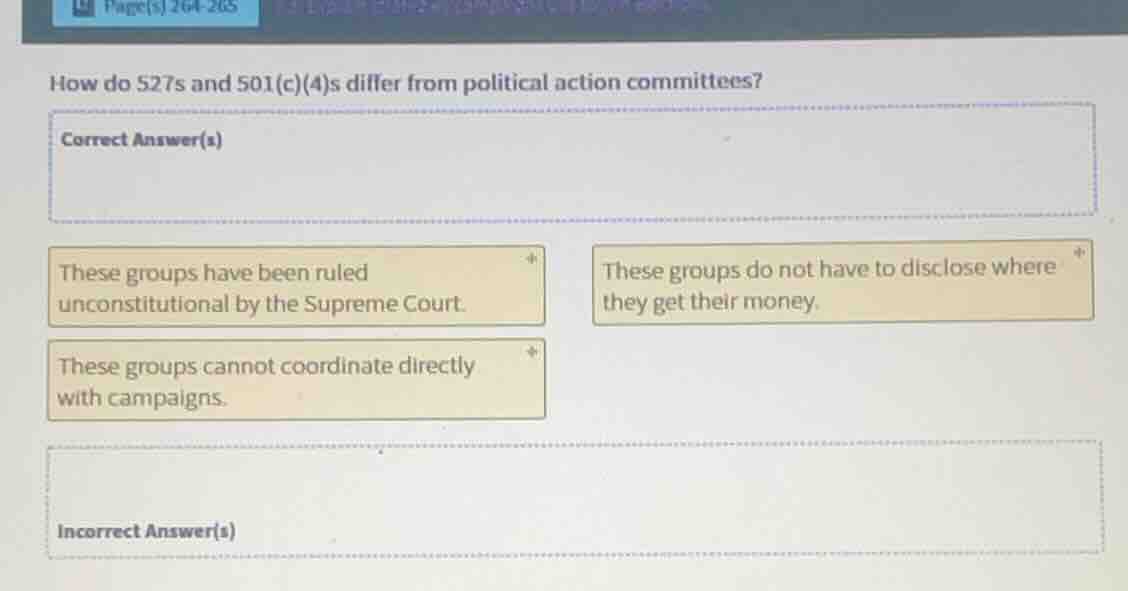
how do 527s and 501(c)(4)s differ from political action committees?
correct answer(s)
these groups have been ruled unconstitutional by the supreme court.
these groups do not have to disclose where they get their money.
these groups cannot coordinate directly with campaigns.
incorrect answer(s)
Analyze campaign coordination rules
Unlike traditional Political Action Committees (PACs), which can contribute directly to candidates and coordinate with campaigns under strict limits, 527s and 501(c)(4)s are independent expenditure-only groups. They are legally prohibited from coordinating directly with official political campaigns or candidates.
Analyze disclosure requirements
Traditional PACs must disclose their donors to the Federal Election Commission (FEC). While 527s also disclose donors, 501(c)(4) organizations (social welfare organizations) do not have to publicly disclose their donors, allowing for "dark money" in politics. Therefore, the statement regarding non-disclosure of funding sources does not apply to both 527s and 501(c)(4)s as a defining difference from PACs, because 527s must disclose.
Evaluate constitutionality
Neither 527s nor 501(c)(4)s have been ruled unconstitutional by the Supreme Court; they are active and legally protected vehicles for political spending.

Snap & solve any problem in the app
Get step-by-step solutions on Sovi AI
Photo-based solutions with guided steps
Explore more problems and detailed explanations
- These groups have been ruled unconstitutional by the Supreme Court.
- These groups cannot coordinate directly with campaigns. (Correct answer)
- These groups do not have to disclose where they get their money.