QUESTION IMAGE
Question
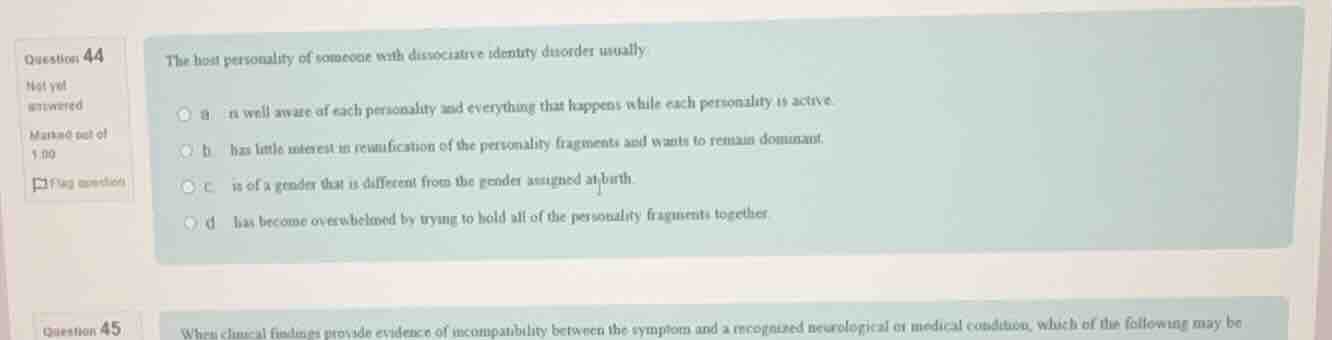
the host personality of someone with dissociative identity disorder usually
a. is well aware of each personality and everything that happens while each personality is active.
b. has little interest in reunification of the personality fragments and wants to remain dominant.
c. is of a gender that is different from the gender assigned at birth.
d. has become overwhelmed by trying to hold all of the personality fragments together.
<pre_analysis>
{
"quality": "clear",
"question_count": 1,
"skills_matched": [
"direct_cot",
"multiple_choice_formatter",
"explain_then_answer",
"quick"
],
"needs_drawing": false,
"concepts_used": [
"Dissociative Identity Disorder Identifying Features"
],
"new_concepts": [],
"current_concepts": [
"Dissociative Identity Disorder Identifying Features",
"Dissociative Identity Disorder"
]
}
</pre_analysis>
<reasoning>
Analyze the characteristics of the host identity in DID
In Dissociative Identity Disorder (DID), the "host" identity is the primary personality that carries the individual's given name and is active most of the time. This identity is typically passive, dependent, guilty, and depressed. Crucially, the host identity is usually overwhelmed by the attempt to keep the fragmented pieces of the self together and cope with the severe trauma that underlies the disorder.
Evaluate the given options
- Option (a) is incorrect because the host identity is typically unaware of the other alter personalities (one-way or mutual amnesia is common).
- Option (b) is incorrect because the host identity usually seeks help and desires integration/reunification, rather than actively resisting it to remain dominant.
- Option (c) is incorrect because there is no diagnostic requirement or typical pattern stating that the host identity must be of a different gender than the one assigned at birth.
- Option (d) is correct because the host identity is typically overwhelmed by the psychological burden of managing the fragmented personality structure.
</reasoning>
<answer>
<mcq-option>a. is well aware of each personality and everything that happens while each personality is active.</mcq-option>
<mcq-option>b. has little interest in reunification of the personality fragments and wants to remain dominant.</mcq-option>
<mcq-option>c. is of a gender that is different from the gender assigned at birth.</mcq-option>
<mcq-correct>d. has become overwhelmed by trying to hold all of the personality fragments together.</mcq-correct>
</answer>
<post_analysis>
{
"subject": "Natural Science",
"question_type": "Multiple Choice",
"knowledge_point": [
"Natural Science",
"Psychology",
"Dissociative Identity Disorder Identifying Features"
]
}
</post_analysis>
Snap & solve any problem in the app
Get step-by-step solutions on Sovi AI
Photo-based solutions with guided steps
Explore more problems and detailed explanations
<pre_analysis>
{
"quality": "clear",
"question_count": 1,
"skills_matched": [
"direct_cot",
"multiple_choice_formatter",
"explain_then_answer",
"quick"
],
"needs_drawing": false,
"concepts_used": [
"Dissociative Identity Disorder Identifying Features"
],
"new_concepts": [],
"current_concepts": [
"Dissociative Identity Disorder Identifying Features",
"Dissociative Identity Disorder"
]
}
</pre_analysis>
<reasoning>
Analyze the characteristics of the host identity in DID
In Dissociative Identity Disorder (DID), the "host" identity is the primary personality that carries the individual's given name and is active most of the time. This identity is typically passive, dependent, guilty, and depressed. Crucially, the host identity is usually overwhelmed by the attempt to keep the fragmented pieces of the self together and cope with the severe trauma that underlies the disorder.
Evaluate the given options
- Option (a) is incorrect because the host identity is typically unaware of the other alter personalities (one-way or mutual amnesia is common).
- Option (b) is incorrect because the host identity usually seeks help and desires integration/reunification, rather than actively resisting it to remain dominant.
- Option (c) is incorrect because there is no diagnostic requirement or typical pattern stating that the host identity must be of a different gender than the one assigned at birth.
- Option (d) is correct because the host identity is typically overwhelmed by the psychological burden of managing the fragmented personality structure.
</reasoning>
<answer>
<mcq-option>a. is well aware of each personality and everything that happens while each personality is active.</mcq-option>
<mcq-option>b. has little interest in reunification of the personality fragments and wants to remain dominant.</mcq-option>
<mcq-option>c. is of a gender that is different from the gender assigned at birth.</mcq-option>
<mcq-correct>d. has become overwhelmed by trying to hold all of the personality fragments together.</mcq-correct>
</answer>
<post_analysis>
{
"subject": "Natural Science",
"question_type": "Multiple Choice",
"knowledge_point": [
"Natural Science",
"Psychology",
"Dissociative Identity Disorder Identifying Features"
]
}
</post_analysis>