QUESTION IMAGE
Question
hi li ming:
i was moved by the chinese families handwritten letters you posted yesterday. they are priceless. could you please tell me a bit more about them? and are they currently on public display somewhere? i am keen to see them in person. thanks.
paul
you should write about 100 words on the answer sheet.
do not use your own name in the email. use \li ming\ instead. (10points)
part b
- directions:
write an essay based on the charts below. in your writing, you should
- describe the charts briefly,
- interpret the charts, and
- give your comments.
write your answer in 160-200 words on the answer sheet. (20 points)
🆕 New Concept Discovered: Chart-Based Essay Writing
Structuring data descriptions and interpretations systematically
Step 1: Analyze the prompt and data
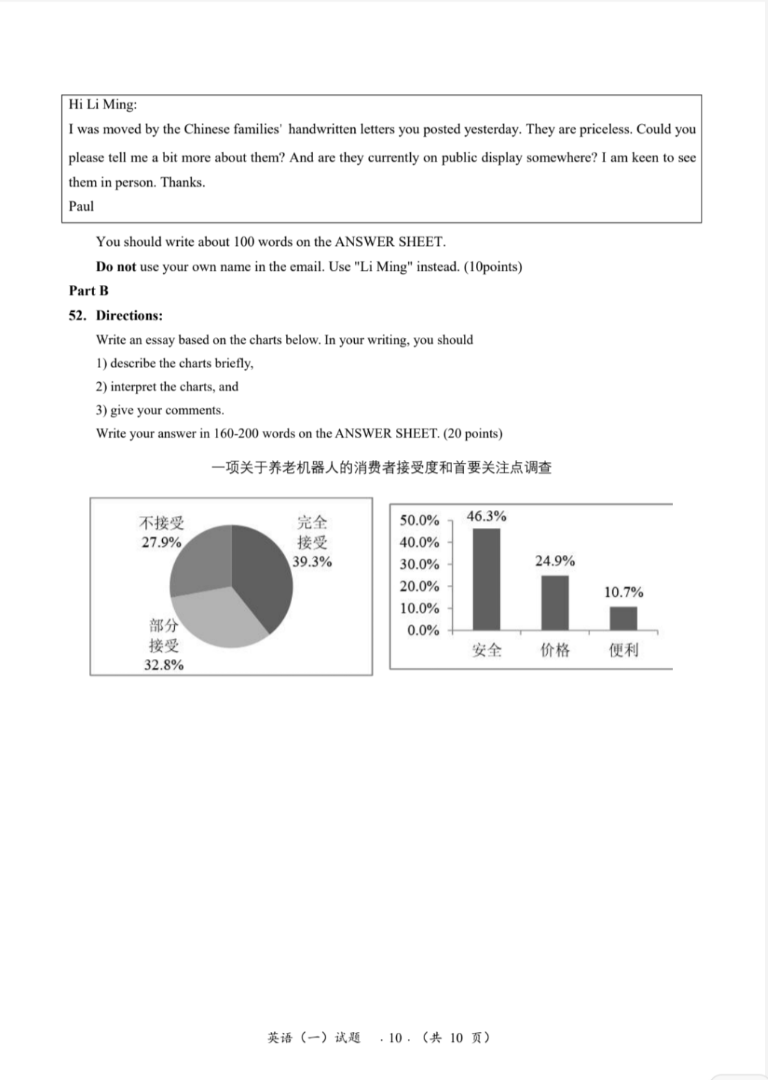
The task requires writing a 160–200 word essay based on two charts. The overall title of the survey is "一项关于养老机器人的消费者接受度和首要关注点调查" (A Survey on Consumer Acceptance and Primary Concerns Regarding Elder-Care Robots).
- Chart 1 (Pie Chart): Consumer Acceptance (消费者接受度)
- Fully accept (完全接受): \(39.3\%\)
- Partially accept (部分接受): \(32.8\%\)
- Do not accept (不接受): \(27.9\%\)
- Key takeaway: A significant majority (\(72.1\%\) combined) show some level of acceptance toward elder-care robots.
- Chart 2 (Bar Chart): Primary Concerns (首要关注点)
- Safety (安全): \(46.3\%\)
- Price (价格): \(24.9\%\)
- Convenience (便利): \(10.7\%\)
- Key takeaway: Safety is the most critical factor for consumers, followed by price and convenience.
Step 2: Structure the essay
A standard three-paragraph structure works best for academic chart-based essays:
- Paragraph 1: Describe the charts briefly. Introduce the topic of the survey and present the key data points from both the pie chart and the bar chart.
- Paragraph 2: Interpret the charts. Explain the underlying reasons behind these trends (e.g., why acceptance is high, and why safety is the top concern for elder-care technology).
- Paragraph 3: Give your comments. Provide a concluding thought on the future outlook of elder-care robots.
Step 3: Draft the essay
- Paragraph 1 (Description):
The charts present the findings of a survey regarding consumer attitudes toward elder-care robots. According to the pie chart, a combined majority of consumers welcome this technology, with \(39.3\%\) fully accepting it and \(32.8\%\) partially accepting it, while only \(27.9\%\) reject it. Meanwhile, the bar chart highlights consumers' primary concerns: safety ranks highest at \(46.3\%\), followed by price at \(24.9\%\) and convenience at \(10.7\%\).
- Paragraph 2 (Interpretation):
Several factors contribute to these trends. First, the high acceptance rate reflects the pressing demands of an aging society. With a shrinking workforce, robots offer a practical solution to assist the elderly with daily tasks. Second, the prominent concern over safety is highly reasonable. Because elder-care robots directly interact with vulnerable seniors, any mechanical malfunction or software glitch could lead to physical injuries. Additionally, the concern over price suggests that while people appreciate the technology, it must remain affordable to be widely adopted.
- Paragraph 3 (Comments):
In conclusion, elder-care robots hold immense potential to improve the quality of life for senior citizens. To ensure their widespread adoption, manufacturers must prioritize safety and cost-effectiveness. With continuous technological advancements, I am confident these robots will play an indispensable role in future elderly care.

Snap & solve any problem in the app
Get step-by-step solutions on Sovi AI
Photo-based solutions with guided steps
Explore more problems and detailed explanations
The charts present the findings of a survey regarding consumer attitudes toward elder-care robots. According to the pie chart, a combined majority of consumers welcome this technology, with \(39.3\%\) fully accepting it and \(32.8\%\) partially accepting it, while only \(27.9\%\) reject it. Meanwhile, the bar chart highlights consumers' primary concerns: safety ranks highest at \(46.3\%\), followed by price at \(24.9\%\) and convenience at \(10.7\%\).
Several factors contribute to these trends. First, the high acceptance rate reflects the pressing demands of an aging society. With a shrinking workforce, robots offer a practical solution to assist the elderly with daily tasks. Second, the prominent concern over safety is highly reasonable. Because elder-care robots directly interact with vulnerable seniors, any mechanical malfunction could lead to physical injuries. Additionally, the concern over price suggests that while people appreciate the technology, it must remain affordable to be widely adopted.
In conclusion, elder-care robots hold immense potential to improve the quality of life for senior citizens. To ensure their widespread adoption, manufacturers must prioritize safety and cost-effectiveness. With continuous technological advancements, I am confident these robots will play an indispensable role in future elderly care. (198 words)