Sovi.AI - AI Math Tutor

Scan to solve math questions

QUESTION IMAGE

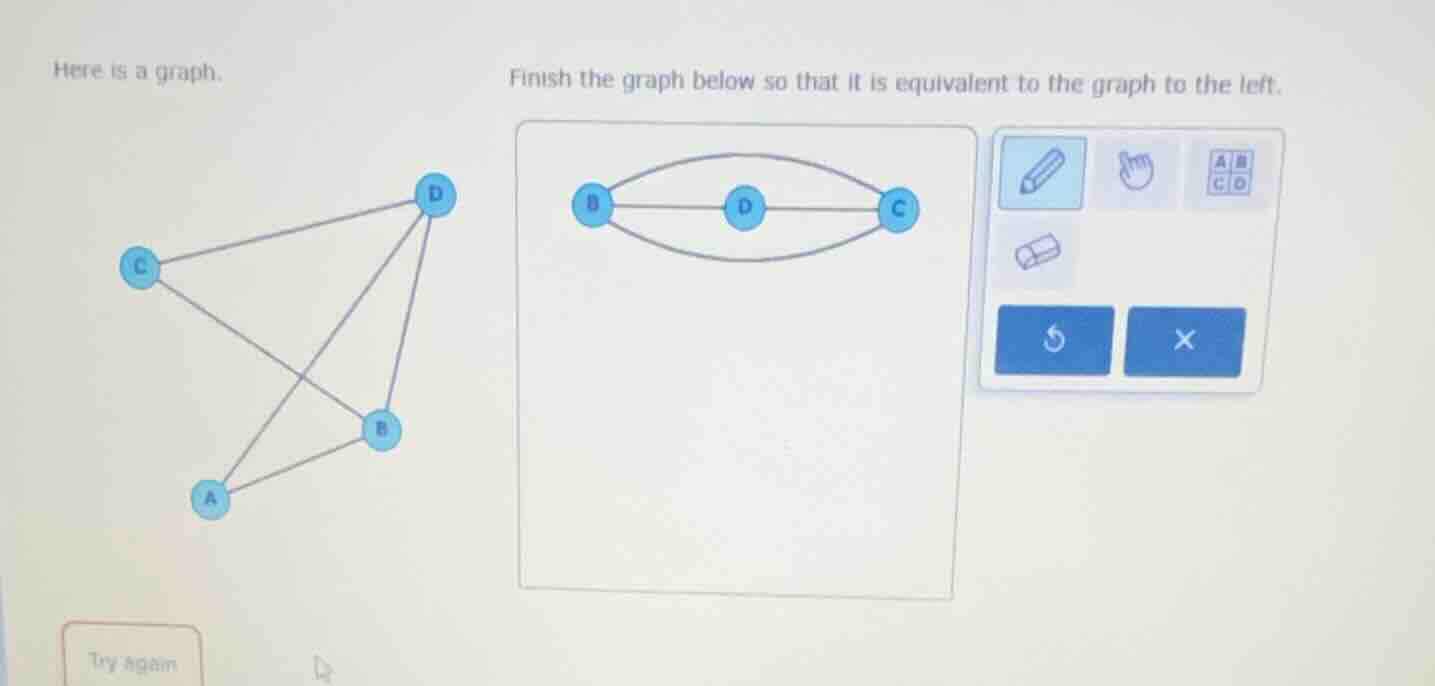
here is a graph. finish the graph below so that it is equivalent to the…

Question

here is a graph.
finish the graph below so that it is equivalent to the graph to the left.

Explanation:

Response

<pre_analysis>
{
"quality": "clear",
"question_count": 1,
"skills_matched": [
"step_cot",
"explain_then_answer",
"quick"
],
"needs_drawing": true,
"concepts_used": [
"Graph Vertices",
"Graph Edges"
],
"new_concepts": [
"Graph Isomorphism",
"Equivalent Graphs"
],
"current_concepts": [
"Graph Vertices",
"Graph Edges",
"Graph Isomorphism",
"Equivalent Graphs"
]
}
</pre_analysis>

<reasoning>

Identify the vertices and edges of the original graph

\[

$$\begin{aligned} V &= \{A, B, C, D\} \\ E &= \{\{A, B\}, \{A, D\}, \{B, C\}, \{B, D\}, \{C, D\}\} \end{aligned}$$

\]

Identify the existing elements in the target graph

\[

$$\begin{aligned} V_{\text{target}} &= \{B, C, D\} \quad (\text{with vertex } A \text{ missing}) \\ E_{\text{target}} &= \{\{B, D\}, \{C, D\}, \{B, C\} \text{ (two parallel edges between } B \text{ and } C\text{)}\} \end{aligned}$$

\]
Note: The original graph has only one edge between \(B\) and \(C\), but the target graph shows two curved edges and one straight line through \(D\) connecting \(B\) and \(C\). Specifically, the target graph has a straight segment \(B-D\), a straight segment \(D-C\), and two curved paths directly between \(B\) and \(C\). This means the connection \(B-D-C\) is already drawn, along with two direct edges between \(B\) and \(C\). To make the graphs equivalent, we must place vertex \(A\) and connect it to its adjacent vertices.

Determine the missing vertex and edges to complete the graph

\[

$$\begin{aligned} &\text{Missing Vertex: } A \\ &\text{Edges connected to } A \text{ in original graph: } \{A, B\}, \{A, D\} \\ &\text{Action: Place vertex } A \text{ (e.g., below } B \text{ and } D\text{) and draw segments } \{A, B\} \text{ and } \{A, D\}. \end{aligned}$$

\]
</reasoning>

<answer>
To finish the graph so that it is equivalent to the original graph on the left:

  1. Add the missing vertex \(A\) in the lower portion of the drawing area (below vertices \(B\), \(D\), and \(C\)).
  2. Draw an edge connecting vertex \(A\) to vertex \(B\).
  3. Draw an edge connecting vertex \(A\) to vertex \(D\).

</answer>

<plot>
{
"elements": [
{
"type": "point",
"params": [[-3, 1]],
"properties": {
"name": "B",
"size": 5,
"color": "#8C55F2",
"withLabel": true
}
},
{
"type": "point",
"params": [[0, 1]],
"properties": {
"name": "D",
"size": 5,
"color": "#8C55F2",
"withLabel": true
}
},
{
"type": "point",
"params": [[3, 1]],
"properties": {
"name": "C",
"size": 5,
"color": "#8C55F2",
"withLabel": true
}
},
{
"type": "point",
"params": [[-1.5, -2]],
"properties": {
"name": "A",
"size": 5,
"color": "#F2557F",
"withLabel": true
}
},
{
"type": "segment",
"params": [[-3, 1], [0, 1]],
"properties": {
"strokeColor": "#583C87",
"strokeWidth": 2
}
},
{
"type": "segment",
"params": [[0, 1], [3, 1]],
"properties": {
"strokeColor": "#583C87",
"strokeWidth": 2
}
},
{
"type": "curve",
"params": [
{
"x": { "js": "t", "latex": "t" },
"y": { "js": "1 + 0.5 (9 - tt)", "latex": "1 + 0.5(9-t^2)" }
},
-3,
3
],
"properties": {
"strokeColor": "#583C87",
"strokeWidth": 2
}
},
{
"type": "curve",
"param…

Answer:

<pre_analysis>
{
"quality": "clear",
"question_count": 1,
"skills_matched": [
"step_cot",
"explain_then_answer",
"quick"
],
"needs_drawing": true,
"concepts_used": [
"Graph Vertices",
"Graph Edges"
],
"new_concepts": [
"Graph Isomorphism",
"Equivalent Graphs"
],
"current_concepts": [
"Graph Vertices",
"Graph Edges",
"Graph Isomorphism",
"Equivalent Graphs"
]
}
</pre_analysis>

<reasoning>

Identify the vertices and edges of the original graph

\[

$$\begin{aligned} V &= \{A, B, C, D\} \\ E &= \{\{A, B\}, \{A, D\}, \{B, C\}, \{B, D\}, \{C, D\}\} \end{aligned}$$

\]

Identify the existing elements in the target graph

\[

$$\begin{aligned} V_{\text{target}} &= \{B, C, D\} \quad (\text{with vertex } A \text{ missing}) \\ E_{\text{target}} &= \{\{B, D\}, \{C, D\}, \{B, C\} \text{ (two parallel edges between } B \text{ and } C\text{)}\} \end{aligned}$$

\]
Note: The original graph has only one edge between \(B\) and \(C\), but the target graph shows two curved edges and one straight line through \(D\) connecting \(B\) and \(C\). Specifically, the target graph has a straight segment \(B-D\), a straight segment \(D-C\), and two curved paths directly between \(B\) and \(C\). This means the connection \(B-D-C\) is already drawn, along with two direct edges between \(B\) and \(C\). To make the graphs equivalent, we must place vertex \(A\) and connect it to its adjacent vertices.

Determine the missing vertex and edges to complete the graph

\[

$$\begin{aligned} &\text{Missing Vertex: } A \\ &\text{Edges connected to } A \text{ in original graph: } \{A, B\}, \{A, D\} \\ &\text{Action: Place vertex } A \text{ (e.g., below } B \text{ and } D\text{) and draw segments } \{A, B\} \text{ and } \{A, D\}. \end{aligned}$$

\]
</reasoning>

<answer>
To finish the graph so that it is equivalent to the original graph on the left:

  1. Add the missing vertex \(A\) in the lower portion of the drawing area (below vertices \(B\), \(D\), and \(C\)).
  2. Draw an edge connecting vertex \(A\) to vertex \(B\).
  3. Draw an edge connecting vertex \(A\) to vertex \(D\).

</answer>

<plot>
{
"elements": [
{
"type": "point",
"params": [[-3, 1]],
"properties": {
"name": "B",
"size": 5,
"color": "#8C55F2",
"withLabel": true
}
},
{
"type": "point",
"params": [[0, 1]],
"properties": {
"name": "D",
"size": 5,
"color": "#8C55F2",
"withLabel": true
}
},
{
"type": "point",
"params": [[3, 1]],
"properties": {
"name": "C",
"size": 5,
"color": "#8C55F2",
"withLabel": true
}
},
{
"type": "point",
"params": [[-1.5, -2]],
"properties": {
"name": "A",
"size": 5,
"color": "#F2557F",
"withLabel": true
}
},
{
"type": "segment",
"params": [[-3, 1], [0, 1]],
"properties": {
"strokeColor": "#583C87",
"strokeWidth": 2
}
},
{
"type": "segment",
"params": [[0, 1], [3, 1]],
"properties": {
"strokeColor": "#583C87",
"strokeWidth": 2
}
},
{
"type": "curve",
"params": [
{
"x": { "js": "t", "latex": "t" },
"y": { "js": "1 + 0.5 (9 - tt)", "latex": "1 + 0.5(9-t^2)" }
},
-3,
3
],
"properties": {
"strokeColor": "#583C87",
"strokeWidth": 2
}
},
{
"type": "curve",
"params": [
{
"x": { "js": "t", "latex": "t" },
"y": { "js": "1 - 0.5 (9 - tt)", "latex": "1 - 0.5(9-t^2)" }
},
-3,
3
],
"properties": {
"strokeColor": "#583C87",
"strokeWidth": 2
}
},
{
"type": "segment",
"params": [[-1.5, -2], [-3, 1]],
"properties": {
"strokeColor": "#F2557F",
"strokeWidth": 3,
"dash": 2
}
},
{
"type": "segment",
"params": [[-1.5, -2], [0, 1]],
"properties": {
"strokeColor": "#F2557F",
"strokeWidth": 3,
"dash": 2
}
}
],
"timestamps": [0.5, 1.0, 1.5]
}
</plot>

<post_analysis>
{
"subject": "Mathematics",
"question_type": "Free Response",
"knowledge_point": [
"Mathematics",
"Geometry",
"Graph Isomorphism"
]
}
</post_analysis>