QUESTION IMAGE
Question
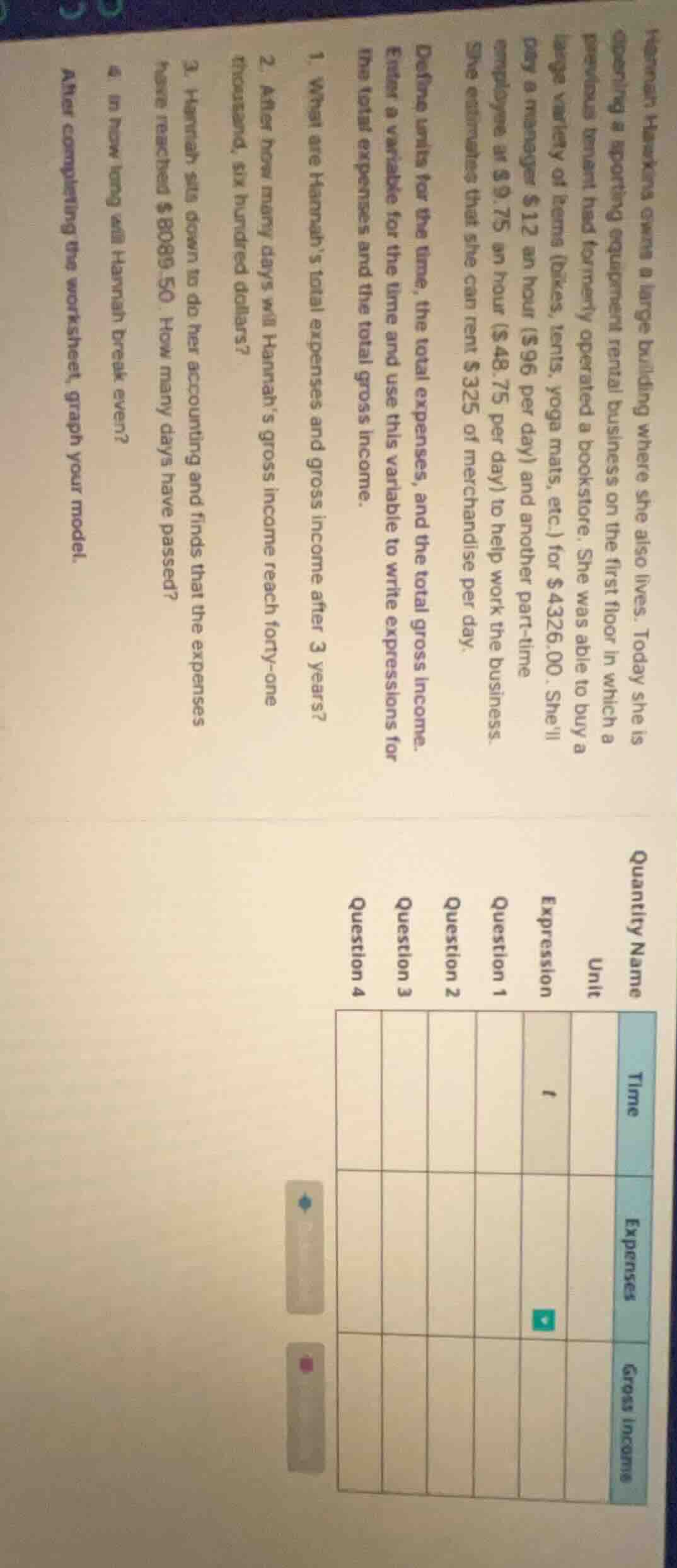
hannah hawkins owns a large building where she also lives. today she is operating a sporting equipment rental business on the first floor in which a previous tenant had formerly operated a bookstore. she was able to buy a large variety of items (bikes, tents, yoga mats, etc.) for $4326.00. she’ll pay a manager $12 an hour ($96 per day) and another part - time employee at $9.75 an hour ($48.75 per day) to help work the business. she estimates that she can rent $325 of merchandise per day.
- what are hannah’s total expenses and gross income after 3 years?
- after how many days will hannah’s gross income reach forty - one thousand, six hundred dollars?
- hannah, sits down to do her accounting and finds that the expenses have reached $8089.50. how many days have passed?
- in how long will hannah break even?
after completing the worksheet, graph your model.
quantity name\tunit\texpression\tquestion 1\tquestion 2\tquestion 3\tquestion 4
time\t\t1\t\t\t\t
expenses\t\t\t\t\t\t
gross income\t\t\t\t\t\t
To solve the problem, we first define the variable and then establish the expressions for total expenses and gross income.
Step 1: Define the variable
Let \( t \) be the number of days.
Step 2: Calculate total expenses per day
Hannah pays a manager \( \$12 \) per hour and another part - time employee \( \$9.75 \) per hour. Assuming an 8 - hour workday (since the part - time employee's daily pay is given as \( \$48.75\) and \( 9.75\times5 = 48.75\), wait, maybe the workday is 5 hours for the part - time? Wait, the problem says "a manager \$12 an hour (\$96 per day)" - so \( 12\times8=96\), so the manager works 8 hours a day. And the part - time employee: \( 9.75\times5 = 48.75\), so 5 hours a day. Also, she estimates she can rent \$325 of merchandise per day. Wait, no, the expenses: the manager's daily pay is \$96, the part - time's daily pay is \$48.75, and is there any other expense? Wait, the problem says "she was able to buy a large variety of items (bikes, tents, yoga mats, etc.) for \$4326.00". Wait, maybe that's a one - time expense? But the problem is about daily operations? Wait, maybe the total expenses per day are the sum of the manager's daily pay, the part - time's daily pay. Let's re - read:
"She’ll pay a manager \$12 an hour (\$96 per day) and another part - time employee at \$9.75 an hour (\$48.75 per day) to help work the business. She estimates that she can rent \$325 of merchandise per day."
Wait, the expenses: the labor costs (manager and part - time) and is the \$4326 a one - time cost (like initial investment) or is it amortized? The problem is a bit unclear, but maybe for the purpose of daily operations, the total daily expenses LXI0 are the sum of the manager's daily pay and the part - time's daily pay. So LXI1 dollars per day. And the gross income per day LXI2 dollars (from renting merchandise). Wait, no, gross income is the revenue, so if she rents \$325 of merchandise per day, that's her gross income per day. And the total expenses per day are the labor costs (manager and part - time) plus any other costs? Wait, the \$4326 is a one - time cost for buying the items. Maybe we can consider it as a fixed cost, but the problem is about daily operations for now.
Wait, let's re - establish:
- Let \( t \) be the number of days.
- Total Expenses (\( E \)):
The manager's daily pay is \$96, the part - time employee's daily pay is \$48.75. So the total daily operating expenses (labor) are \( 96+48.75 = 144.75\) dollars per day. If we consider the \$4326 as a fixed cost (initial investment), but maybe in the context of the problem, we are to consider the daily operating expenses and the gross income. Wait, the problem says "total expenses" and "total gross income". Let's assume that the total expenses \( E(t)\) consist of the daily operating expenses (labor) times the number of days plus the fixed cost of \$4326. And the gross income \( G(t)\) is the daily gross income times the number of days.
So:
- Total Expenses: \( E(t)=4326 + 144.75t\)
- Total Gross Income: \( G(t)=325t\)
Step 1: Hannah's total expenses and gross income after 3 years
First, we need to find the number of days in 3 years. Assuming a non - leap year has 365 days, 3 years have \( 3\times365 = 1095\) days.
- Total Expenses after 3 years (\( t = 1095\))
\( E(1095)=4326+144.75\times1095\)
First, calculate \( 144.75\times1095\):
\( 144.75\times1095=144.75\times(1000 + 95)=144.75\times1000+144.75\times95=144750+13751.25 = 158501.25\)
Then \( E(1095)=4326 + 158501.25=162827.25\)
- **Total Gross Inc…

Snap & solve any problem in the app
Get step-by-step solutions on Sovi AI
Photo-based solutions with guided steps
Explore more problems and detailed explanations
To solve the problem, we first define the variable and then establish the expressions for total expenses and gross income.
Step 1: Define the variable
Let \( t \) be the number of days.
Step 2: Calculate total expenses per day
Hannah pays a manager \( \$12 \) per hour and another part - time employee \( \$9.75 \) per hour. Assuming an 8 - hour workday (since the part - time employee's daily pay is given as \( \$48.75\) and \( 9.75\times5 = 48.75\), wait, maybe the workday is 5 hours for the part - time? Wait, the problem says "a manager \$12 an hour (\$96 per day)" - so \( 12\times8=96\), so the manager works 8 hours a day. And the part - time employee: \( 9.75\times5 = 48.75\), so 5 hours a day. Also, she estimates she can rent \$325 of merchandise per day. Wait, no, the expenses: the manager's daily pay is \$96, the part - time's daily pay is \$48.75, and is there any other expense? Wait, the problem says "she was able to buy a large variety of items (bikes, tents, yoga mats, etc.) for \$4326.00". Wait, maybe that's a one - time expense? But the problem is about daily operations? Wait, maybe the total expenses per day are the sum of the manager's daily pay, the part - time's daily pay. Let's re - read:
"She’ll pay a manager \$12 an hour (\$96 per day) and another part - time employee at \$9.75 an hour (\$48.75 per day) to help work the business. She estimates that she can rent \$325 of merchandise per day."
Wait, the expenses: the labor costs (manager and part - time) and is the \$4326 a one - time cost (like initial investment) or is it amortized? The problem is a bit unclear, but maybe for the purpose of daily operations, the total daily expenses LXI0 are the sum of the manager's daily pay and the part - time's daily pay. So LXI1 dollars per day. And the gross income per day LXI2 dollars (from renting merchandise). Wait, no, gross income is the revenue, so if she rents \$325 of merchandise per day, that's her gross income per day. And the total expenses per day are the labor costs (manager and part - time) plus any other costs? Wait, the \$4326 is a one - time cost for buying the items. Maybe we can consider it as a fixed cost, but the problem is about daily operations for now.
Wait, let's re - establish:
- Let \( t \) be the number of days.
- Total Expenses (\( E \)):
The manager's daily pay is \$96, the part - time employee's daily pay is \$48.75. So the total daily operating expenses (labor) are \( 96+48.75 = 144.75\) dollars per day. If we consider the \$4326 as a fixed cost (initial investment), but maybe in the context of the problem, we are to consider the daily operating expenses and the gross income. Wait, the problem says "total expenses" and "total gross income". Let's assume that the total expenses \( E(t)\) consist of the daily operating expenses (labor) times the number of days plus the fixed cost of \$4326. And the gross income \( G(t)\) is the daily gross income times the number of days.
So:
- Total Expenses: \( E(t)=4326 + 144.75t\)
- Total Gross Income: \( G(t)=325t\)
Step 1: Hannah's total expenses and gross income after 3 years
First, we need to find the number of days in 3 years. Assuming a non - leap year has 365 days, 3 years have \( 3\times365 = 1095\) days.
- Total Expenses after 3 years (\( t = 1095\))
\( E(1095)=4326+144.75\times1095\)
First, calculate \( 144.75\times1095\):
\( 144.75\times1095=144.75\times(1000 + 95)=144.75\times1000+144.75\times95=144750+13751.25 = 158501.25\)
Then \( E(1095)=4326 + 158501.25=162827.25\)
- Total Gross Income after 3 years (\( t = 1095\))
\( G(1095)=325\times1095\)
\( 325\times1095=(300 + 25)\times1095=300\times1095+25\times1095=328500+27375 = 355875\)
Step 2: Number of days to reach gross income of \$41600 (forty - one thousand, six hundred)
We set \( G(t)=41600\), and \( G(t) = 325t\)
So, \( 325t=41600\)
\( t=\frac{41600}{325}=\frac{41600\div25}{325\div25}=\frac{1664}{13} = 128\) days.
Step 3: Number of days when expenses are \$8089.50
We set \( E(t)=8089.50\), and \( E(t)=4326+144.75t\)
\( 4326+144.75t=8089.50\)
Subtract 4326 from both sides:
\( 144.75t=8089.50 - 4326=3763.50\)
\( t=\frac{3763.50}{144.75}=\frac{376350}{14475}=\frac{376350\div14475}{14475\div14475}=26\) days.
Step 4: Break - even time
Break - even occurs when total expenses equal total gross income, i.e., \( E(t)=G(t)\)
\( 4326+144.75t=325t\)
Subtract \( 144.75t\) from both sides:
\( 4326=325t - 144.75t=180.25t\)
\( t=\frac{4326}{180.25}=\frac{4326\times100}{18025}=\frac{432600}{18025}=\frac{432600\div25}{18025\div25}=\frac{17304}{721}\approx24\) days (wait, \( 180.25\times24 = 4326\), yes! Because \( 180.25\times24=(180+\ 0.25)\times24=180\times24 + 0.25\times24=4320 + 6=4326\))
Final Answers
- After 3 years (1095 days), total expenses \( E(1095)=162827.25\) dollars and total gross income \( G(1095) = 355875\) dollars.
- The number of days to reach a gross income of \$41600 is \( t = 128\) days.
- The number of days when expenses are \$8089.50 is \( t = 26\) days.
- The break - even time is \( t = 24\) days.