QUESTION IMAGE
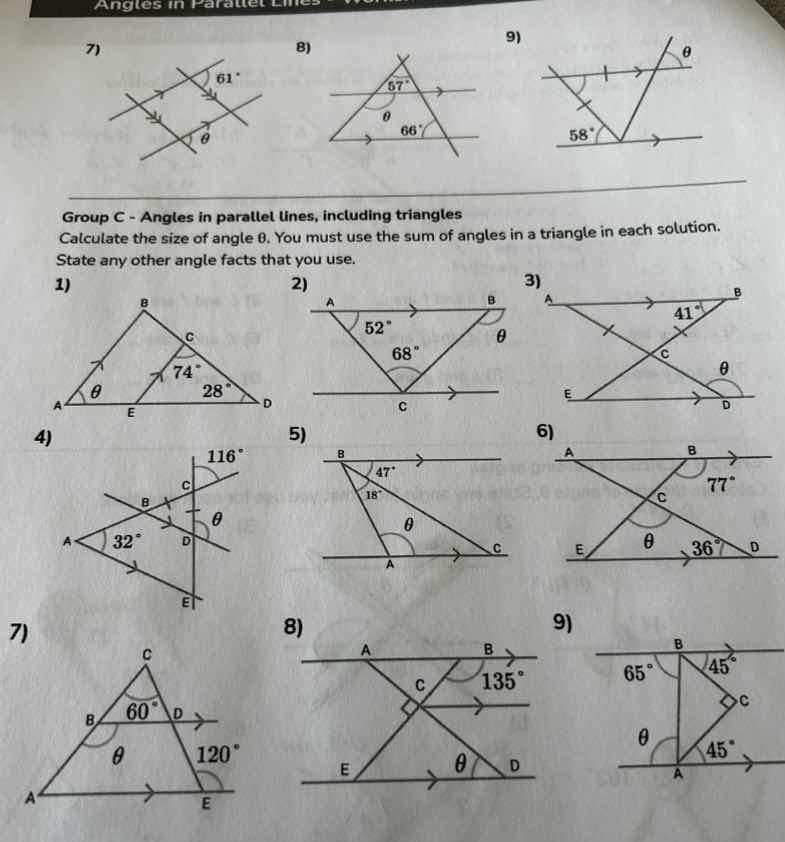
Question
group c - angles in parallel lines, including triangles
calculate the size of angle \\(\theta\\). you must use the sum of angles in a triangle in each solution.
state any other angle facts that you use.
1)
\\(\theta\\), \\(74^\circ\\), \\(28^\circ\\)
2)
\\(52^\circ\\), \\(68^\circ\\), \\(\theta\\)
3)
\\(41^\circ\\), \\(\theta\\)
4)
\\(32^\circ\\), \\(116^\circ\\), \\(\theta\\)
5)
\\(47^\circ\\), \\(18^\circ\\), \\(\theta\\)
6)
\\(77^\circ\\), \\(36^\circ\\), \\(\theta\\)
7)
\\(60^\circ\\), \\(120^\circ\\), \\(\theta\\)
8)
\\(135^\circ\\), \\(\theta\\)
9)
\\(65^\circ\\), \\(45^\circ\\), \\(45^\circ\\), \\(\theta\\)
Solve Question 1
Using the Parallel Line Angles and Angle Relationships knowledge points
Solve Question 2
Using the Parallel Line Angles and Angle Relationships knowledge points
Solve Question 3
Using the Parallel Line Angles and Angle Relationships knowledge points
Solve Question 4
Using the Parallel Line Angles and Angle Relationships knowledge points
Solve Question 5
We need to find \(\theta\) in Question 5.
First, let's identify the angles in \(\triangle ABC\).
The top line containing \(B\) is parallel to the bottom line containing \(A\) and \(C\).
Thus, the alternate interior angle to \(\angle ABC\) is \(\angle BAA'\) (where \(A'\) is to the left on the bottom line).
Specifically, \(\angle BAC\) and the angle of \(47^\circ + 18^\circ = 65^\circ\) at \(B\) are alternate interior angles:
In \(\triangle ABC\), the sum of angles is \(180^\circ\):
Since \(\angle ABC = 47^\circ\):
Now, looking at the triangle containing \(\theta\), which is \(\triangle PAC\) (where \(P\) is the point on the segment \(AB\))…

Snap & solve any problem in the app
Get step-by-step solutions on Sovi AI
Photo-based solutions with guided steps
Explore more problems and detailed explanations