QUESTION IMAGE
Question
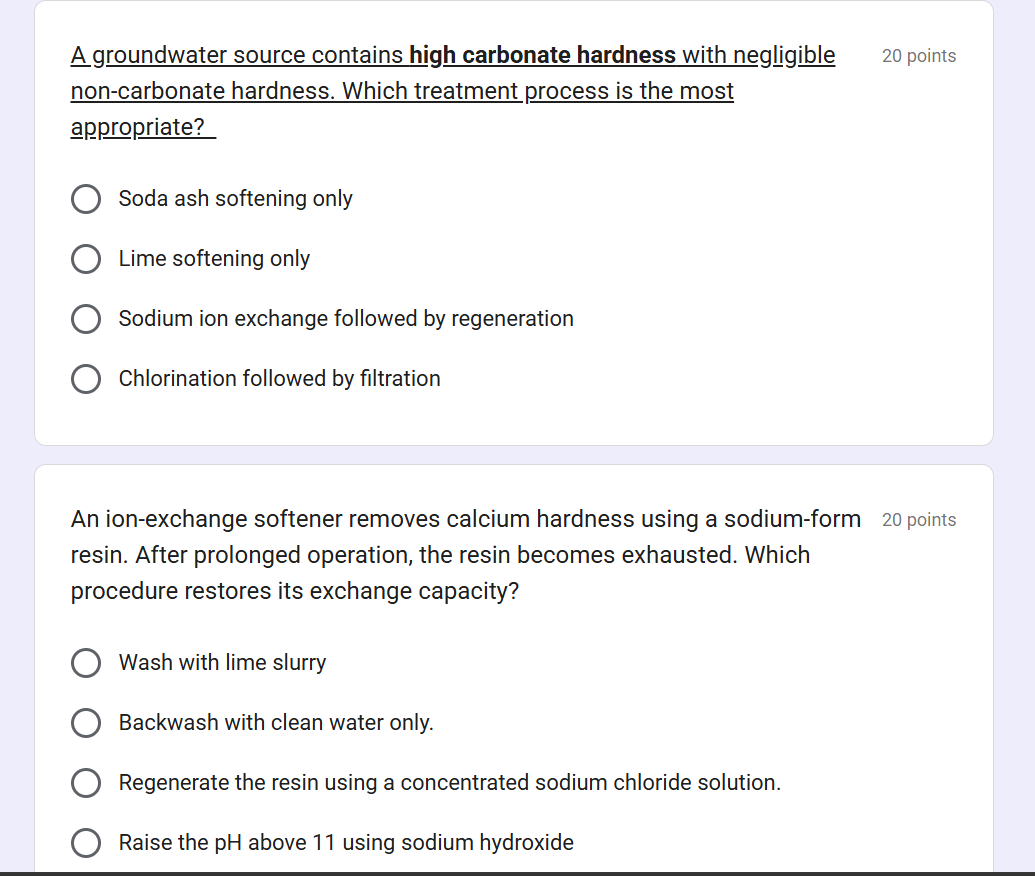
a groundwater source contains high carbonate hardness with negligible non-carbonate hardness. which treatment process is the most appropriate?
- soda ash softening only
- lime softening only
- sodium ion exchange followed by regeneration
- chlorination followed by filtration
an ion-exchange softener removes calcium hardness using a sodium-form resin. after prolonged operation, the resin becomes exhausted. which procedure restores its exchange capacity?
- wash with lime slurry
- backwash with clean water only.
- regenerate the resin using a concentrated sodium chloride solution.
- raise the ph above 11 using sodium hydroxide
🆕 New Concept Discovered: Water Softening Chemistry
Removing hardness ions using chemical precipitation or ion exchange.
Step 1: Analyze Question 1 (Carbonate Hardness Removal)
The first question asks for the most appropriate treatment process for groundwater containing high carbonate hardness with negligible non-carbonate hardness.
- Carbonate hardness (temporary hardness) is caused by calcium and magnesium bicarbonate.
- Lime softening (adding hydrated lime, \( \text{Ca(OH)}_2 \)) raises the pH, converting soluble bicarbonates into insoluble calcium carbonate (\( \text{CaCO}_3 \)) and magnesium hydroxide (\( \text{Mg(OH)}_2 \)), which precipitate out.
- Soda ash (\( \text{Na}_2\text{CO}_3 \)) is specifically required to remove non-carbonate hardness (calcium and magnesium sulfates or chlorides) by providing the carbonate ions needed for precipitation. Since non-carbonate hardness is negligible here, soda ash is not needed.
- Therefore, Lime softening only is the most efficient and cost-effective method.
Step 2: Analyze Question 2 (Ion-Exchange Resin Regeneration)
The second question asks how to restore the exchange capacity of an exhausted sodium-form resin used to remove calcium hardness.
- During the softening process, sodium ions (\( \text{Na}^+ \)) on the resin are exchanged for calcium ions (\( \text{Ca}^{2+} \)) from the water.
- Once exhausted, the resin is saturated with \( \text{Ca}^{2+} \) and can no longer soften water.
- To reverse this reaction and restore the resin to its sodium form, it must be flushed with a highly concentrated source of sodium ions. This forces the calcium ions off the resin and replaces them with sodium ions.
- A concentrated sodium chloride (\( \text{NaCl} \)) brine solution is standardly used for this regeneration process.

Snap & solve any problem in the app
Get step-by-step solutions on Sovi AI
Photo-based solutions with guided steps
Explore more problems and detailed explanations
Question 1:
Lime softening only
Question 2:
Regenerate the resin using a concentrated sodium chloride solution.