QUESTION IMAGE
Question
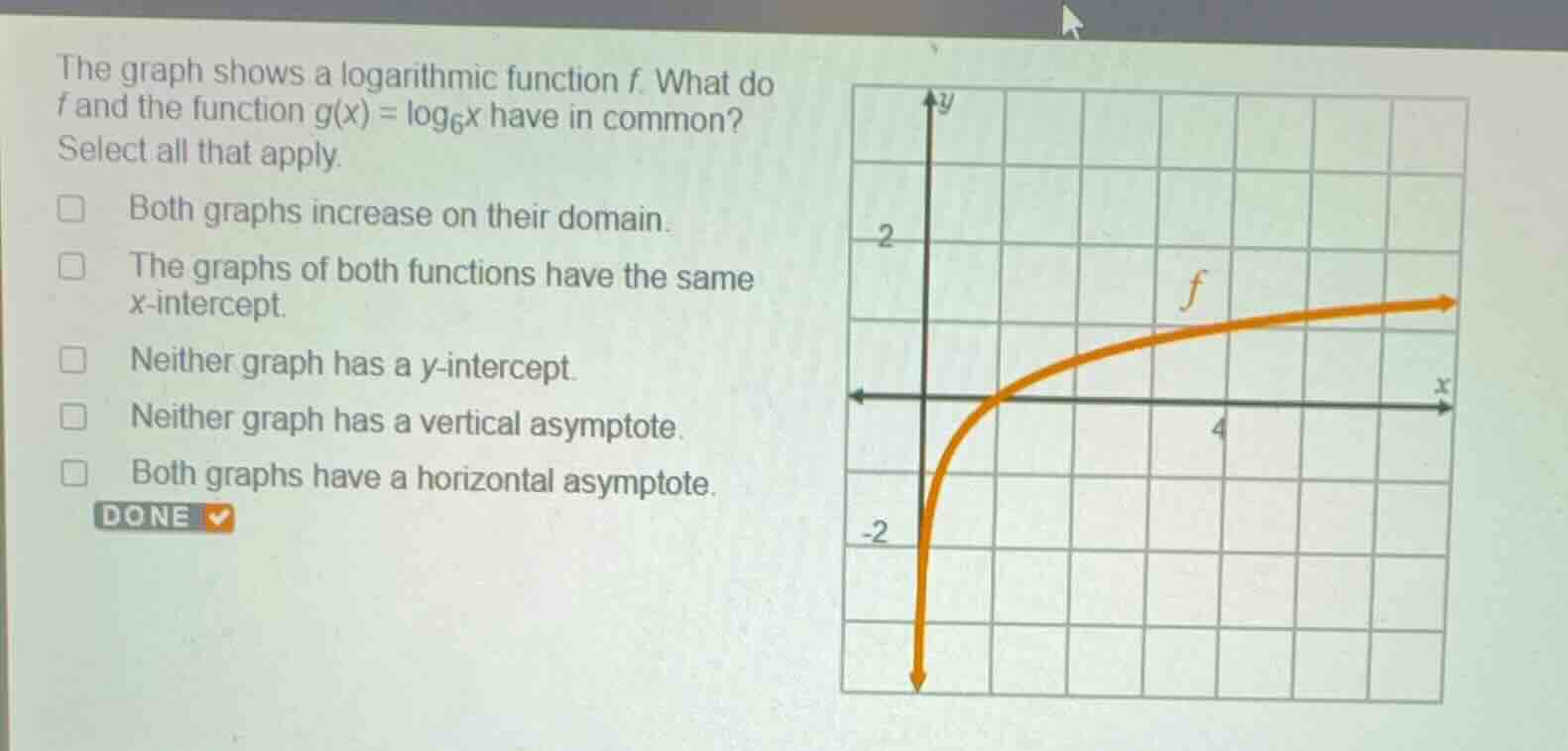
the graph shows a logarithmic function (f). what do (f) and the function (g(x) = \log_{6}x) have in common? select all that apply.
both graphs increase on their domain.
the graphs of both functions have the same x-intercept.
neither graph has a y-intercept.
neither graph has a vertical asymptote.
both graphs have a horizontal asymptote.
Analyze the graph of function f
Using the Logarithmic Functions knowledge point
- The graph of \(f\) passes through \((1, 0)\) and increases from left to right.
- The domain of \(f\) is \((0, \infty)\), and it has a vertical asymptote at \(x = 0\) (the y-axis).
- There is no y-intercept, and there is no horizontal asymptote.
Analyze the function g(x)
Using the Logarithmic Functions knowledge point
- The function \(g(x) = \log_6 x\) is a standard logarithmic function with base \(6 > 1\).
- Its domain is \((0, \infty)\), and it increases on its entire domain.
- Its x-intercept is at \((1, 0)\) since \(\log_6(1) = 0\).
- It has a vertical asymptote at \(x = 0\), meaning it has no y-intercept.
- It has no horizontal asymptote.
Evaluate the given statements
Using the Logarithmic Intercepts and Asymptotic Behavior of Logarithms knowledge points
- Both graphs increase on their domain: True. Both \(f\) and \(g\) are increasing logarithmic functions.
- The graphs of both functions have the same x-intercept: True. Both graphs cross the x-axis at \((1, 0)\).
- Neither graph has a y-intercept: True. Since the domain for both is \(x > 0\), neither graph crosses the y-axis.
- Neither graph has a vertical asymptote: False. Both have a vertical asymptote at \(x = 0\).
- Both graphs have a horizontal asymptote: False. Logarithmic functions grow without bound and do not have horizontal asymptotes.

Snap & solve any problem in the app
Get step-by-step solutions on Sovi AI
Photo-based solutions with guided steps
Explore more problems and detailed explanations
- Both graphs increase on their domain. (Correct answer)
- The graphs of both functions have the same x-intercept. (Correct answer)
- Neither graph has a y-intercept. (Correct answer)
- Neither graph has a vertical asymptote.
- Both graphs have a horizontal asymptote.