QUESTION IMAGE
Question
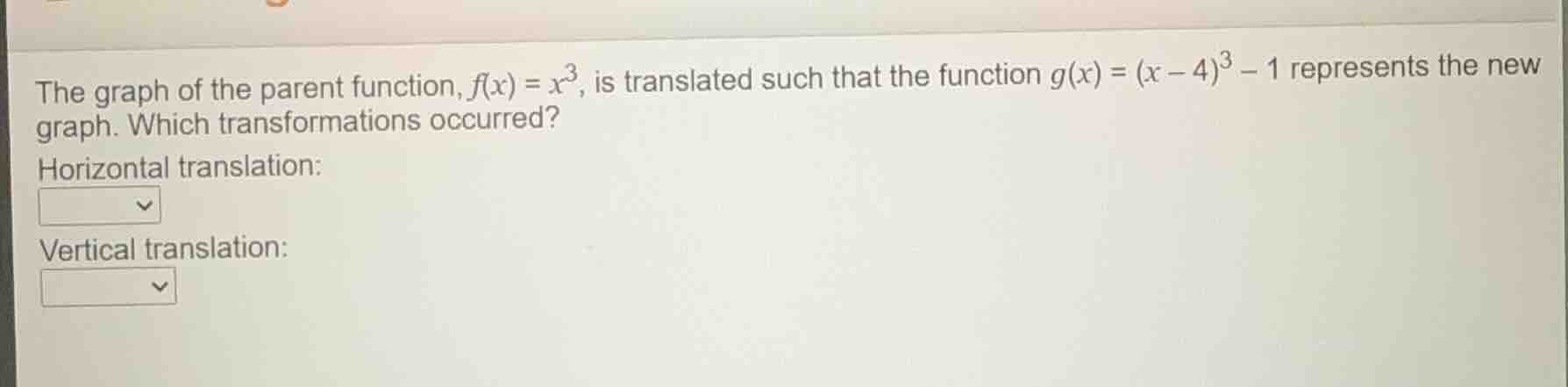
the graph of the parent function, f(x) = x³, is translated such that the function g(x) = (x - 4)³ - 1 represents the new graph. which transformations occurred? horizontal translation: vertical translation:
Step1: Recall horizontal translation rule
For a function \( y = f(x - h) \), the graph of \( f(x) \) is shifted horizontally by \( h \) units. If \( h>0 \), it's a shift to the right; if \( h < 0 \), it's a shift to the left. Here, \( g(x)=(x - 4)^3-1 \) and \( f(x)=x^3 \), so comparing with \( f(x - h) \), we have \( h = 4 \). So the horizontal translation is 4 units to the right.
Step2: Recall vertical translation rule
For a function \( y = f(x)+k \), the graph of \( f(x) \) is shifted vertically by \( k \) units. If \( k>0 \), it's a shift up; if \( k < 0 \), it's a shift down. Here, \( g(x)=(x - 4)^3-1=f(x - 4)+(- 1) \), so \( k=-1 \). So the vertical translation is 1 unit down.

Snap & solve any problem in the app
Get step-by-step solutions on Sovi AI
Photo-based solutions with guided steps
Explore more problems and detailed explanations
Horizontal translation: 4 units to the right
Vertical translation: 1 unit down