QUESTION IMAGE
Question
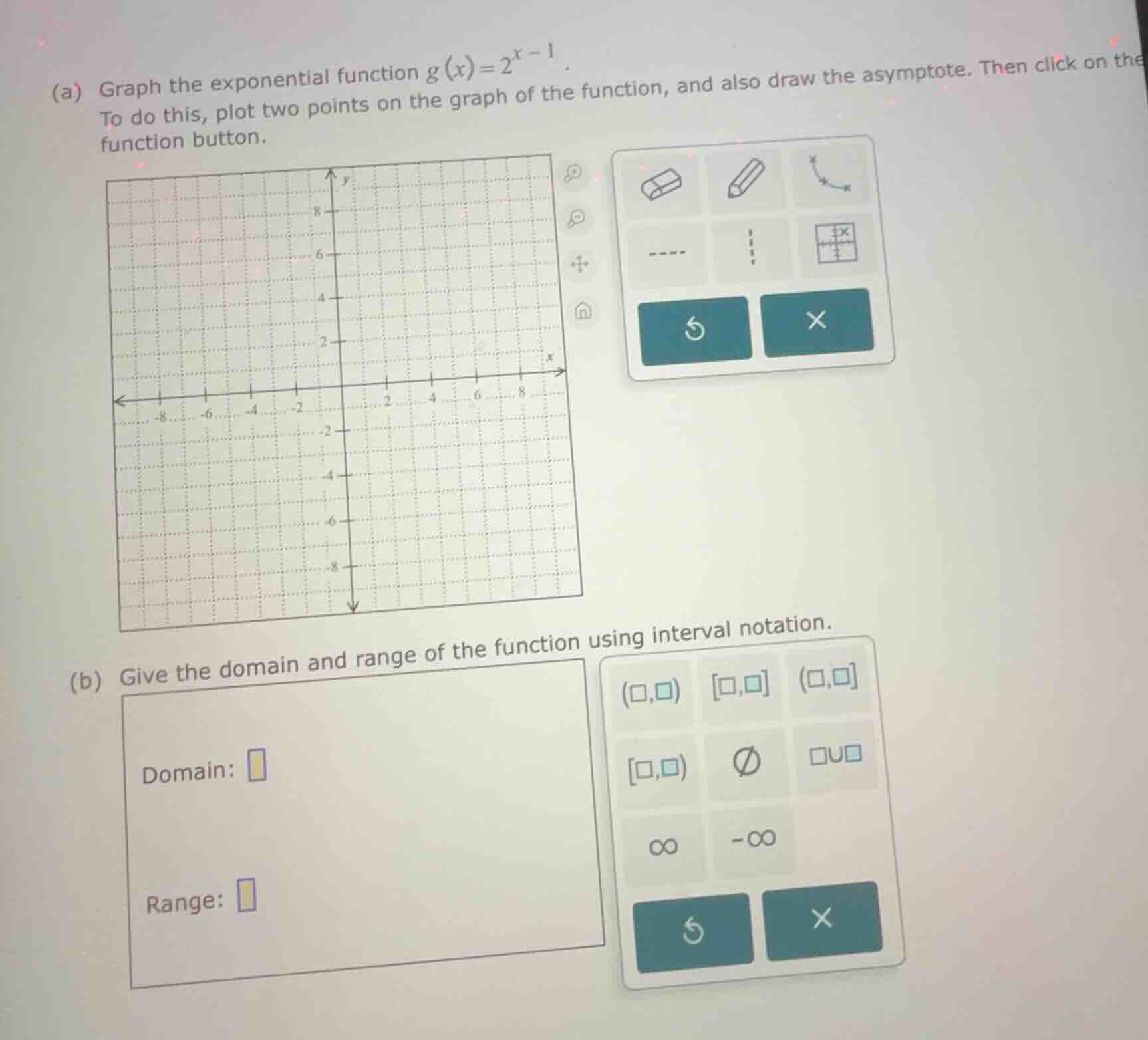
(a) graph the exponential function (g(x) = 2^{x-1}).
to do this, plot two points on the graph of the function, and also draw the asymptote. then click on the function button.
(b) give the domain and range of the function using interval notation.
Find points on the function
To graph the exponential function \(g(x) = 2^{x-1}\), we calculate the coordinates of two points by choosing simple integer values for \(x\).
- Let \(x = 1\):
This gives the point \((1, 1)\).
- Let \(x = 2\):
This gives the point \((2, 2)\).
Determine the asymptote
An exponential function of the form \(y = a \cdot b^{x-h} + k\) has a horizontal asymptote at \(y = k\).
For \(g(x) = 2^{x-1}\), we have \(k = 0\).
Therefore, the horizontal asymptote is the line:
Determine the domain
The domain of any basic exponential function \(g(x) = b^{x-h} + k\) is all real numbers because we can substitute any real value for \(x\).
In interval notation, this is:
Determine the range
Since the base \(2 > 0\) and there is no vertical shift (\(k = 0\)), the value of \(2^{x-1}\) is strictly greater than \(0\) for all real \(x\).
Thus, the range is all values greater than the horizontal asymptote \(y = 0\).
In interval notation, this is:

Snap & solve any problem in the app
Get step-by-step solutions on Sovi AI
Photo-based solutions with guided steps
Explore more problems and detailed explanations
Question a
- Two points to plot: \((1, 1)\) and \((2, 2)\)
- Horizontal asymptote: \(y = 0\) (the x-axis)
Question b
- Domain: \((-\infty, \infty)\)
- Range: \((0, \infty)\)