Sovi.AI - AI Math Tutor

Scan to solve math questions

QUESTION IMAGE

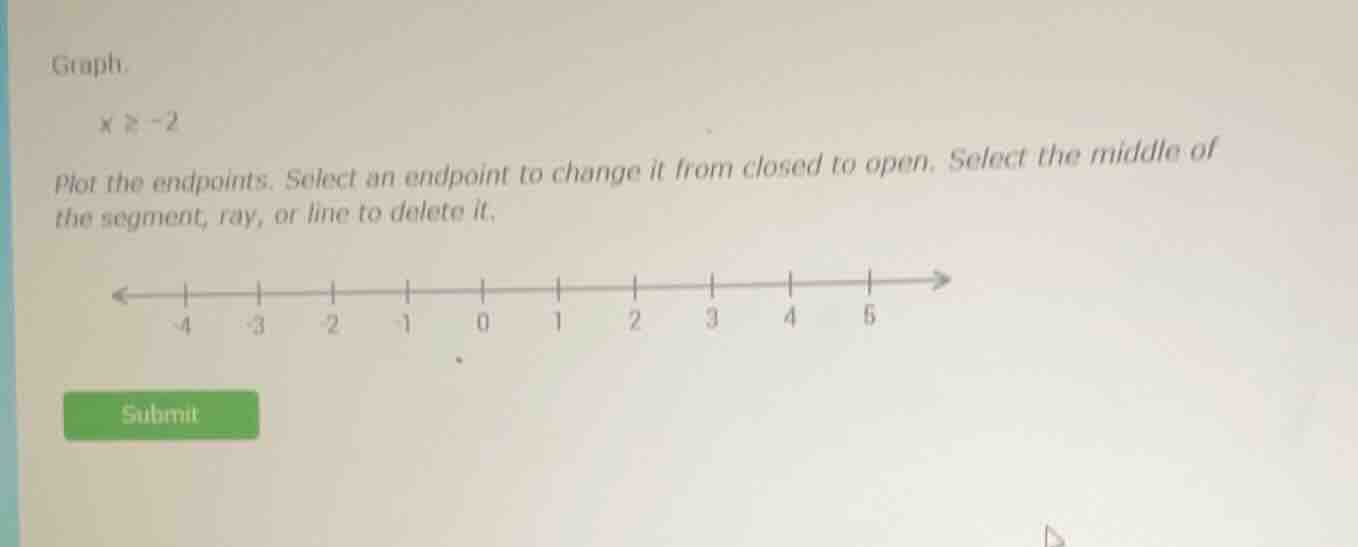
graph. (x \\ge -2) plot the endpoints. select an endpoint to change it …

Question

graph.

(x \ge -2)

plot the endpoints. select an endpoint to change it from closed to open. select the middle of the segment, ray, or line to delete it.

Explanation:

Response

<pre_analysis>
{
"quality": "clear",
"question_count": 1,
"skills_matched": [
"step_cot",
"explain_then_answer",
"quick"
],
"needs_drawing": true,
"concepts_used": [],
"new_concepts": [
"Linear Inequalities",
"Number Line Graphing"
],
"current_concepts": [
"Linear Inequalities",
"Number Line Graphing"
]
}
</pre_analysis>

<reasoning>

Identify the inequality and boundary point

The given inequality is:
\[
x \ge -2
\]
The boundary value is \(x = -2\).

Determine the endpoint type

The inequality uses the "greater than or equal to" symbol (\(\ge\)).
This means the endpoint at \(-2\) is included in the solution set, so it must be represented by a closed (solid) circle.

Determine the direction of the ray

Since the inequality is \(x \ge -2\), the values of \(x\) are greater than or equal to \(-2\).
Therefore, the ray must start at \(-2\) and point to the right, towards positive infinity.
</reasoning>

<answer>
To graph the inequality \(x \ge -2\) on the number line:

  1. Place a closed (solid) circle at \(-2\).
  2. Draw a ray pointing to the right from \(-2\) towards positive infinity.

</answer>

<plot>
{
"elements": [
{
"type": "line",
"params": [[-5, 0], [6, 0]],
"properties": {
"strokeColor": "#583C87",
"strokeWidth": 2,
"fixed": true
}
},
{
"type": "bentinequality",
"params": [{ "x": -2, "operator": ">=", "labelText": "x \ge -2" }],
"properties": {
"strokeColor": "#8C55F2",
"strokeWidth": 4
}
},
{
"type": "point",
"params": [[-2, 0]],
"properties": {
"name": "-2",
"size": 5,
"strokeColor": "#8C55F2",
"fillColor": "#8C55F2",
"withLabel": true,
"fixed": true
}
}
]
}
</plot>

<post_analysis>
{
"subject": "Mathematics",
"question_type": "Free Response",
"knowledge_point": [
"Mathematics",
"Algebra",
"Linear Inequalities"
]
}
</post_analysis>

Answer:

<pre_analysis>
{
"quality": "clear",
"question_count": 1,
"skills_matched": [
"step_cot",
"explain_then_answer",
"quick"
],
"needs_drawing": true,
"concepts_used": [],
"new_concepts": [
"Linear Inequalities",
"Number Line Graphing"
],
"current_concepts": [
"Linear Inequalities",
"Number Line Graphing"
]
}
</pre_analysis>

<reasoning>

Identify the inequality and boundary point

The given inequality is:
\[
x \ge -2
\]
The boundary value is \(x = -2\).

Determine the endpoint type

The inequality uses the "greater than or equal to" symbol (\(\ge\)).
This means the endpoint at \(-2\) is included in the solution set, so it must be represented by a closed (solid) circle.

Determine the direction of the ray

Since the inequality is \(x \ge -2\), the values of \(x\) are greater than or equal to \(-2\).
Therefore, the ray must start at \(-2\) and point to the right, towards positive infinity.
</reasoning>

<answer>
To graph the inequality \(x \ge -2\) on the number line:

  1. Place a closed (solid) circle at \(-2\).
  2. Draw a ray pointing to the right from \(-2\) towards positive infinity.

</answer>

<plot>
{
"elements": [
{
"type": "line",
"params": [[-5, 0], [6, 0]],
"properties": {
"strokeColor": "#583C87",
"strokeWidth": 2,
"fixed": true
}
},
{
"type": "bentinequality",
"params": [{ "x": -2, "operator": ">=", "labelText": "x \ge -2" }],
"properties": {
"strokeColor": "#8C55F2",
"strokeWidth": 4
}
},
{
"type": "point",
"params": [[-2, 0]],
"properties": {
"name": "-2",
"size": 5,
"strokeColor": "#8C55F2",
"fillColor": "#8C55F2",
"withLabel": true,
"fixed": true
}
}
]
}
</plot>

<post_analysis>
{
"subject": "Mathematics",
"question_type": "Free Response",
"knowledge_point": [
"Mathematics",
"Algebra",
"Linear Inequalities"
]
}
</post_analysis>