QUESTION IMAGE
Question
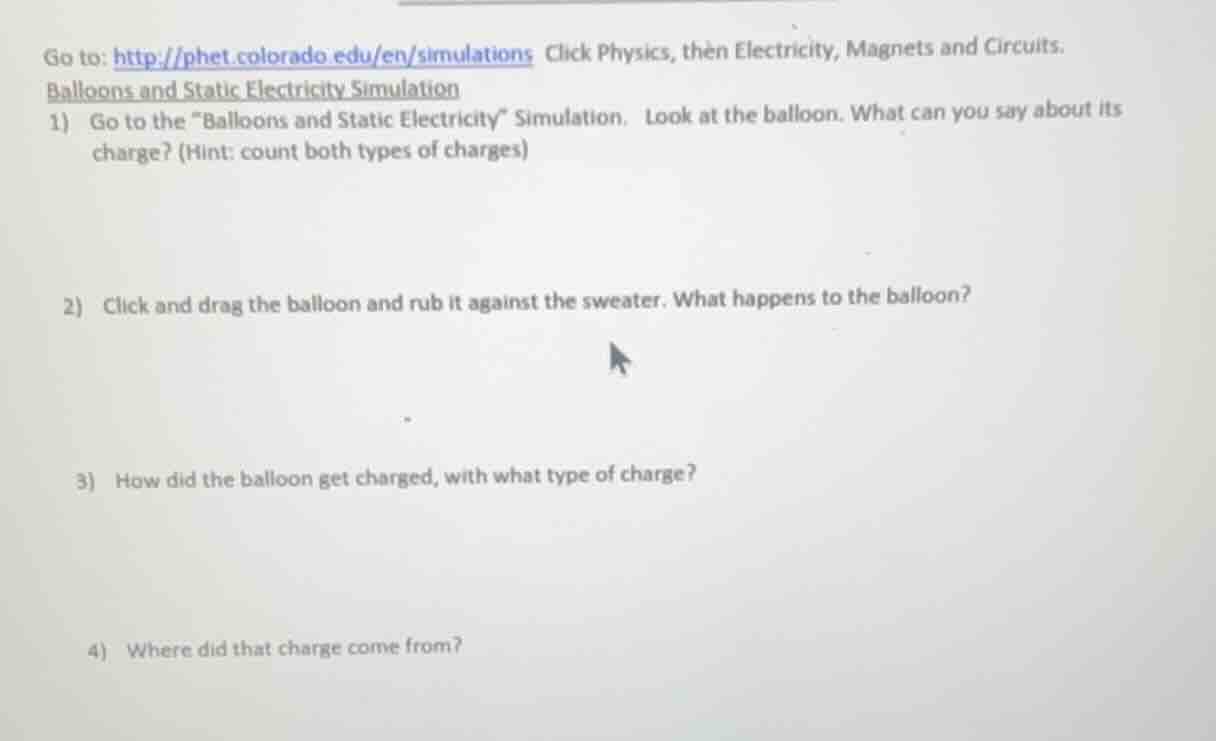
go to: http://phet.colorado.edu/en/simulations click physics, then electricity, magnets and circuits.
balloons and static electricity simulation
- go to the \balloons and static electricity\ simulation. look at the balloon. what can you say about its charge? (hint: count both types of charges)
- click and drag the balloon and rub it against the sweater. what happens to the balloon?
- how did the balloon get charged, with what type of charge?
- where did that charge come from?
Initial state of the balloon
The balloon starts with an equal number of positive charges (protons) and negative charges (electrons), making it electrically neutral.
Interaction with the sweater
Rubbing the balloon against the sweater causes negative charges (electrons) to transfer from the sweater to the balloon, leaving the balloon with a net negative charge and the sweater with a net positive charge. The balloon is then attracted to the sweater.
Mechanism and source of charge
The balloon becomes negatively charged through friction (triboelectric charging). The negative charge comes directly from the sweater, which loses electrons during the rubbing process.

Snap & solve any problem in the app
Get step-by-step solutions on Sovi AI
Photo-based solutions with guided steps
Explore more problems and detailed explanations
Question 1
The balloon is initially neutral because it contains an equal number of positive and negative charges.
Question 2
The balloon attracts negative charges from the sweater, becomes negatively charged, and is attracted to the positively charged sweater when released.
Question 3
The balloon became negatively charged through friction (rubbing).
Question 4
The negative charge (electrons) came from the sweater.