QUESTION IMAGE
Question
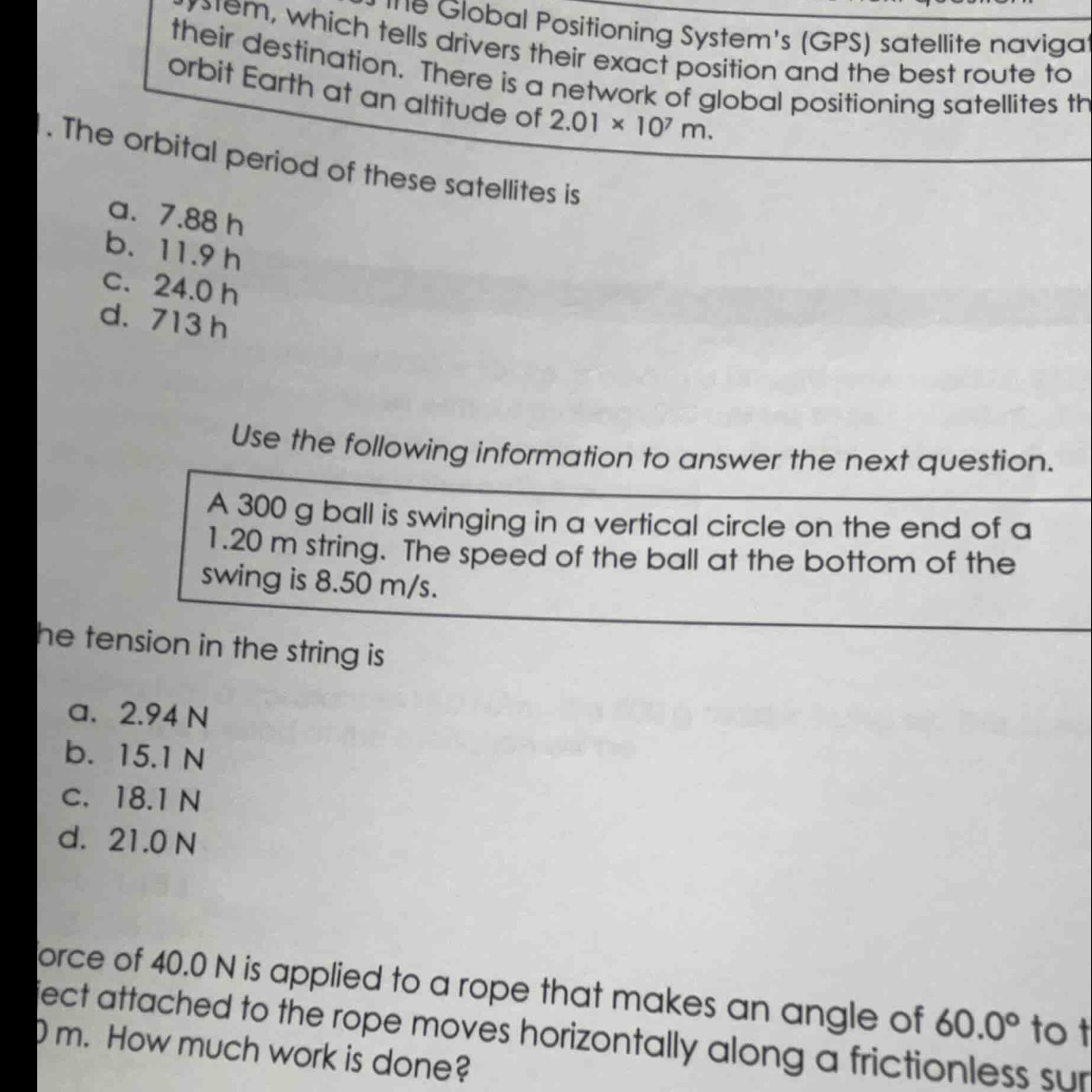
global positioning systems (gps) satellite navigation system, which tells drivers their exact position and the best route to their destination. there is a network of global positioning satellites that orbit earth at an altitude of (2.01 \times 10^7\text{ m}).
- the orbital period of these satellites is
a. (7.88\text{ h})
b. (11.9\text{ h})
c. (24.0\text{ h})
d. (713\text{ h})
use the following information to answer the next question.
a (300\text{ g}) ball is swinging in a vertical circle on the end of a (1.20\text{ m}) string. the speed of the ball at the bottom of the swing is (8.50\text{ m/s}).
- the tension in the string is
a. (2.94\text{ n})
b. (15.1\text{ n})
c. (18.1\text{ n})
d. (21.0\text{ n})
- a force of (40.0\text{ n}) is applied to a rope that makes an angle of (60.0^\circ) to the object attached to the rope moves horizontally along a frictionless surface for (3.00\text{ m}). how much work is done?
Calculate orbital period of GPS satellites
The altitude of the GPS satellites is given as \(h = 2.01 \times 10^7\text{ m}\).
The radius of the Earth is \(R_E \approx 6.37 \times 10^6\text{ m}\).
The orbital radius is:
Using Kepler's Third Law or orbital velocity:
where \(G = 6.674 \times 10^{-11}\text{ N}\cdot\text{m}^2/\text{kg}^2\) and \(M = 5.972 \times 10^{24}\text{ kg}\).
The orbital period \(T\) is:
Convert to hours:
Determine tension at the bottom of a vertical circle
The mass of the ball is \(m = 300\text{ g} = 0.300\text{ kg}\).
The radius of the circle is \(r = 1.20\text{ m}\).
The speed at the bottom is \(v = 8.50\text{ m/s}\).
At the bottom of the swing, the forces acting on the ball are tension \(T\) upward and gravity \(mg\) downward.
The net centripetal force is:
Solving for tension \(T\):
Calculate work done by the applied force
The applied force is \(F = 40.0\text{ N}\).
The angle with the horizontal is \(\theta = 60.0^\circ\).
The displacement is cut off, but we can analyze the formula for work:
Since the displacement \(d\) is not fully visible in the image, we solve the first two fully visible multiple-choice questions.

Snap & solve any problem in the app
Get step-by-step solutions on Sovi AI
Photo-based solutions with guided steps
Explore more problems and detailed explanations
Question 1
- a. 7.88 h
- b. 11.9 h (Correct answer)
- c. 24.0 h
- d. 713 h
Question 2
- a. 2.94 N
- b. 15.1 N
- c. 18.1 N
- d. 21.0 N (Correct answer)