QUESTION IMAGE
Question
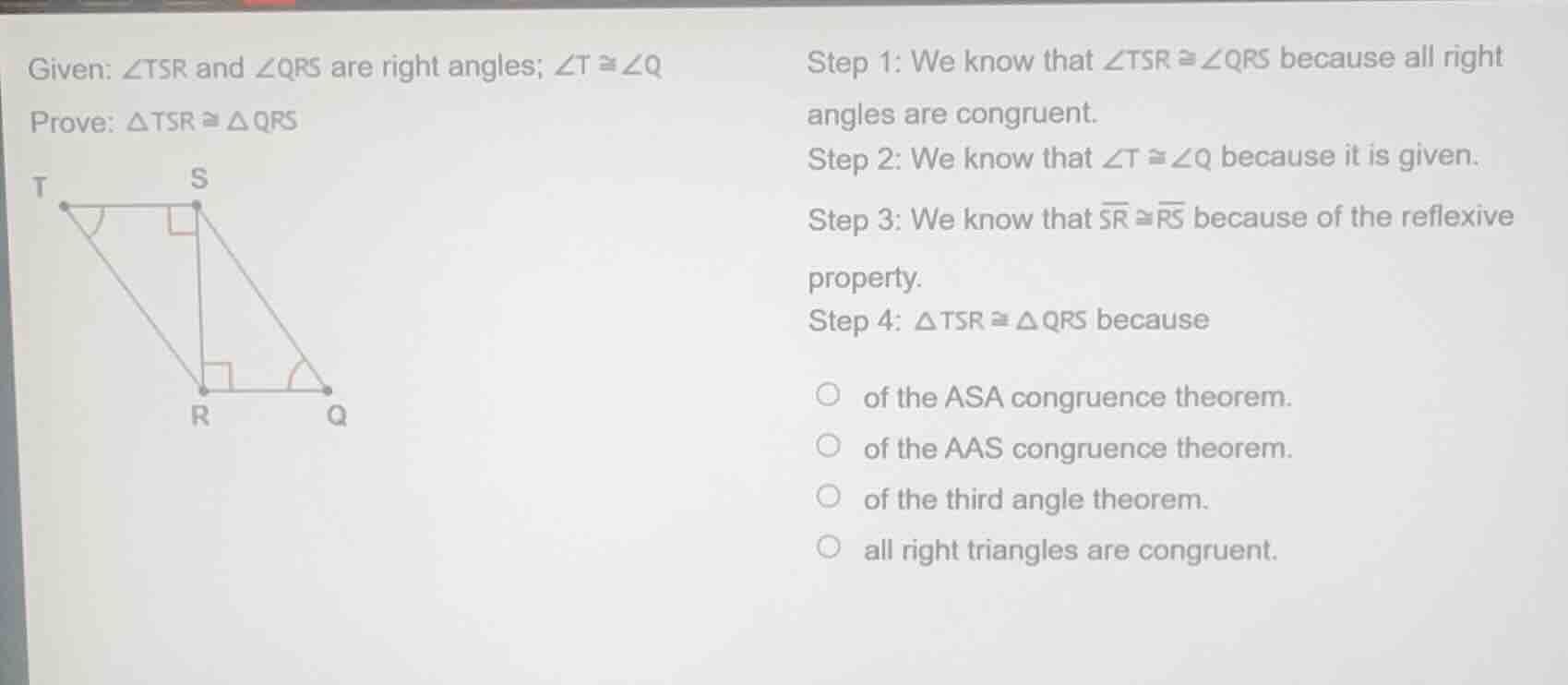
given: \\(\angle tsr\\) and \\(\angle qrs\\) are right angles; \\(\angle t \cong \angle q\\)
prove: \\(\delta tsr \cong \delta qrs\\)
step 1: we know that \\(\angle tsr \cong \angle qrs\\) because all right angles are congruent.
step 2: we know that \\(\angle t \cong \angle q\\) because it is given.
step 3: we know that \\(\overline{sr} \cong \overline{rs}\\) because of the reflexive property.
step 4: \\(\delta tsr \cong \delta qrs\\) because
of the asa congruence theorem.
of the aas congruence theorem.
of the third angle theorem.
all right triangles are congruent.
Identify the given congruent parts
We are given:
- \(\angle TSR \cong \angle QRS\) (right angles, Step 1)
- \(\angle T \cong \angle Q\) (given, Step 2)
Identify the shared side
Using the Reflexive Property of Congruence:
- \(\overline{SR} \cong \overline{RS}\) (Step 3)
Determine the congruence theorem
We have two pairs of congruent angles and a non-included congruent side:
- Angle: \(\angle T \cong \angle Q\)
- Angle: \(\angle TSR \cong \angle QRS\)
- Side: \(\overline{SR} \cong \overline{RS}\)
Using the AAS Congruence Theorem, the triangles are congruent.

Snap & solve any problem in the app
Get step-by-step solutions on Sovi AI
Photo-based solutions with guided steps
Explore more problems and detailed explanations
- of the ASA congruence theorem.
- of the AAS congruence theorem. (Correct answer)
- of the third angle theorem.
- all right triangles are congruent.