QUESTION IMAGE
Question
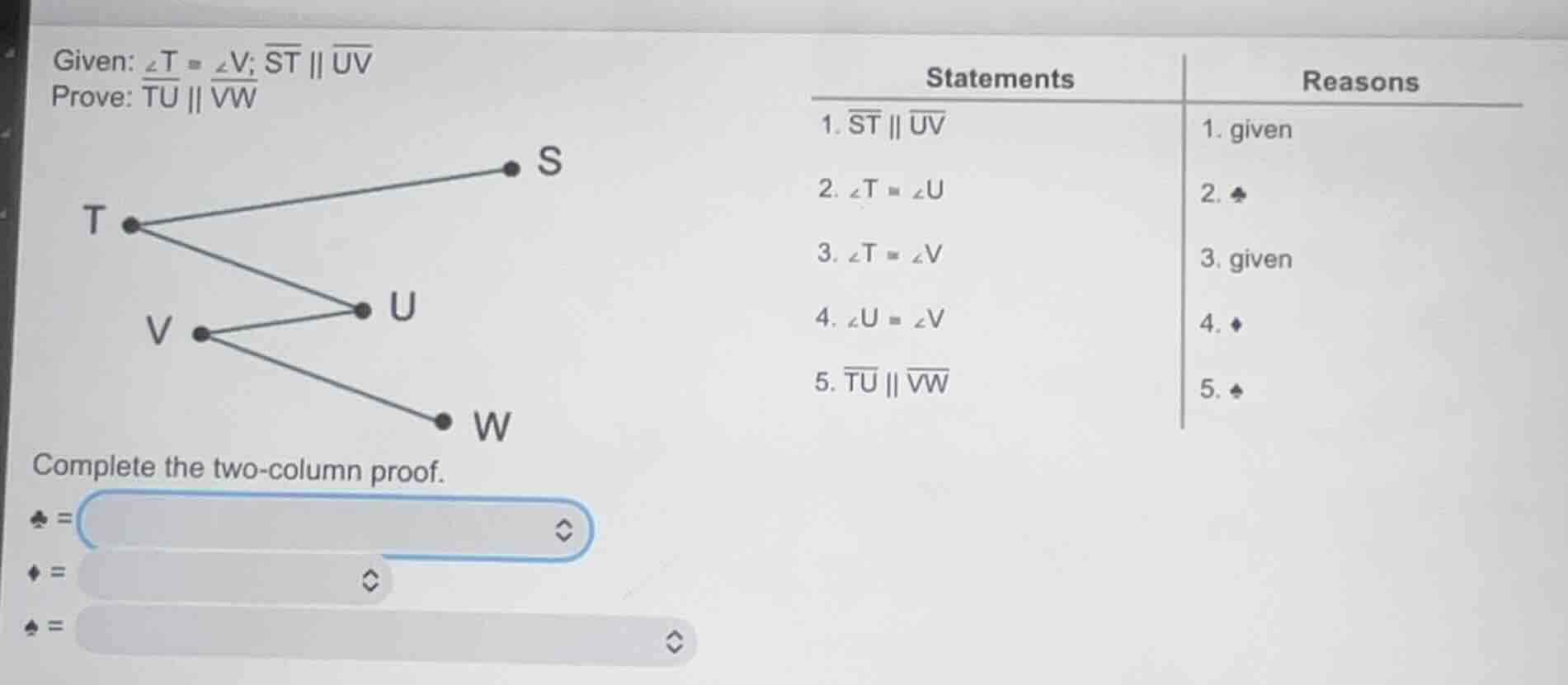
given: \\(\angle t = \angle v\\); \\(\overline{st} \parallel \overline{uv}\\)
prove: \\(\overline{tu} \parallel \overline{vw}\\)
complete the two-column proof.
statements | reasons
- \\(\overline{st} \parallel \overline{uv}\\) | 1. given
- \\(\angle t = \angle u\\) | 2. \\(\clubsuit\\)
- \\(\angle t = \angle v\\) | 3. given
- \\(\angle u = \angle v\\) | 4. \\(\diamondsuit\\)
- \\(\overline{tu} \parallel \overline{vw}\\) | 5. \\(\spadesuit\\)
Analyze the given information
We are given a geometric figure with points \(S, T, U, V, W\).
The given statements are:
- \(\angle T \cong \angle V\)
- \(\overline{ST} \parallel \overline{UV}\)
We need to prove:
\(\overline{TU} \parallel \overline{VW}\)
Determine the reason for Statement 2
Statement 1: \(\overline{ST} \parallel \overline{UV}\) (Reason: given)
Statement 2: \(\angle T \cong \angle U\)
Looking at the diagram, \(\overline{ST}\) and \(\overline{UV}\) are parallel lines cut by the transversal \(\overline{TU}\).
The angles \(\angle T\) (which is \(\angle STU\)) and \(\angle U\) (which is \(\angle TUV\)) are alternate interior angles.
Since the lines are parallel, these alternate interior angles are congruent.
Therefore, the reason for Statement 2 (represented by the club symbol \(\clubsuit\)) is:
Alternate Interior Angles Theorem
Determine the reason for Statement 4
Statement 3: \(\angle T \cong \angle V\) (Reason: given)
Statement 4: \(\angle U \cong \angle V\)
From Statement 2, we have \(\angle T \cong \angle U\).
From Statement 3, we have \(\angle T \cong \angle V\).
Since both \(\angle U\) and \(\angle V\) are congruent to \(\angle T\), they must be congruent to each other.
Therefore, the reason for Statement 4 (represented by the diamond symbol \(\diamondsuit\)) is:
Transitive Property of Congruence (or simply Transitive Property)
Determine the reason for Statement 5
Statement 5: \(\overline{TU} \parallel \overline{VW}\)
From Statement 4, we established that \(\angle U \cong \angle V\) (which are \(\angle TUV\) and \(\angle UVW\)).
Looking at the diagram, \(\angle U\) and \(\angle V\) are alternate interior angles formed by lines \(\overline{TU}\) and \(\overline{VW}\) with transversal \(\overline{UV}\).
Since these alternate interior angles are congruent, the lines must be parallel.
Therefore, the reason for Statement 5 (represented by the spade symbol \(\spadesuit\)) is:
Converse of the Alternate Interior Angles Theorem (or Alternate Interior Angles Converse)

Snap & solve any problem in the app
Get step-by-step solutions on Sovi AI
Photo-based solutions with guided steps
Explore more problems and detailed explanations
Complete the two-column proof.
\(\clubsuit\) = <blank>Alternate Interior Angles Theorem</blank>
\(\diamondsuit\) = <blank>Transitive Property of Congruence</blank>
\(\spadesuit\) = <blank>Converse of the Alternate Interior Angles Theorem</blank>