QUESTION IMAGE
Question
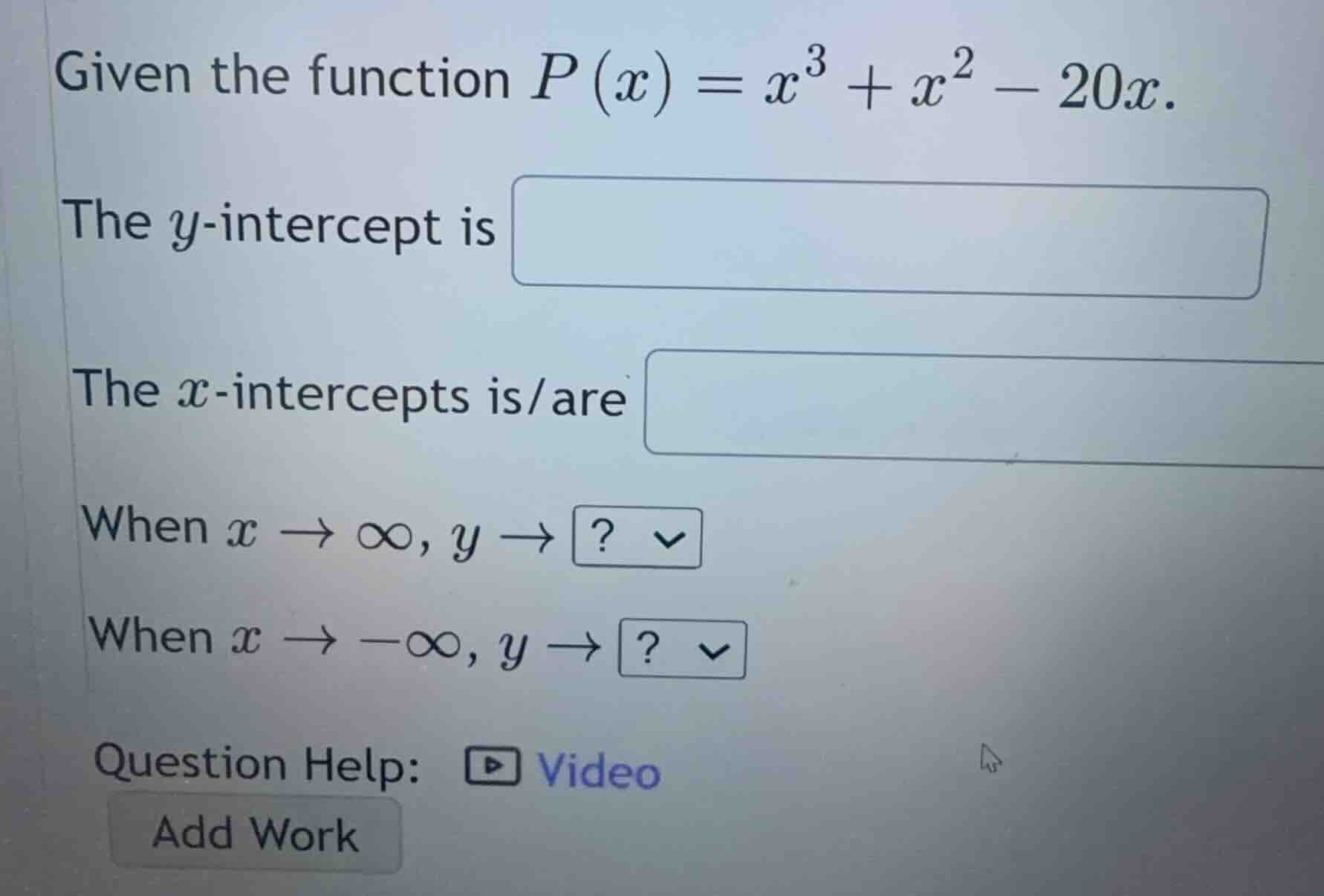
given the function (p(x) = x^3 + x^2 - 20x).
the (y)-intercept is
the (x)-intercepts is/are
when (x
ightarrow infty), (y
ightarrow) ?
when (x
ightarrow -infty), (y
ightarrow) ?
⚡ Using what you learned: Understanding Polynomial Functions
Step 1: Find the \(y\)-intercept
To find the \(y\)-intercept, evaluate the function at \(x = 0\):
The \(y\)-intercept is \(0\) (or written as an ordered pair, \((0, 0)\)).
Step 2: Find the \(x\)-intercepts
To find the \(x\)-intercepts, set \(P(x) = 0\) and solve for \(x\):
Factor out the greatest common factor, \(x\):
Factor the quadratic trinomial:
Set each factor to zero:
The \(x\)-intercepts are \(0, -5, 4\) (or written as ordered pairs, \((0,0), (-5,0), (4,0)\)).
Step 3: Determine the end behavior
The leading term of the polynomial \(P(x) = x^3 + x^2 - 20x\) is \(x^3\).
Since the degree is odd (\(3\)) and the leading coefficient is positive (\(1\)):
- As \(x
ightarrow \infty\), \(y
ightarrow \infty\)
- As \(x
ightarrow -\infty\), \(y
ightarrow -\infty\)

Snap & solve any problem in the app
Get step-by-step solutions on Sovi AI
Photo-based solutions with guided steps
Explore more problems and detailed explanations
- The \(y\)-intercept is \(0\) (or \((0,0)\))
- The \(x\)-intercepts is/are \(0, -5, 4\) (or \((0,0), (-5,0), (4,0)\))
- **When \(x
ightarrow \infty\), \(y
ightarrow\)** \(\infty\)
- **When \(x
ightarrow -\infty\), \(y
ightarrow\)** \(-\infty\)